
Plane-Sized Asteroid Set to Fly Past Earth at Lunar Distance
Asteroid--
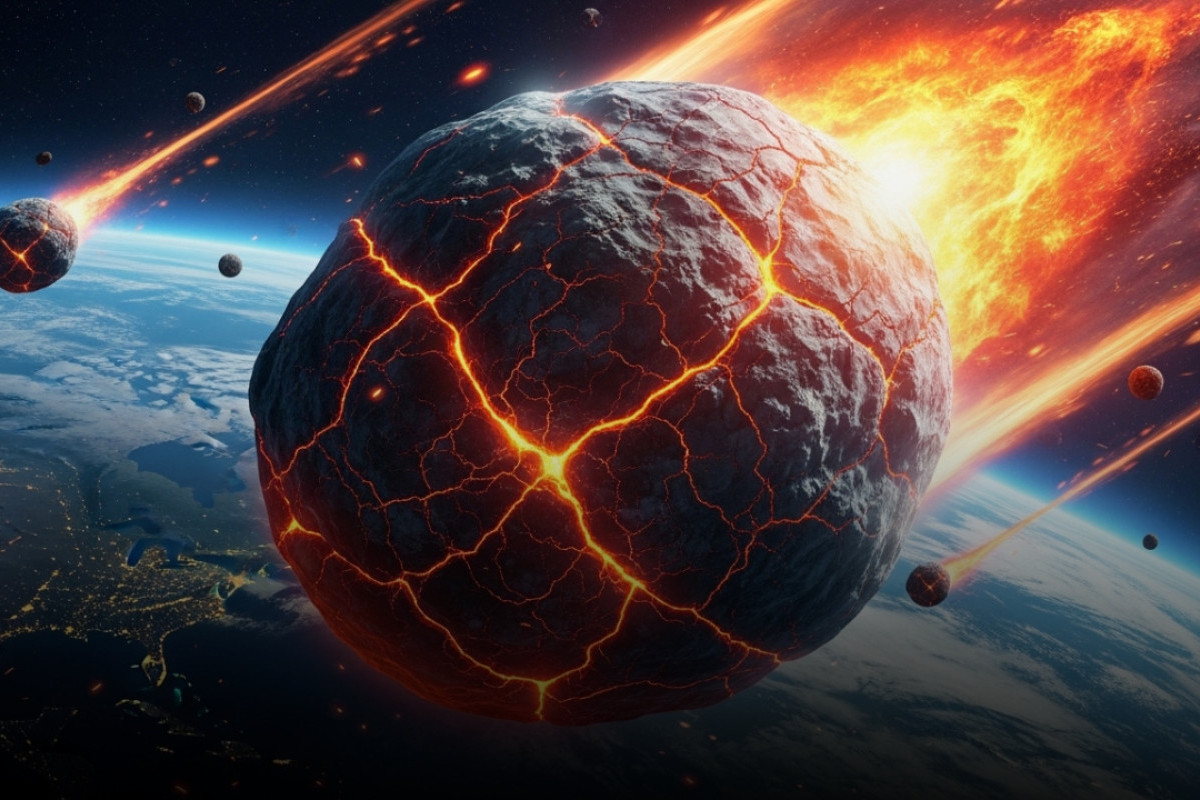
NASA is monitoring a near-Earth asteroid roughly the size of an aircraft as it passes close to the planet at high speed, based on observations from the agency’s Center for Near-Earth Object Studies.
The asteroid, designated 2026 CC, is estimated to be about 100 feet in diameter and is traveling at approximately 22,000 miles per hour. Scientists calculate that its closest approach will occur tomorrow, at a distance of around 379,000 miles from Earth.
That distance places the object slightly beyond the average separation between Earth and the moon, which is about 239,000 miles, according to data from NASA’s Jet Propulsion Laboratory.
Asteroids are remnants from the early formation of the solar system roughly 4.6 billion years ago. They are primarily composed of rocky, metallic, and dusty material and are most commonly found in the main asteroid belt between Mars and Jupiter.
Some asteroids, however, follow trajectories that bring them closer to the inner solar system. These are classified as near-Earth objects, a category that includes bodies whose orbits bring them within about 120 million miles of the sun and into Earth’s broader orbital region.

Recent research has highlighted the diversity of these objects. Last month, astronomers identified the fastest-spinning asteroid ever recorded, designated 2025 MN45. Measuring about 2,300 feet across, it completes a full rotation roughly every two minutes.
The rapidly rotating asteroid is one of 19 super- and ultra-fast-spinning objects identified among nearly 1,900 asteroids discovered during observations conducted last June.
NASA has also previously tracked objects with higher short-term impact probabilities. In February 2025, the agency reported that asteroid 2024 YR4 had a calculated 3.1 percent chance of impacting Earth in 2032, the highest probability ever recorded for an object of its size.
Further analysis later ruled out any meaningful risk from that asteroid, with scientists concluding it poses no significant threat to Earth in 2032 or beyond.
NASA emphasizes that most near-Earth objects do not come close enough to pose a danger. A smaller subset, known as potentially hazardous asteroids, are monitored more closely because their orbits can approach within about 4.6 million miles of Earth’s path around the sun.
Despite ongoing tracking of these objects, NASA maintains that no known asteroid is expected to collide with Earth in the foreseeable future.