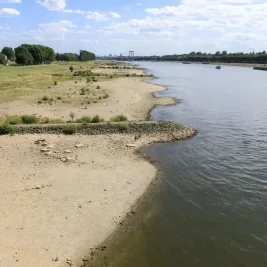
Parts of the South West entered severe drought conditions on Thursday, October 15, as reservoir levels fell sharply and farmers reported losses.
Devon County Council leader Julian Brazil blamed South West Water for infrastructure shortcomings, while the government defended its preparations.
Wimbleball Reservoir, serving about 300,000 properties across east Devon, north Devon, Somerset, west Dorset and West Somerset, was at 14.9% capacity.
Stithians in Cornwall was at 21.9%, compared with an Environment Agency expectation of about 75% at this point in the year.
Ardingly Reservoir in West Sussex was at 19% capacity and serves about 95,000 properties.
The severe drought declaration covers parts of Cornwall, Devon, Dorset, Somerset, East Sussex and West Sussex.
Brazil Criticizes South West Water
Brazil said the situation had developed over many years and linked it to South West Water’s infrastructure record.
"Decades in the making" was Brazil's description of the drought, while he said the firm's "neglect" had "put us here".
He also criticized the company's reservoir investment record.
Brazil said South West Water had "not built the reservoirs Devon's people and businesses deserved".
South West Water said it was taking measures to protect supplies while calling for lower consumption from customers and businesses.
"We are doing everything we can to manage resources, strengthen our network and fix leaks, and we need customers and local businesses to help reduce water use wherever possible to protect supplies until rivers and reservoirs can recover," South West Water said.
Richard Stanbrook, South West Water's drought programme director, said the declaration reflected worsening conditions across the region.
He described the situation as the "critical phase the South West is entering of this exceptionally prolonged drought".
Stanbrook said recent rainfall had provided some assistance, but water resources remained under pressure.
"While some recent rainfall has helped, water resources remain under significant pressure.
We continue to rely heavily on reservoir storage to maintain customer supplies while river flows remain extremely low, with no significant rain forecast in the coming weeks," Stanbrook said.
Brazil called for South West Water to finance a major public campaign covering conservation, leakage reduction and reservoir planning.
"From its own deep pockets, South West Water must fund a huge communications campaign to conserve water, cut leakage, bring forward plans for new reservoirs and make sure it is keeping every customer, business and public body fully informed so we can to do what we can to help," Brazil said.
He also sought compensation for customers and businesses experiencing losses during the drought.
"They agreed to pay 10 times the paltry minimum compensation level after the Brixham water poisoning incident.
If businesses and customers suffer loss during this drought they must do so again," Brazil said.
Brazil said Devon County Council would continue conserving water while maintaining essential public services and monitoring the company's response.
"As a council we will be doing all we can to save water while still delivering vital public services but we cannot allow South West Water to fail again and will be holding them to account in the months to come," Brazil said.
Farmers are already reporting production losses.
Andrea Semmens, whose family runs the 1,500-acre Raftra Farm near St Levan, Cornwall, said potato yields had dropped because of limited water.
"We normally average about 15 to 16 tonnes per acre and just because of the growth and the lack of water we're looking around 10 to 11 tonnes," Semmens said.
The scale of the farm means the lower yield has produced a substantial shortfall.
"When you're growing 310 acres, that's quite a lot of tons of potatoes that we've missed out on," Semmens said.
Semmens said the reduction would affect the farm's finances and subsequent production.
"That's going to have a knock-on effect on our profit and money going forward for our next year's harvest," Semmens said.
About 56,000 households are within the severe drought area in west Cornwall.
Government Defends Drought Response
Water minister Emma Hardy defended the government's preparations in the House of Commons on Friday, October 16, as MPs raised concerns about farmers and water security.
Residents were urged to "use water wisely", while water companies were instructed to monitor reservoir and river levels daily.
Hardy said the prolonged heat and rainfall shortage required immediate action and described a planned expansion of national water infrastructure.
"While the record-breaking heat and lack of rainfall have put our water resources under immense pressure this year, we must take action now to prevent this situation becoming the norm.
We are at the start of a decade-long journey into a very different water system, including nine new major reservoirs to secure supplies.
I will continue to take the action needed to protect essential public water supplies," Hardy said.
Shadow environment, food and rural affairs minister Robbie Moore said the government should have anticipated the conditions.
Moore said the drought "should not have caught the Government off guard".
He said the recurrence of drought conditions had exposed weaknesses in the government's response.
"This is the third drought in five years. It should not have caught the government off guard.
But here we are on a sitting Friday, listening to the water minister roll out an emergency statement, effectively saying she's been busy having meetings.
Our communities, our farmers, our businesses are facing severe challenges today," Moore said.
Hardy said the government could not control rainfall but had tested its response arrangements earlier in the year.
"There are many things I can do, unfortunately, I can't make it rain.
But what I can do is ensure that this government is prepared, and that is exactly what we've been doing.
Going back to February this year, Defra and Cobra ran a cross-government drought exercise to test the current response arrangements with lessons learned from the previous year.
So we have been planning for this since I came into government because this government actually believes that climate change is real.
We are not the government of climate change deniers.
We are not the government that wishes to repeal the Climate Change Act and that thinks that actually, when it's sunny, we should be just enjoying more barbecues," Hardy said.
The Environment Agency was instructed to prioritize public water supplies in severe drought areas where protecting reserves creates unavoidable environmental trade-offs.
Liberal Democrat MP Al Pinkerton urged faster action and stronger leakage controls as agricultural concerns intensified.
Pinkerton called on the government to "act now and at speed" and urged water companies to "cut leakage".
Hardy said £15 million had been allocated to on-farm reservoirs and to making them easier to build through the planning system.