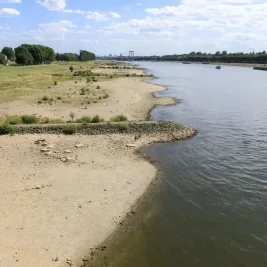
Authorities have declared a severe nationwide drought across Wales and parts of England as record-breaking heat and minimal rainfall continue to parch the United Kingdom.
Natural Resources Wales announced the extended environmental alert on July 30, 2026, following Wales' driest July in 190 years, with the country receiving just 8% of its long-term average rainfall.
In England, the Environment Agency reported that 78% of rivers were flowing well below normal levels after experiencing only 7% of average seasonal rainfall.
The extreme conditions have caused widespread ecological damage, including dry riverbeds, increased algal blooms, and heightened wildfire threats.
Officials Urge Water Conservation
Rhian Thomas, a representative at Natural Resources Wales, stressed the need for public cooperation.
"With no strong indications for notable rainfall in the forecasts, and risks of further heatwaves over the summer, it's more important than ever that we all use water wisely," she said.
"Every drop we waste is less water for our rivers and wildlife when they need it the most."
Government officials assured that drinking water supplies remain stable due to earlier winter precipitation, but structural water policy must adapt.
"There is no immediate risk to the provision of drinking water, but we need more resilience in our water supplies across Wales and the UK," said First Minister Rhun ap Iorwerth.
Farmers Face Severe Losses
Agricultural producers report severe operational losses due to scorched pastures and unworkable soil.
George Tomlinson, a farmer at Rossett Park Farming, described the dire situation for livestock.
"There's nothing available for the cows to eat on the grazing platform apart from a little bit of dead grass some dry cows are eating," he said.
"If this continues a lot of farmers will be forced to close their gates and never open them again."
Crop growers similarly noted unprecedented soil hardness preventing seasonal planting cycles.
Richard Anthony, a farmer in the Vale of Glamorgan and Bridgend, highlighted the immediate impact on harvest yields.
"Our wheat deals are down between 20% and 30%. That is massive.
We'll have to cope, we will survive, but the knock-on effect is huge," he said.
He expressed worry about potential rapid weather reversals delaying future planting operations.
"It'll go from this to being too wet."
Abi Reader, president of National Farmers Union Cymru, noted the spiraling expenses facing agricultural businesses.
"We're going to see costs for these farms rising, because they might be having to buy in extra feed for their livestock, or they might be spending a lot of money carting water," she said.
"We've been in this a long time now, and it's going to take a long time to recover, and absolutely everybody needs to remember that food security starts with water security."
Environmental regulators in England described the situation as critical for natural resources and regional infrastructure.
"The hot and dry weather means we are currently using water faster than nature can replenish it," said Helen Wakeham, director of water at the Environment Agency.
"It's an exceptionally serious situation and one that will have long-lasting impacts on our environment, wildlife, and the economy."
Health experts warned that recurring crop disruptions pose broader public health challenges.
"The drought could have a direct knock-on effect on food supplies," said Pauline Scheelbeek, associate professor at the London School of Hygiene and Tropical Medicine.
"Repeated disruption to vegetable production could make healthy food less affordable for households and have lasting effects on public health."
Hydrology experts pointed out that rapid swings between severe rain and intense dry periods reflect broader climate patterns.
"It's indicative of what we expect in a warming world," said Jamie Hannaford, head of water resources and drought at the UK Centre for Ecology and Hydrology.
Academic researchers urged immediate national investment in infrastructure to build drought resilience.
"We need long-term planning for water resourcing in the UK," said Chloe Brimicombe, climate scientist at the University of Oxford.
"Investment in water infrastructure to maintain as much water as possible."
Meteorological authorities confirmed that no immediate weather changes are expected to resolve the water deficit.
"There is currently little sign of the widespread, sustained rainfall that would be needed to make a significant difference to the areas most affected by the dry weather," said Will Lang, chief meteorologist at the Met Office.
The ongoing dry period follows 2,877 heat-associated deaths recorded in the UK during May and June heatwaves, as emergency services continue battling regional wildfires, including a major blaze on the Suffolk coast.