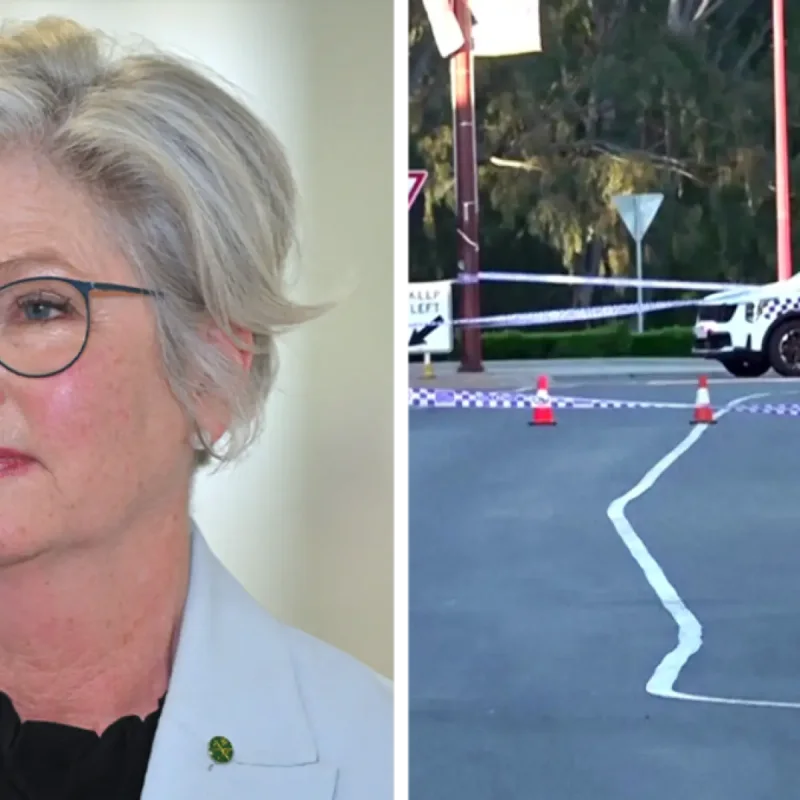
Australian federal lawmaker Helen Haines has lost both legs after a vehicle struck her outside her electorate office in Wangaratta, northeastern Victoria, on Monday afternoon.
Her husband, Phil Haines, confirmed the amputations at a press conference at The Alfred hospital in Melbourne on Wednesday, October 21, 2026, as police continued investigating the alleged deliberate attack.
Haines, 65, remains in critical condition but is stable, according to her husband.
Surgeons initially amputated her left leg on Monday before removing her right leg after they were unable to save it.
She was airlifted to Melbourne for emergency surgery following the incident.
According to CNN, Haines was standing behind her parked vehicle and unloading items from the trunk when a driver in a Toyota LandCruiser allegedly passed her, turned around, and rammed her against her car.
Bystanders rushed to help, and a local barber reportedly detained the driver until police arrived.
Her husband confirmed that doctors had been unable to save the second leg despite the family's hopes for a different outcome.
He also emphasized that she had survived the attack and was stable in hospital.
“Helen’s left leg was amputated on Monday.
We had been hoping that her right leg would be saved, but… the surgeons had to also remove her right leg,” Phil Haines said at the press conference.
Haines has represented her community as an independent federal member of Parliament since 2019. Floral tributes have accumulated outside her Wangaratta office as residents react to the attack.
Phil Haines said his wife enjoys flowers but suggested that supporters consider a different way to express their support, given the difficulty of managing numerous bouquets during her recovery.
“She loves flowers, but it’s a bit difficult to look after many bunches of flowers,” Phil Haines said.
He said the family would encourage people to donate to a children's charity instead.
“We will ask people if they would like to support Helen financially to make a donation to Save the Children Fund,” Phil Haines said.
The alleged driver, 43-year-old Brendan Nugent, appeared in court on Wednesday.
He faces charges of dangerous driving causing serious injury, intentionally causing serious injury, and causing harm to a Commonwealth public official.
Court documents also list charges related to cultivating and possessing cannabis.
No bail application was made during the brief hearing, and the next court appearance is scheduled for February 4.
According to CNN, Nugent's lawyer told the court that his client has a rare neurological condition and was not taking medication for it.
Police have not established the full motive for the incident.
Authorities have indicated that they will allege the attack was targeted, while investigations continue into whether it was politically motivated.
Victoria Police Chief Commissioner Mike Bush said police had no intelligence indicating that Nugent posed an imminent threat before the incident.
The attack has nevertheless intensified scrutiny of the security of Australia's elected representatives.
Members of Parliament received detailed security briefings in Canberra on Wednesday as Australian Federal Police Commissioner Krissy Barrett highlighted an increase in reports of harassment and threats against federal lawmakers.
Barrett identified growing political polarization, anti-government sentiment, conspiracy-driven behavior, and grievances as factors contributing to the trend.
She also described cases involving individuals whose personal grievances, mental health vulnerabilities, and ideological concerns converged.
Governor-General Sam Mostyn, who spoke after Phil Haines at the Melbourne hospital, said she was keeping King Charles III informed about developments.
She described the attack as a source of profound shock and distress, particularly in Victoria.
“Australia is still reeling with the shock and distress of this terrible attack,” Sam Mostyn said.
Mostyn said people in Victoria were struggling to comprehend the severity of the incident.
“I know that here in Victoria, in particular, people are simply dumbfounded and finding it very hard to fathom the scale of this tragedy,” Mostyn said.
Australian Prime Minister Anthony Albanese has previously described the incident as a deliberate act.
Nugent's family also issued a statement expressing shock, describing the apparent attack as devastating and unfathomable and saying they had been friends with Haines for many years.
The case has also prompted calls for Australians to reject political violence.
Kim Leadbeater, sister of murdered British lawmaker Jo Cox and now the representative for Cox's former constituency, expressed sympathy for Haines' family and friends in an interview with the Australian Broadcasting Corporation's 7.30 program.
“Maybe for Australia this is your moment to think about what your politics looks like and how we can bring people together [and] find common ground,” Kim Leadbeater said.
Leadbeater said her sister had been particularly effective at bringing people together and suggested Haines shared that quality.
“That was something my sister was brilliant at, and I would imagine it's something Helen [Haines] is good at,” she said.
Jo Cox, a British member of Parliament, was 41 when a far-right extremist shot and stabbed her to death in 2016.
Her husband, Brendan Cox, also responded to the Australian attack in an article published by The Guardian.
“We cannot undo what happened to Jo. We cannot take away the pain of those affected by the alleged attack in Australia.
But we can decide what kind of society we build in response,” Brendan Cox wrote.
He warned that violence could deepen divisions and fear but argued that the response to such incidents could instead reinforce democratic values and shared principles.
“We can allow violence to make us more divided, more suspicious and more fearful.
Or we can use this moment to reaffirm our commitment to democracy, decency and what we have in common,” Brendan Cox wrote.