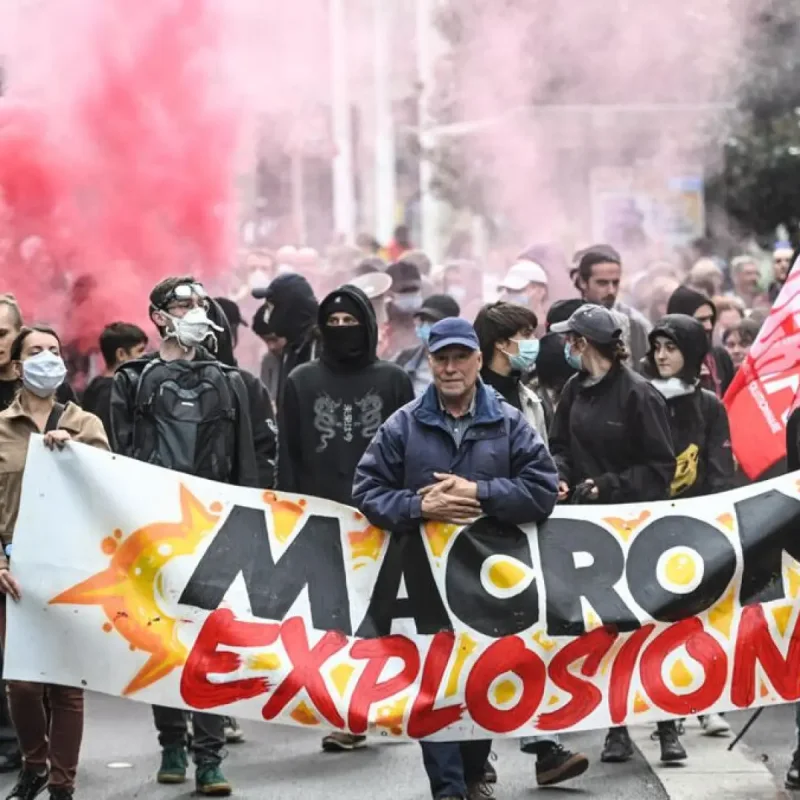
France faced a wave of nationwide demonstrations on Saturday, October 17, with organizers planning more than 600 rallies over living costs, social inequality and deteriorating education conditions.
Police fired tear gas during clashes in Paris and Marseille as authorities braced for a turnout that could reach nearly 200,000 people, a police source cited by AFP said.
Interior Minister Laurent Nunez told France 2 television that officials expected a substantial turnout.
Police restricted demonstrations in Paris, banning gatherings near the Elysee presidential palace, the prime minister's office, the Champs-Elysee avenue and several other key locations.
The main Paris march was scheduled to start at 2 p. m.
local time at Place de la Republique before heading north through the city, while a march through central Paris was prohibited.
Late Saturday morning, reports emerged of clashes between riot police and protesters in Saint-Denis, on the outskirts of the capital, and near Gare du Nord train station.
Leaders Urge Calm as Tensions Mount
President Emmanuel Macron called for calm and respect ahead of the rallies, saying the right to demonstrate went hand in hand with respect for people and property.
Prime Minister Sebastien Lecornu warned on Thursday that authorities feared violence during the demonstrations, linking the tensions to a broader period of economic and international uncertainty.
“This is a moment of fatigue in the country,” Lecornu said, citing wars, inflation and issues surrounding purchasing power.
Earlier student demonstrations involved significant violence, with several protesters and more than 900 police officers injured, according to the source report.
In one incident, a teenage student lost one hand and sustained injuries to several fingers on the other hand after a stun grenade exploded.
France's internal police watchdog is investigating at least two dozen alleged cases of police violence.
Jordan Bardella, leader of the far-right National Rally, said he was extremely concerned about possible confrontations, describing the day as one of chaos for France.
His party was leading opinion polls ahead of next year's presidential election, according to the source report.
The protests bring together students, trade unionists and members of the Yellow Vests movement, which held mass weekly demonstrations from November 2018 to June 2020.
The movement initially opposed rising fuel prices before expanding its demands to include the cost of living and economic inequality.
Jean-Luc Melenchon, leader of the hard-left France Unbowed party, has supported the recent student protests and joined a demonstration on Tuesday.
The government has accused his party of intensifying public discontent, an allegation France Unbowed has denied.