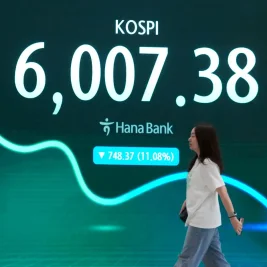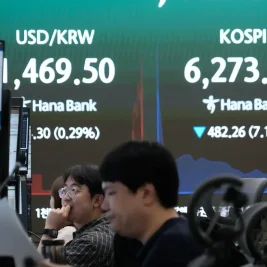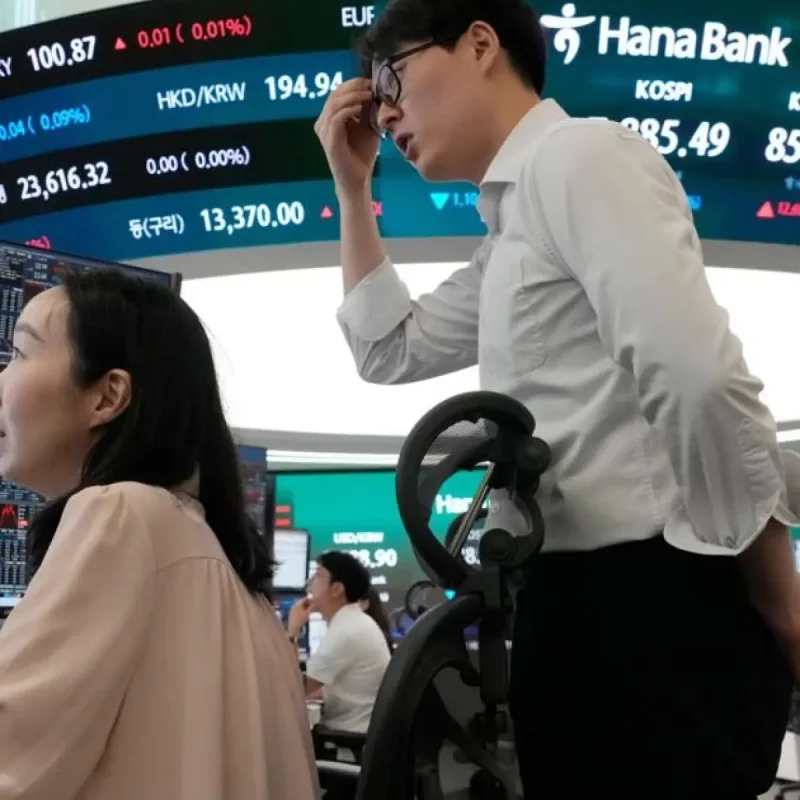
Asian markets retreated on Tuesday, July 7, 2026, led by severe losses in Seoul's tech sector despite a massive projected spike in quarterly profits from semiconductor giant Samsung Electronics.
South Korea's Kospi index plunged between 5% and 7.6% to close at 7,444.13, erasing recent gains as major tech firms dragged the market down.
Shares of both Samsung Electronics and SK Hynix tumbled 8.7% during the trading session, stoking broader investor anxiety that the artificial intelligence-driven market rally might be cooling off.
The market downturn occurred directly after Samsung announced its preliminary second-quarter results, projecting a 19-fold surge in operating income to 89.4 trillion won ($58.7 billion) alongside a more than doubling of its revenue.
Investors appeared to have already factored in these short-term gains, shifting their focus toward longer-term capital expenditures and the ultimate profitability of the artificial intelligence boom.
"Samsung's preliminary second-quarter numbers were, on their face, spectacular," said Stephen Innes, an analyst at SPI Asset Management.
Innes noted that while demand for AI memory remains incredibly high and semiconductor manufacturers are enjoying unprecedented profit margins, investor expectations have climbed significantly.
"AI memory demand remains ferocious, supply remains tight, and the major memory makers are enjoying margins that would have looked implausible only a few years ago," said Innes.
He explained that the current market environment leaves little room for error, as even exceptional corporate performance can struggle to outpace the vertically rising expectations of Wall Street.
"The first proper AI stress test may not have arrived with weak demand, a capex warning, or some sudden crack in the data center story.
It may have arrived with Samsung posting an extraordinary quarter and the stock falling anyway," said Innes.
Broader Asian Selloff
The tech selloff spread to other major Asian hubs as Tokyo's Nikkei 225 index declined 1.8% to 68,493.52, with chip manufacturer Tokyo Electron losing 3.4% and Kioxia Holdings shedding 10.7%.
In Hong Kong, the Hang Seng index slid 0.4% to 23,517.70, while China's Shanghai Composite index gave up 1% to land at 3,999.03.
The downward movement contrasted with gains recorded on Wall Street the previous day, where the S&P 500 climbed 0.7% to 7,537.54 and the Nasdaq composite added 1.1% to reach 26,121.16.
Broadcom provided the largest boost to U. S.
indexes after securing long-term semiconductor supply agreements with Apple.
Meanwhile, international energy benchmarks reacted to geopolitical tensions near the Strait of Hormuz, where an oil tanker traveling off the coast of Oman caught fire after being struck by an unidentified projectile on Monday.
Brent crude oil rose 52 cents to settle at $72.51 a barrel, while U. S.
West Texas Intermediate crude increased 43 cents to reach $68.98 a barrel.