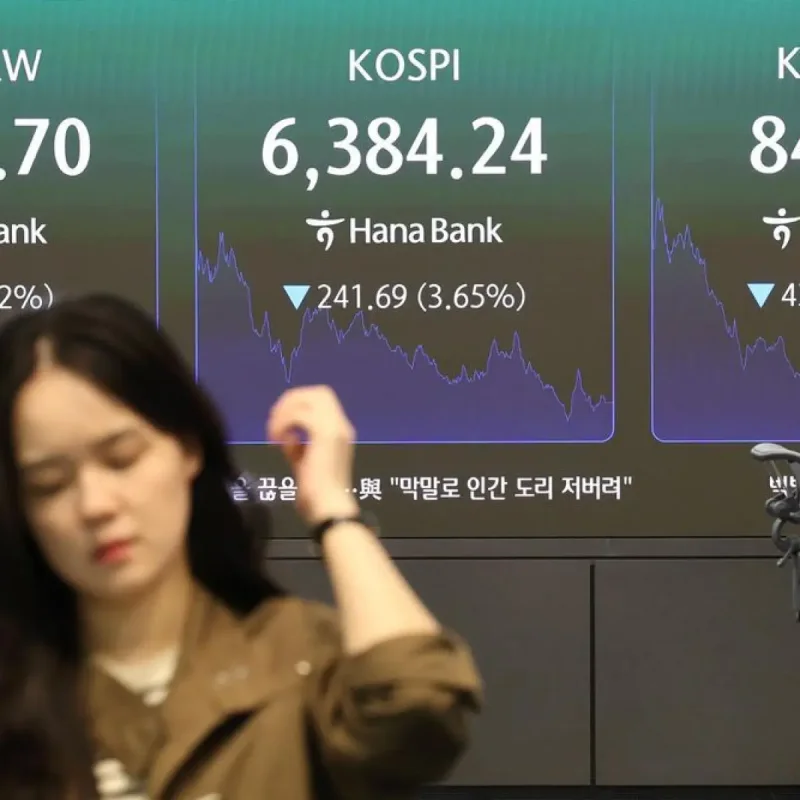
South Korea's benchmark KOSPI index dropped 3.65% on Monday, October 12, closing at 6,384.24.
The decline extended a four-session losing streak as foreign selling, renewed concerns about an artificial intelligence investment bubble and uncertainty over semiconductor earnings weighed on the market.
The index shed 241.69 points during the session, marking its steepest daily percentage decline since September 2, when it fell 3.99%.
Since October 6, the KOSPI has lost 619.50 points, or 8.85%, slipping below both the 6,500 and 6,400 thresholds.
The technology-heavy Kosdaq index also weakened, losing 43.08 points, or 4.83%, to finish at 849.19.
Meanwhile, the South Korean won strengthened against the US dollar, with the exchange rate falling 7.7 won to close onshore trading at 1,335.1 won per dollar.
Foreign Outflows and Chipmaker Pressure
Foreign investors have withdrawn $131 billion from South Korean equities this year, the largest outflow among major Asian markets, according to exchange data compiled by Bloomberg and cited by Yahoo Finance.
Trading turnover in the country's $4.3 trillion stock market has fallen 70% from its late-May peak, while the KOSPI has declined 22% during the second half of 2026.
The downturn follows a powerful rally in the first half of the year, when the KOSPI was the world's best-performing major equity benchmark, supported by strong demand for artificial intelligence memory chips.
However, Samsung Electronics and SK hynix, which together account for more than half of the benchmark's weighting, have become central to investor concerns about the sustainability of semiconductor earnings growth.
Samsung shares fell despite the company reporting a nearly ninefold increase in quarterly operating profit, according to Yahoo Finance.
On Monday, Samsung Electronics dropped 4.39%, while SK hynix declined 4.52%, contributing to the benchmark's losses.
Kim Seok-hwan, an analyst at Mirae Asset Securities, linked the pressure on the two major chipmakers to renewed questions about AI-related valuations following reports concerning OpenAI.
"The two chip heavyweights came under pressure as investors weighed renewed concerns about an artificial intelligence (AI) bubble following reports about OpenAI," said Kim Seok-hwan, an analyst at Mirae Asset Securities.
The Korea Times noted that differences in reported revenue reflected accounting methods rather than a decline in sales.
A 0.64% recovery in the Nasdaq the following day also indicated that concerns involving OpenAI alone did not fully explain the continued weakness in South Korean equities.
Buybacks, Retail Sentiment and Taiwan Shift
Market support from corporate share repurchases is also approaching a turning point.
Samsung Electronics and SK hynix are nearing completion of combined buyback programs valued at 55 trillion won, or $41 billion, according to Yahoo Finance.
Retail participation has weakened since July's selloff, with outstanding margin loans declining to approximately 33 trillion won from a June peak of 38.6 trillion won.
Brokerage deposits have also fallen to around 100 trillion won from nearly 140 trillion won.
Investors are increasingly looking to Taiwan for exposure to artificial intelligence-related technology businesses.
Taiwan's Taiex has gained 70% this year and outperformed the KOSPI by approximately 23 percentage points last quarter.
UBS Global Wealth Management has expressed a preference for Taiwanese equities for tactical AI exposure, citing a more diversified technology hardware ecosystem and substantial capital spending by major technology companies.
Analysts have also highlighted differences between South Korea's semiconductor-focused earnings growth and the broader range of AI services and infrastructure businesses represented by major US technology companies.
Lee Jae-won, an analyst at Yuanta Securities, said the two markets occupy different positions in the global AI supply chain.
"Although both markets stand to gain from rising global AI spending, their companies generate revenue differently and occupy distinct positions in the value chain," said Lee Jae-won, an analyst at Yuanta Securities.
Lee cautioned that the divergence between markets did not necessarily indicate that South Korean chipmakers were losing their competitive position.
He said investors should consider capital allocation trends, relative valuations and expectations for future earnings growth when assessing the sector's outlook.
"Investors need to examine changes in global portfolio allocations, Korean semiconductor stocks' relative valuations and differing expectations for future profit growth," said Lee Jae-won, an analyst at Yuanta Securities.
Upcoming semiconductor earnings reports could influence investor sentiment.
ASML and Taiwan Semiconductor Manufacturing Co. are scheduled to report results this week, followed by SK hynix on October 27 and Samsung Electronics' conference call on October 29.
Investors are watching for evidence that demand for AI infrastructure and high-bandwidth memory can sustain the industry's earnings expansion.