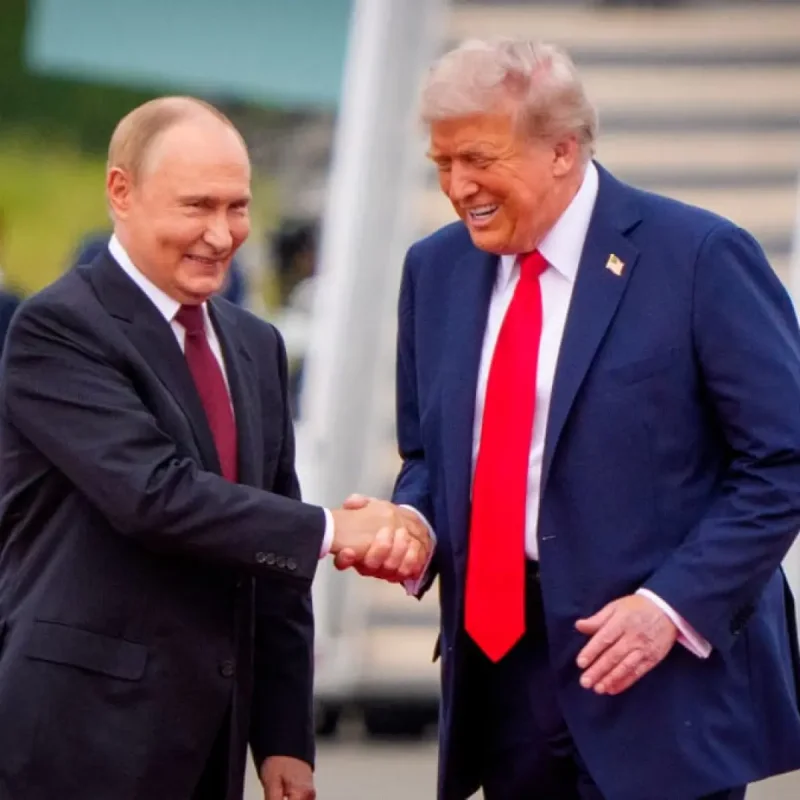
Russian President Vladimir Putin has reportedly proposed a three-way summit with U. S.
President Donald Trump and Chinese President Xi Jinping to negotiate an end to the war in Ukraine.
The Wall Street Journal reported the proposal on October 19, 2026, citing a former Russian intelligence officer briefed on the matter.
According to the report, the idea was raised during a phone call between Putin and Trump on October 9.
Ukrainian President Volodymyr Zelenskyy would not take part in the proposed meeting.
The summit could be held on the sidelines of the Asia-Pacific Economic Cooperation summit in November in Shenzhen, China, the newspaper reported.
The meeting has not been confirmed. The reported call also produced an agreement allowing Moscow to sell diesel on the global market.
Washington Signals Openness as Tensions With Kyiv Grow
The proposal emerges as Washington faces mounting friction with Kyiv over its approach to Russia, including sanctions relief and military support for Ukraine.
Bloomberg reported on October 18 that Trump's recent overtures to Putin had drawn criticism from Ukraine and European allies, as well as political figures in Washington.
U. S.
Secretary of State Marco Rubio addressed the possibility of a meeting during a visit to Uzbekistan, according to Reuters.
He said the administration remained open to diplomatic efforts to end the conflict.
"There's been talks of a meeting. I don't know whether it's been finalized, but the president has been clear," Rubio said.
Rubio stressed that Trump was willing to consider opportunities for negotiations, though no final agreement on the summit had been announced.
"The president is open to anything that he can do to help bring a war to an end, if it's possible, and we'll continue to look for opportunities to do that," Rubio said.
Ukraine, meanwhile, has voiced concerns about Washington's decisions concerning Russia.
Trump defended temporarily lifting sanctions on Russian diesel exports over the weekend and issued an executive order on October 18 waiving new Russia sanctions contained in a bill introduced by the late Senator Lindsey Graham.
Zelenskyy criticized the easing of restrictions, arguing that such measures could weaken pressure on Moscow while Russian attacks continued.
"The decision to undo all of this, to block all of it, seems wrong to me," Zelenskyy wrote on X.
Ukraine's First Deputy Minister for Recovery, Infrastructure and Transport, Serhiy Derkach, said Kyiv still hoped to preserve its relationship with Washington despite the disagreements.
He addressed concerns that the United States might abandon Ukraine or align itself with Russia.
"Stay in the middle," Derkach said, describing what Ukraine hoped Washington would do.
He stressed that continued American assistance remained a central concern for the Ukrainian government.
"That's most important for us actually, not to lose the support of the U. S.
," Derkach said.
Derkach also said Russia had intensified attacks on Ukrainian transport infrastructure, including road border crossings, railways and shipping routes.
His comments followed Trump's demand that Ukraine stop striking Russian energy infrastructure, which Trump said was contributing to higher global diesel prices.
Trump announced an energy ceasefire on October 11, but Russia continued attacking Ukrainian infrastructure.
Kyiv paused its strikes for three days before resuming them the following Thursday, citing continued Russian attacks.
Zelenskyy argued that Moscow had not responded to sanctions relief or agreements with reciprocal steps, saying continued Russian attacks undermined efforts to reduce hostilities.
"America should see that Russia is not taking any reciprocal steps in response to sanctions relief or agreements.
On the contrary, they take every signal of an opportunity to make money as proof that their bet on war is paying off and they can keep fighting," Zelenskyy wrote on Sunday.
In separate comments to Bloomberg on Sunday, Zelenskyy expressed concern that international pressure could push Ukraine toward concessions at its own expense.
"Steps have been taken to convince Ukraine to capitulate," Zelenskyy said.
He cautioned against assuming that Ukraine's partners intended to end the war by forcing Kyiv to accept unfavorable terms, while acknowledging that recent developments had created that impression.
"I am not saying that this is the goal our partners are pursuing.
I don't want to think that our American partners believe the war against Russia could be ended sooner at Ukraine's expense.
But that's how it looks," Zelenskyy told Bloomberg.
Russia also launched another wave of attacks on Ukraine, firing 16 ballistic missiles at Kyiv and the surrounding region and more than 200 drones across the country, according to Zelenskyy.
He said the strikes damaged more than 10 energy infrastructure facilities and left at least 550,000 households without electricity.
Casualties were reported, and a medical clinic, school, metro station and residential buildings sustained damage.
Zelenskyy also said Ukraine had received no advance warning from its partners about the missile attacks.
Over the same weekend, Ukraine launched more than 1,000 drones into Russia, setting fires at an oil export terminal and a refinery in St. Petersburg, while Russian forces attacked Kyiv with ballistic missiles.
Another source of friction involved restrictions on Starshield, the military-grade satellite network operated by SpaceX.
Ukraine said the restrictions affected its ability to use satellite connectivity to track and intercept incoming threats.
SpaceX CEO Elon Musk attributed responsibility for the system's operation to the U. S.
government.
"Starshield systems are owned and controlled by the U. S.
government," Musk wrote on X.
Trump denied on Friday that the White House had ordered restrictions on Starlink satellite internet services used by Ukraine's armed forces.
Reuters had reported, citing two U. S.
officials, that someone inside the White House had called for restrictions.
Ukrainian media also reported Zelenskyy describing the restrictions as a planned operation, while reports indicated that the connectivity limitations affected platforms traveling faster than 160 kilometers per hour, including interceptor drones.
The proposed Putin-Trump-Xi meeting remains unconfirmed, with the November APEC summit in Shenzhen identified as a possible venue.