
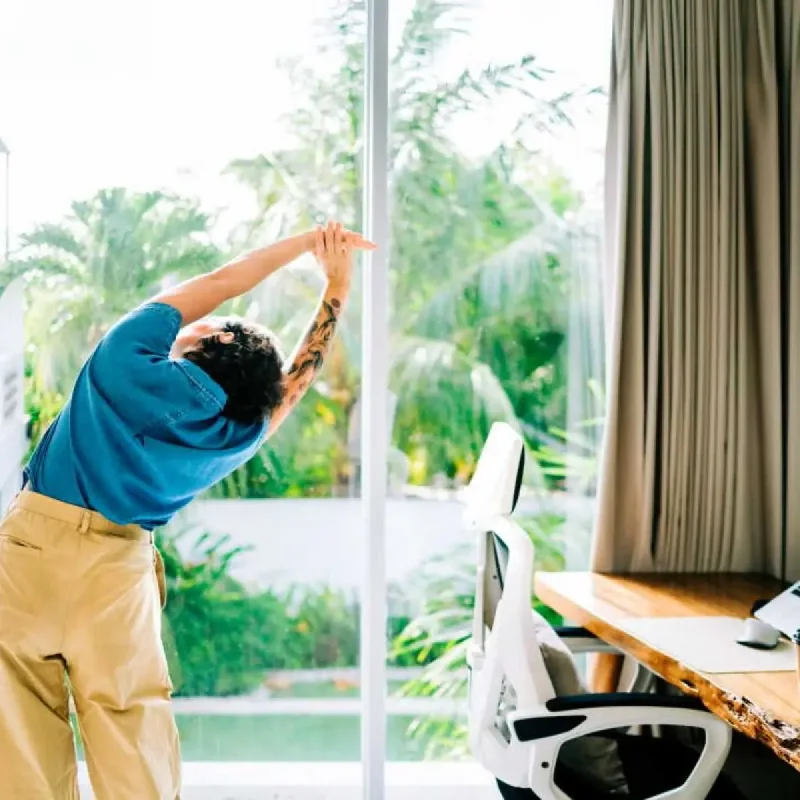
Health professionals say long stretches of screen time and sitting can leave people with muscle fatigue, neck and back pain, headaches, and discomfort in the hands.
Reports cited by NPR, The Times of India, and Gulf News stress that the strain comes from posture and repetitive motion, not from screens causing arthritis or structural spinal deformities.
The guidance is consistent for adults and children: move more often, adjust how devices are set up, and take breaks from repeated motions.
Sitting Hours and the Case for Short Walks
NPR reported that adults in the United States sit for an average of 9.5 hours a day while using computers, laptops, and phones.
A 2023 study from Columbia University Medical Center found that walking for five minutes every 30 minutes was the most effective strategy tested to counter the health risks of prolonged sitting.
More than 20,000 participants later joined a five-minute walking challenge run by NPR's Body Electric and reported better productivity and less fatigue.
Physical therapist Vinh Pham recommends movements that encourage spinal flexibility for discomfort linked to slouching.
His modified 3D T-spine rotation involves standing with one foot behind the other, rotating the torso, and moving both arms before switching sides.
Digital eye strain is another concern for people who look at screens for long periods.
Sustained close-up viewing forces the eyes to converge and stay focused, which can contribute to eye fatigue, headaches, and blurred vision, according to NPR.
Physical therapists Katy Bowman and Leada Malek advise varying body positions instead of trying to hold one supposedly perfect posture all day.
Alternating between sitting, standing, reclining, and walking can cut the time spent in a static position.
Professional ergonomist Meg Honan recommends placing computer monitors at eye level and keeping keyboards and mice low enough that the shoulders do not lift.
Laptop users can connect an external keyboard and mouse so the screen sits higher without raising the arms.
Children and Hand Strain Draw Separate Warnings
The Times of India reported on October 17 that children aged 8-16 were showing up with neck pain, upper and lower back discomfort, stiffness, and headaches potentially tied to long screen use and poor sitting habits.
Dr. Akshay Mehta, a consultant neonatologist and paediatrician at Motherhood Hospital in Greater Noida, said how long and how devices are used matters more than screens alone.
He said children who stay bent forward for long periods force the neck, shoulder, and back muscles to work continuously to support the head and hold posture.
Dr. Mehta said his outpatient department sees children aged 8-16 each week reporting neck pain, upper and lower back pain, stiffness, and headaches that may be linked to unhealthy screen habits.
He noted that children can develop poor sitting habits when using laptops on beds, sofas, or floors, where a neutral posture is hard to maintain.
He advises parents to focus on correcting posture and ensuring regular movement rather than simply banning devices.
His recommendations include suitable chairs and tables, screens near eye level, regular stretching, outdoor play, enough sleep, and breaks from prolonged sitting.
He lists persistent pain, disrupted sleep, headaches, numbness, weakness, and changes in posture as warning signs that may need medical evaluation.
Gulf News reported on October 19 that specialists in the United Arab Emirates separate this mechanical strain from arthritis, which involves joint damage or inflammation and can have multiple causes.
Dr. Tania Sultana Memon, a rheumatology specialist at NMC Royal Hospital DIP Dubai and a member of the Middle East Arthritis Foundation, said how people hold and use their devices affects the strain on their hands.
She said the problem is not simply time spent on a phone but the weight of the phone and how it is held and used.
Repeated thumb movements and sustained gripping can tire muscles and irritate tendons around the thumb and wrist.
Larger or heavier phones may increase the effort needed to hold a device, though phone weight alone has not been established as a cause of arthritis.
Dr. Chaitanya D, a consultant orthopaedic, hand and microsurgeon at Medcare Orthopaedics & Spine Hospital, said the concern is less about occasional phone use and more about prolonged, repetitive movement without adequate rest.
Phone-related strain may cause aching around the thumb and wrist that eases with rest or less repetitive activity.
Osteoarthritis, by contrast, can cause discomfort during gripping and everyday tasks, stiffness after rest, and hard bumps around finger joints.
Rheumatoid arthritis is an autoimmune disease that can cause persistent pain, swelling, warmth, and prolonged morning stiffness across multiple joints.
Dr. Memon said symptoms alone cannot reliably establish the cause of hand pain.
She said persistent discomfort, swollen joints, or prolonged morning stiffness warrants medical assessment rather than an assumption that device use is responsible.
People can reduce repetitive strain by switching hands, resting phones on a surface, loosening their grip, and taking regular breaks.
A case report titled Cellular Phone Overuse as A Cause for Trapeziometacarpal Osteoarthritis described a 33-year-old woman who developed wrist pain after using her smartphone for several hours daily.
An MRI showed inflammation around the joint at the base of her thumb, but the report does not establish that smartphone use directly causes arthritis in the wider population.