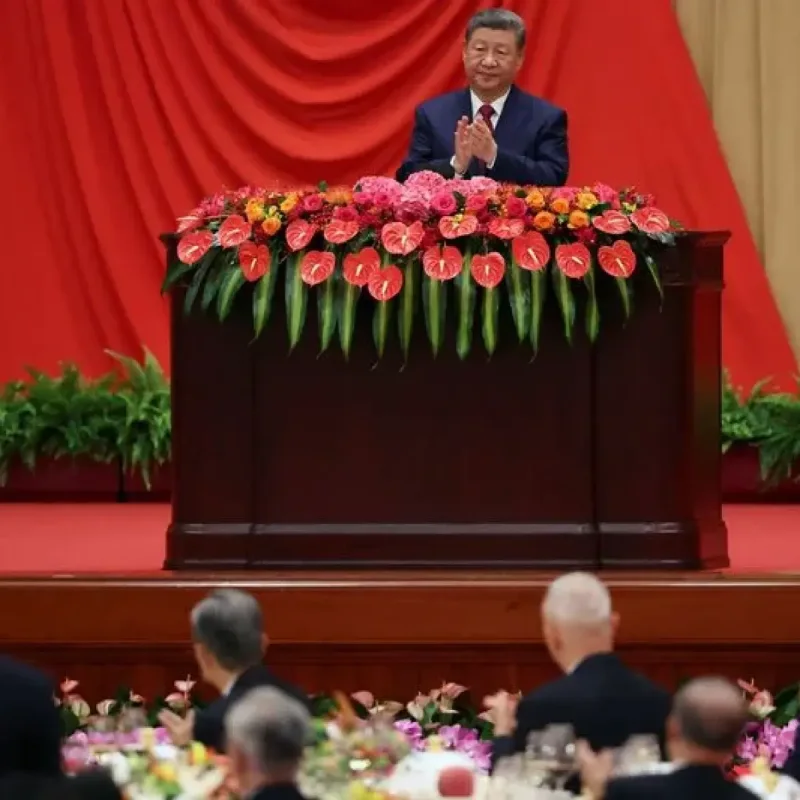
China's ruling Communist Party will hold its fifth plenum in Beijing from October 26 to 29, with internal discipline and central leadership at the top of the agenda.
The four-day gathering brings roughly 300 senior party members together ahead of the 2027 leadership reshuffle.
President Xi Jinping has intensified his anti-corruption drive and is pressing officials to carry out party directives without deviation.
A Different Fifth Plenum
This session departs from the usual fifth plenum script, which traditionally centers on the next five-year economic plan.
That ground was already covered in October 2025, when the fourth plenum adopted recommendations for the 15th Five-Year Plan covering 2026 to 2030.
Instead, discussions will focus on what Chinese authorities describe as full and rigorous party self-governance.
The meeting also unfolds in the run-up to the 21st National Congress in 2027, when the party will set its leadership lineup and political direction for the following five years.
Analysts expect Xi to seek a fourth term as top leader, though the plenum is not expected to announce a succession plan or major personnel changes.
Discipline as a Leadership Tool
Shortly before the meeting, Xi laid out his priorities in Qiushi, the party's flagship journal.
He called for enforcing central decisions, placing officials' extensive powers under institutional constraints, and sustaining anti-corruption work through stronger oversight.
Xi also criticized officials who publicly back party leadership while privately resisting its decisions, and those who chase short-term gains at the expense of balanced national development.
Ruby Osman, a senior policy adviser on China at London's Tony Blair Institute, said the campaign's growing intensity reflects political stakes rather than necessarily worsening misconduct.
"The growing focus on discipline is not because behaviour is getting worse, but because the stakes are getting higher," Osman said.
She said many of Xi's closest associates could retire during the 2027 reshuffle, making discipline an instrument for shaping the next generation of leadership.
"This plenum is probably less about deciding individual promotions, more about signalling the system-wide changes Xi wants ahead of a competitive 2027 Party Congress," she said.
Jean Christopher Mittelstaedt of the University of Zurich said investigations and expulsions have substantially reduced the Central Committee's membership, and he expects attendance to be exceptionally low compared with previous plenums held after Mao Zedong's era.
He noted that three of the 24 Politburo members elected in 2022 are gone, the most removed from a sitting Politburo in one term since 1980, along with five of the original seven members of the Central Military Commission.
The New York-based Asia Society Policy Institute estimates that only 77.4% of the original 2022 Central Committee cohort will be in a position to attend.
The plenum is expected to ratify the expulsions of Politburo members Zhang Youxia and Ma Xingrui over allegations that include corruption and disloyalty.
The meeting's focus also follows a party-wide education campaign launched in 2026 to promote what Beijing calls a correct outlook on performance.
That initiative targets vanity projects, abrupt policy reversals and official inaction, reflecting concerns that local and central officials may fail to carry out directives effectively.
Chong Ja Ian, an associate professor at the National University of Singapore, said the governance agenda remains important amid ongoing corruption investigations and mounting economic and demographic pressures.
He noted that the upcoming congress would provide the broader framework for leadership renewal, while intervening plenums translate political priorities into specific measures.
Hou Yichao, a researcher on China's political economy, said Xi's approach increasingly emphasizes institutional mechanisms rather than periodic anti-corruption campaigns.
He identified party organization, political education, supervision, institutional rules and accountability as key areas in the governance framework.
Observers will assess the communiqué expected at the end of the October 26-29 meeting and the details of its decision on party self-governance.
Any subsequent senior appointments could offer further indications of leadership renewal before the 2027 National Congress.