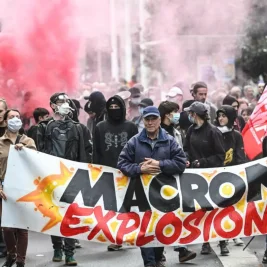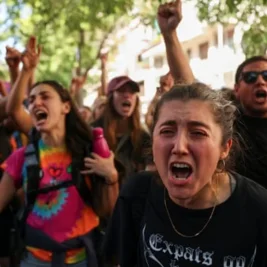
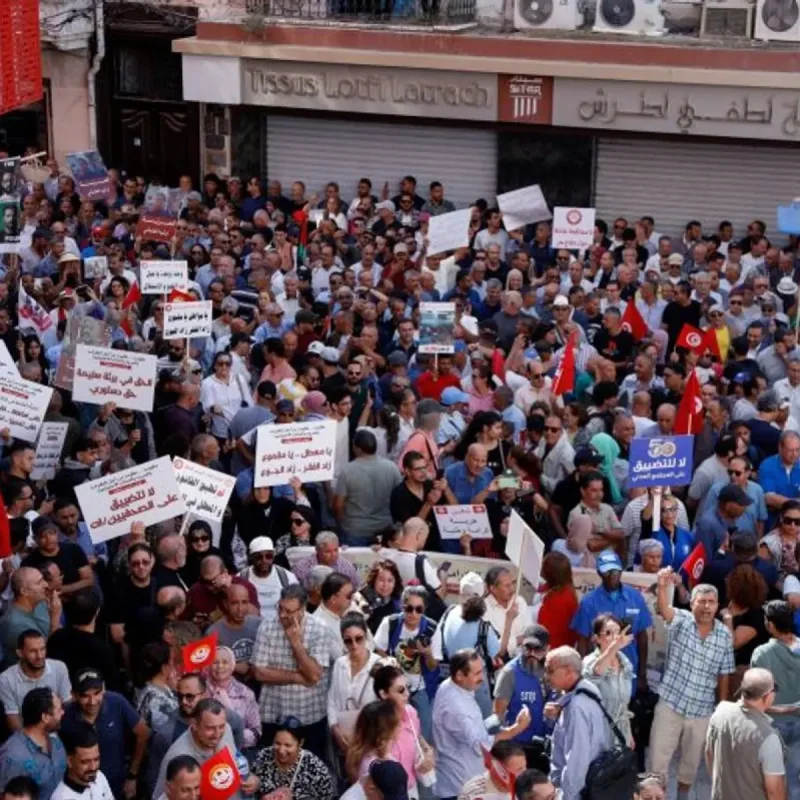
Tunisian police fired tear gas in Tunis and Jebiniana on Thursday as protesters angered by two recent deaths linked by relatives to security forces took to the streets.
The unrest adds fresh pressure to a wider crisis marked by unemployment, weak public services and mounting opposition to President Kais Saied.
In Ettadhamen, a suburb of the capital, demonstrators blocked roads, burned tires and threw stones after a detained man died following his arrest on suspicion of drug dealing.
His family said police abuse caused his death and demanded accountability, while local media cited by Al Jazeera reported that the man died after swallowing drugs.
In Jebiniana, in Sfax governorate, clashes also broke out after another man's relatives said he died while being chased by security forces.
Protesters there set a vehicle on fire and burned tires, and police again used tear gas, according to Tunisian media reports cited by Al Jazeera.
In Sfax, students separately protested the death of a female student after what classmates described as a delayed ambulance response to a cardiac emergency.
The unrest followed one of the largest demonstrations against Saied in years, when thousands gathered in Tunis on October 17 in a march led by the Tunisian General Labour Union, opposition parties and civil society groups.
They denounced deteriorating living conditions and restrictions on freedoms.
"A suffocating crisis on all levels, frankly speaking.
Almost all rights today have been violated," said Jamaleddine Sebaa, vice president of the Tunisian Human Rights League.
"The state is no longer fulfilling its duty to provide rights for Tunisian citizens, and that is what made us determined today to make the voice of the Tunisian people heard.
Tunisia first, and the Tunisian people above all."
Economic grievances fuel anger
The protest wave has unfolded against a worsening economic backdrop.
According to Tunisia's National Institute of Statistics, unemployment stood at 14.9 percent in the second quarter of 2026, while the rate among university graduates reached 26.6 percent.
The figures were higher for women graduates at 35.6 percent, compared with 14.2 percent for men, while unemployment among people aged 15 to 24 reached 35.4 percent.
Al Jazeera reported that long-term joblessness has fueled demands for faster implementation of laws promising public-sector hiring.
On September 27, unemployed graduates began a roughly 300km march from Menzel Bouzaiane toward Tunis to press for jobs and enforcement of recruitment measures.
Organizers said 23 people started the march and more than 120 had joined by the time it advanced toward the capital.
"We studied and graduated believing we had finally found a way out of poverty," said Cherine Ghanmi.
Her account reflected the frustration of graduates who say years of study have not led to work.
Al Jazeera reported that marchers were blocked by police in Borj Cedria on October 6 as they tried to continue together toward Carthage.
"We thought that once we found jobs, we could make up for all that hardship, repay our parents for their sacrifices and make them happy," she said.
Participants said the march was meant to pressure authorities to implement Law No. 18 of 2025, which provides for phased public-sector recruitment of long-term unemployed graduates over no more than three years from its publication in the Official Gazette.
"Unfortunately, reality was a big shock for us," she said.
The economic grievances have sharpened criticism of Saied, who has concentrated power since 2021.
Democracy Now reported that protesters accused him of crushing dissent, while Al Jazeera said a military court on Wednesday sentenced opposition politician Olfa Hamdi to four years in prison on state security-related charges.
"Instead of helping them, we have burdened them even more," she added.
Broader criticism has also come from graduate advocates who argue successive governments failed to prioritize development.
Al Jazeera reported that Tunisia's weak investment climate, poor infrastructure and limited job creation have left many educated young people without clear prospects.
"Almost all the governments that succeeded one another after the [2011] revolution did not make the economic situation, development and the treatment of social issues real priorities," said Cherif Khraifi, spokesperson for the Tunisian Union of Higher Education Graduates.
Khraifi said repeated policy promises had raised expectations without delivering durable solutions for graduates.
He argued that public-sector hiring alone would not solve unemployment without stronger investment and business growth.
"Their biggest concern was ensuring they stayed in power," he said.
The same concerns were echoed by analysts who said Tunisia's problem is tied not only to education, but to an economy struggling to convert skills into jobs.
Public anger has increasingly merged social demands with accusations of democratic backsliding.
"The authorities insist on promoting community companies as a solution for jobs and development, yet none of these companies managed to do that," said Cherine Ghanmi.
Al Jazeera also quoted a tax adviser and university professor who said weak investment had limited the economy's ability to turn skills into production and employment.
That backdrop has left local deaths, service failures and political repression feeding into the same national confrontation.