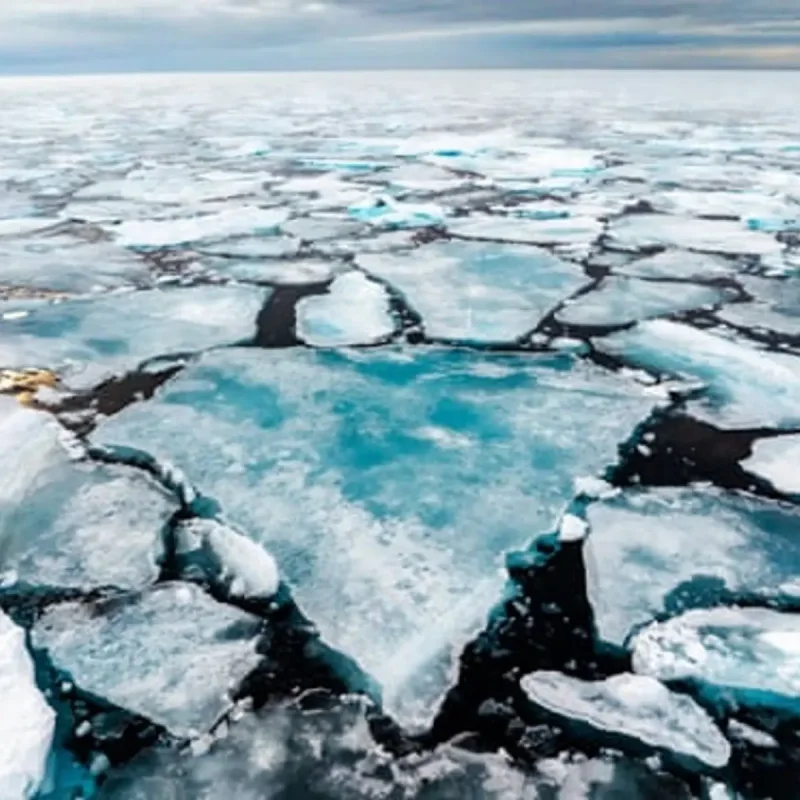
A temporary pause in Arctic sea ice loss has ended, marked by the steepest year-to-year wintertime reduction on record, according to a study cited by The Guardian.
Previous research published last summer indicated that melting had slowed over the past two decades. Between 2005 and 2024, scientists observed no statistically significant reduction in ice extent.
Natural variations in ocean currents temporarily offset rising global temperatures during that period. However, researchers cautioned that the buffer was short-term and predicted accelerated melting would eventually return.
Record Winter Decline
Updated satellite observations reveal that the 2005 to 2024 stabilization was a brief pause within a broader downward trajectory.
Dr. Duo Chan, lead author of the study from the University of Southampton, noted that what appeared to be a pause in the early 2020s was simply a temporary slowdown.
Since satellite tracking began in 1979, the total area of September sea ice at its annual minimum has been cut in half.
Satellite measurements showed a 5.8% drop in Arctic sea ice between 2024 and 2025, marking the sharpest single-year winter decline recorded.
Dr. Alessandro Silvano, co-author from the University of Southampton, explained that while the 2025 drop was unusually steep, it remains physically plausible under current warming conditions.
Winter sea ice acts as an insulating layer between the warmer ocean and the colder atmosphere.
Losing this ice allows more ocean heat and moisture to escape into the air.
Researchers warned that this heat transfer disrupts atmospheric circulation, pressure systems, and storm patterns, altering weather patterns further south.
"Short-term recoveries can temporarily obscure the longer-term direction of Arctic sea ice change.
The low winter sea ice extents in 2025 and 2026 clearly show that Arctic sea ice loss has not stopped – it is continuing in a warming climate," said Chan.