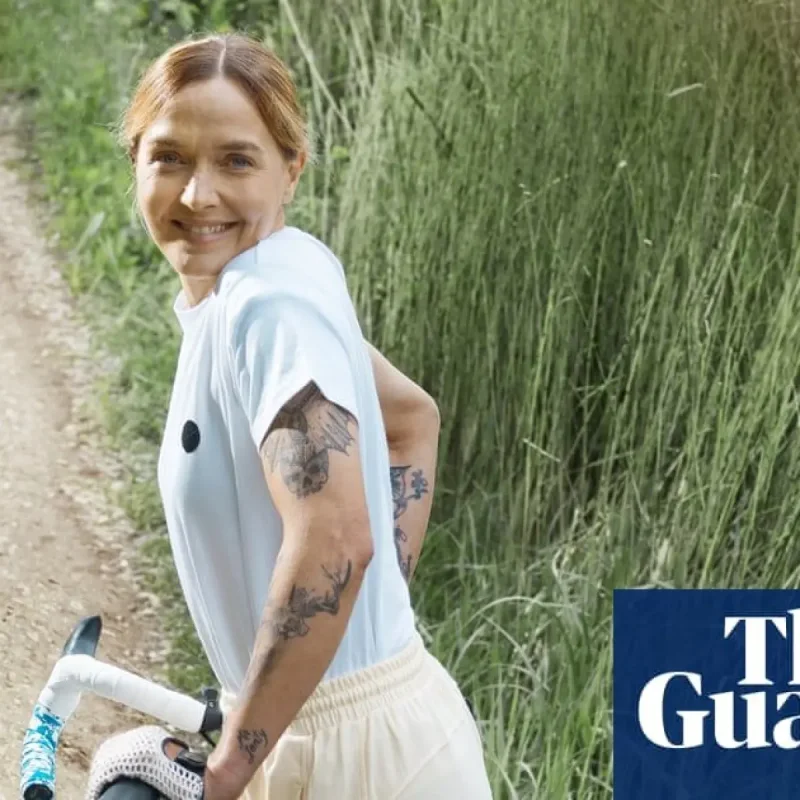
A vintage photograph captures a young girl on holiday in the south of France, not far from Saint-Tropez, during a time when cycling was nothing more than a hobby.
It was a moment of pure innocence, featuring a secondhand solo racing bike that had been custom sprayed by her father.
For Victoria Pendleton, born in Bedfordshire in 1980, this simple machine marked the quiet beginning of a trajectory that would establish her as one of Britain's most decorated athletes.
She accumulated nine world championship golds, two Olympic golds, and an Olympic silver before her retirement from the track in 2012.
The Solitude of the Playground
Despite her growing athletic prowess, young Victoria remained incredibly shy and timid.
Her parents raised the siblings as a "twinny" unit rather than treating her differently as a little girl.
This egalitarian upbringing instilled a profound sense of capability.
Yet the realities of the outside world soon shattered that domestic fairness, particularly within the confines of the school yard.
The limitations of gender became starkly apparent in the school playground.
It was strictly segregated into sports pitches for boys, while the girls were pushed to the peripheral spaces to avoid being struck by flying footballs.
Finding break times incredibly boring, she noticed that girls were never encouraged to pursue sports.
The activities the boys played looked vastly more interesting, physical, and free from the psychological constraints placed upon the girls.
Furthermore, the exact traits required to forge an Olympic champion proved entirely incompatible with becoming a popular teenage girl.
She played sports with an uncompromising intensity, driven by full confidence and an absolute intention to win.
Taking everything with an extreme seriousness, she found herself socially cast away for most of her teenage years.
This painful isolation was hard for someone who desperately wanted to fit in and please people.
This profound loss of control and lack of social belonging eventually manifested as an obsessive-compulsive disorder.
She became entirely obsessive over her food intake and developed a habit of hand-washing so severe that her skin was frequently left red and raw.
Art classes became a sanctuary not just for creativity.
The giant sinks allowed her to wash her brushes and her hands repeatedly without drawing unwanted attention from her peers.
The Call That Changed Everything
Isolation transformed into opportunity on a single afternoon when she was 16 years old.
The family landline rang, bringing a life-altering proposition from a representative of the British Cycling Federation named Marshall.
He noted that her name had been consistently appearing in the results section of Cycling Weekly. He invited her to try out for the national team.
While her father was delighted, she harbored deep worries that a career as a professional athlete was an impossible fantasy.
When she entered the professional circuit, an overwhelming sense of imposter syndrome took hold.
On the flight to her very first European Championships, she found herself seated next to Bradley Wiggins.
Though they were the exact same age, he was already an established expert in his field.
She felt like an absolute fraud who did not belong. She constantly feared that officials would realize their mistake and eject her from the team.
This lingering doubt only vanished when she finally secured her first world championship title in 2005.
As her career advanced, the external environment remained challenging, dominated by critical voices claiming she was too small, too puny, and entirely too feminine for elite success.
Sheltered only by her father's fierce belief, she retreated into the shadows to quietly absorb the constant slights.
Her coaches further compounded the issue, misinterpreting her natural smile and lighthearted demeanor as a lack of competitive focus.
They completely failed to realize how intensely self-critical she already was internally. The level of control exerted over her life reached extreme levels.
She was reprimanded simply for reading a book while stretching on a mat in the track center. The pretense was that it demonstrated a lack of focus.
Despite these internal frictions, she found vital support in remarkable teammates like Jason Quealy, Chris Hoy, and Craig McLean.
They treated her like a little sister and served as healthy role models during the golden era of British cycling at the Beijing Olympics.
By the time the London 2012 Olympics arrived, the immense pressure of entering a home games as the reigning world and Olympic champion became terrifying.
Her face adorned countless billboards and magazines.
The public constantly demanded to know if she was going to win gold.
She managed the immense expectation by pleading for forgiveness in advance if she happened to fail to achieve the top spot.
The immediate aftermath of winning Olympic gold brought an unexpected emotional flatness. This is a common consequence of channeling every ounce of human energy into a singular goal.
When the adrenaline finally stopped pumping, life suddenly felt vacant.
She accepted every single sponsorship and corporate offer available simply to keep her mind completely preoccupied and avoid the void of retirement.
The transition into life after professional cycling proved incredibly difficult. It triggered severe emotional lows as she struggled to untangle her identity from her athletic performance.
Having felt for a decade that winning was the only thing she had to offer, the emotional strain worsened.
It became clear that some people valued her more as a champion than as an individual.
An attempt to escape these feelings by climbing Mount Everest was cut short by hypoxia. This occurred simultaneously with a painful divorce.
Overwhelmed, she ultimately disappeared into the jungle to take up surfing as a form of therapy. In the years since, she has channeled her energy into extreme sports.
She attributes her fearlessness to a childhood spent competing alongside her twin brother.
Following the tragic passing of her twin Alex due to a brain tumor, she sought to explore the unique confidence that twindom had gifted her by entering the dangerous worlds of motorcycling and horse racing.
The world of horse racing proved entirely life-changing.
It offered an exhilarating blend of danger and a deep connection with horses that has redefined her life.
This proves that the young girl in the old photograph was capable of far more than she ever dreamed possible.