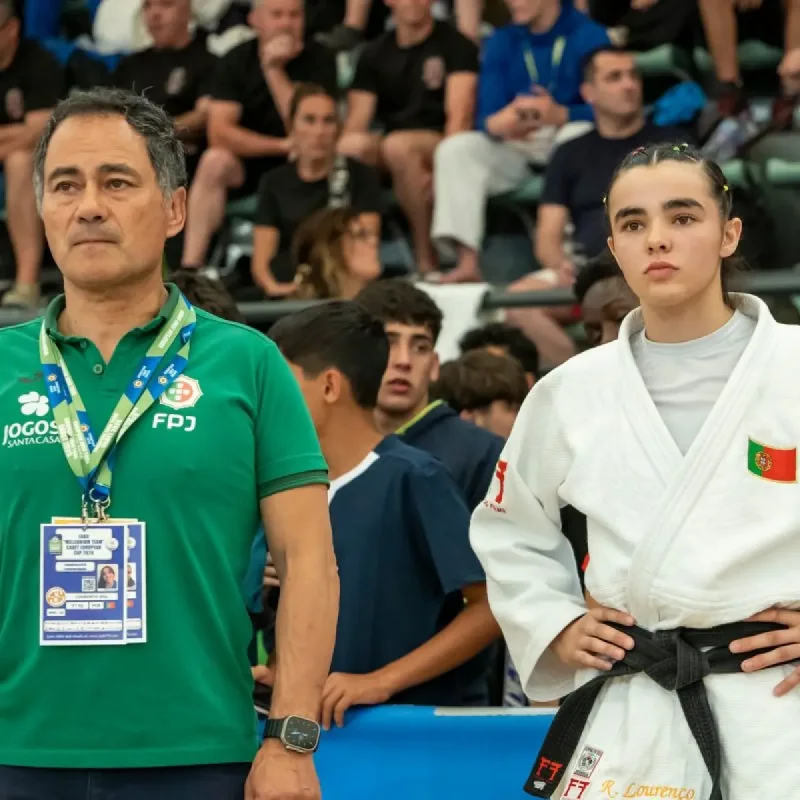
A record-breaking field of 618 young judokas representing 32 countries gathered at the Pavilhão Municipal da Penha in Faro, Portugal, for the Faro Millennium Team Cadet European Cup 2026 on May 23 and 24.
The event marked the largest international judo competition ever held on Portuguese soil, according to the Portuguese Judo Federation (FPJ).
Among the 374 male and 244 female under-18 athletes, 21 competitors were ranked in the global top 10.
Spain sent the largest contingent with 136 athletes, followed by Italy with 100, host nation Portugal with 99, France with a sizeable delegation, and Brazil with 34 competitors, as reported by JudoInside.
com.
Italy Dominates Lightweight Categories on Opening Day
Italy dominated the lighter weight categories on Saturday, winning six of the eight contested divisions and sweeping the entire boys' -55 kg podium.
Italian judoka Aurora Ferro claimed gold in the girls' -44 kg category by defeating world number three Fenne Peeters of the Netherlands in the final.
"Last year I won bronze and I was very happy but this year I came for gold. Character, technique, and tactics made the difference," Ferro said.
Spanish athlete Hugo Lopez Pereira earned silver in the boys' -50 kg division after beating world ranking leader Arthur Bonato of Brazil before losing to Italy's Ismael Mehabra in the final.
"It was a good competition. I went contest by contest, without thinking about who was in front of me," Lopez Pereira said.
The first-year Spanish cadet faced the world number one without hesitation.
"In that contest, I went without fear, knowing that the one who had something to lose was him.
The pressure was on his side. I am a first-year cadet and I had no pressure at all," he added.
The victory positioned Lopez Pereira near qualification for the upcoming European tournament after mixed results in his prior two international competitions.
"I came wanting to do something important.
In the last two competitions, I was winning some contests but something was always missing in the end.
Here I came to leave everything on the tatami because it was the last opportunity to qualify for the Europeans.
Now I don't know if I will go to the Europeans but I know I gave everything, the work is done, and the medal is at home," Lopez Pereira said.
Portuguese athlete Sofia Gaspar, ranked 14th globally in the girls' -52 kg category, aimed for the podium on home soil as preparation for the European Championships.
"The objective is to reach the medals and give my best on the tatami in every contest," Gaspar said.
Gaspar noted that local spectators provided a significant psychological boost despite the tournament being far from her home city of Coimbra.
"For me, competing in my country feels different. Even though Faro is far from Coimbra, the support feels much stronger.
Hearing the crowd behind us at home gives us a special confidence," she said.
Gaspar credited her competitive consistency this season to balancing academic and sporting responsibilities.
"The factors for achieving good results involve continuous training, great dedication, balancing school and training, and developing an increasingly stronger mindset," she said.
She expressed appreciation for her support network.
"I want to thank everyone who supports me, whether they are judoka or not, especially my family, friends, coaches and club teammates.
All that support means a lot to me," Gaspar said.
Portuguese cadet national team coach Joana Ramos highlighted the event as a critical qualification gateway and the emotional peak of the seasonal training cycle.
"This competition represents the culmination of an entire season of work for these cadets.
It is the final major opportunity before the cadet European Championships and therefore carries very special competitive and emotional significance," Ramos said.
Ramos emphasized that the tournament allowed domestic athletes to showcase their skills in front of local families and home club networks.
"For many athletes, this event may prove decisive in achieving qualification standards for the cadet European Championships but above all, it is an opportunity to show their best level in a very special environment: at home, in front of club teammates, national teammates, families and coaches who support them every day," she said.
Brazil and Spain Shine in Heavier Categories on Final Day
On Sunday, Brazil emerged as the dominant force in the heavier weight categories with five finalists, while Spain produced four finalists and Italy secured only one finalist placement in the women's +70 kg category.
Portugal's Rita Lourenço rebounded from a quarter-final loss against Brazilian gold medalist Gabriela Pereira to claim bronze in the -57 kg category by defeating two consecutive French opponents.
"Judo is a physical sport but it is also very mental.
An athlete being able to overcome themselves mentally is very important in order to score in contests following a defeat and manage to reach a medal," Lourenço said.
Lourenço credited her podium finish to collaborative preparation within her local club and regional training camps. "This medal is not only the result of my work.
It is the result of the work of many people, both in training camps and at the club," she said.
She expressed profound gratitude to local spectators for their vocal support during the repechage rounds. "Thank you very much.
I don't know how to thank everyone with words alone," Lourenço said.
In the men's -90 kg division, Spain's Pablo Fernandez Calero captured gold after navigating a grueling opening sequence of matches.
"I started a little badly. I did not feel comfortable with my judo.
The first contest was very long and it was very difficult for me to win. The second was more of the same, although my judo was improving.
In the semi-final and final, I felt very good, doing my judo," Fernandez Calero said.
He outlined a simple training philosophy behind his success.
"The secret is to train, train and train, compete, and never stop until victory is achieved," he said.
Fernandez Calero set clear goals for the remainder of the international season.
"I hope to go to the cadet Europeans and the Worlds, and there the objective is to win a medal," he said.
After the tournament, athletes remained in the Algarve region for a three-day international training camp focused on mutual growth.