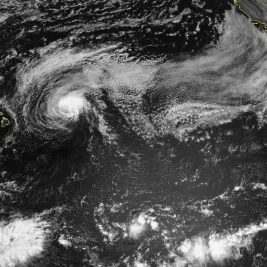
Tropical Storm Rachel brought heavy rainfall and flooding to the Las Vegas Valley over the weekend, but the storm did little to replenish Lake Mead.
The reservoir, which supplies Southern Nevada and other communities along the Colorado River, remained at 26 percent capacity, according to reported measurements.
Lake Mead's water level stood at 1,037.75 feet above mean sea level, only slightly above record lows recorded days before the storm.
Experts said the precipitation offered some relief but was insufficient to resolve the reservoir's long-term supply problems.
Snowmelt, Not Rainfall, Key to Recovery
Jack Schmidt, a senior research scientist with the Utah State University Center for Colorado River Studies, said the storm improved conditions at the reservoir but would not provide a lasting solution.
He emphasized that sustained recovery depends largely on winter snowfall and the water released when snow melts.
"This storm definitely improves conditions in Lake Mead," Schmidt said.
Schmidt explained that rainfall alone cannot restore the substantial volume of water lost from the region's major reservoirs.
Lake Mead and Lake Powell depend heavily on snowmelt from the winter snowpack to replenish their supplies.
"To rebuild the amount of water in Lake Mead or Lake Powell, is entirely based on what is snow melt from the winter snowpack," Schmidt said.
Snow conditions have remained a significant concern for Colorado River water supplies.
Colorado State University estimated in March that snowpack levels were only 38 percent of their typical average, limiting the potential contribution from seasonal melting.
Las Vegas resident Rafael Rodriguez welcomed the storm's rainfall but said he had hoped it would deliver more water to the struggling reservoir.
"I was hoping for 24 hours straight of water because I want Lake Mead to fill-up," Rodriguez said.
Rodriguez said the rain was valuable despite the damage caused by the storm.
Floodwaters moved through parts of the Las Vegas Valley, illustrating the immediate hazards accompanying the heavy precipitation.
"I am grateful for it. We need the water.
Lake Mead water levels are down.
So even though it was a hurricane, the swath going through it, of course we did sustain damage but I am grateful for all the water we can get," he said.
Beyond weather conditions, interstate agreements and federal water policies influence how much water reaches Lake Mead.
Elizabeth Koebele, a political science professor at the University of Nevada-Reno, said agreements between Western states and the federal government govern transfers from Lake Powell to downstream users.
"There is a complex series of agreements between the states and the federal government in the western United States that dictates how much water gets sent down from our other major reservoir Lake Powell," Koebele said.
Koebele explained that the Colorado River Compact divides the river's states into Upper Basin and Lower Basin groups.
Arizona, California and Nevada belong to the Lower Basin, where Nevada has historically received a relatively small share of the available water.
Negotiations over the river's management could further reduce Nevada's allocation, adding pressure to a region already facing limited supplies.
Koebele also pointed to a legal dispute involving a new federal policy that took effect October 1.
"Nevada was the first state to sue the federal government over this new policy that was put in place on October 1st," Koebele said.
The potential consequences for Southern Nevada could be substantial, Koebele said, with Las Vegas facing a major reduction in its available water supply under the most severe scenario.
"At the highest end, Las Vegas can take an over 70% cut to its water supply," she said.
Schmidt said a sustained recovery would require multiple years of favorable precipitation, a prospect he considered unlikely given the region's climate conditions.
"We can pray and hope for snow and rain, but that is a tough bet and that would be unusual given the climate of the 21st century," he said.