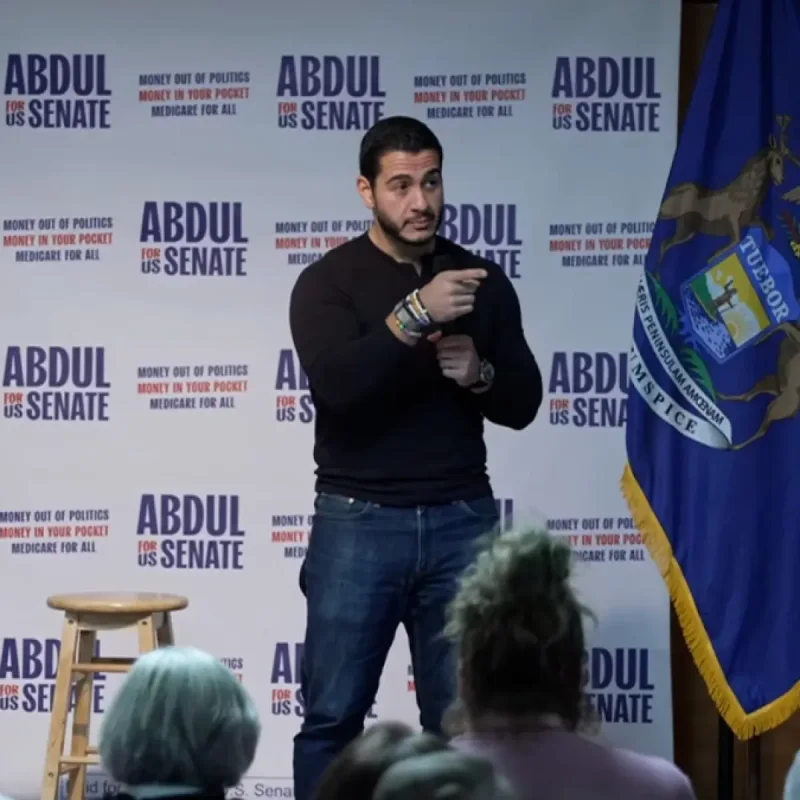
Abdul El-Sayed, the Democratic Senate nominee in Michigan, disavowed the Muslim Brotherhood during a heated town hall exchange in Caro, Michigan.
The moment sharpened a political debate over allegations about his ties to the Islamist movement and questions about how his Muslim faith relates to the US Constitution.
An attendee repeatedly pressed El-Sayed on the organization and demanded that he explicitly reject its activities.
"Abdul, will you disavow the Muslim Brotherhood?" the audience member shouted at El-Sayed.
After disavowing the movement, El-Sayed criticized what he described as an assumption that his religious identity implied conflicting political loyalties.
"You assume … that because I am Muslim, that somehow I would have some allegiance to something that is not our Constitution," El-Sayed said.
He described the Constitution as the central principle guiding his political commitments.
"For me, that Constitution is the guiding light," El-Sayed said.
The attendee left after the exchange, while members of the audience cheered for the Senate nominee.
Family posts and pushback
The dispute has also centered on social media posts by El-Sayed's half-sister that recently resurfaced online.
One post from 2012 described a conversation about their mother's alleged activism in the Muslim Brotherhood during her college years in the early 1970s.
Earlier that week, El-Sayed rejected allegations that he or his relatives had ties to the organization.
He called the suggestion that members of his family belonged to the movement an unreasonable assumption.
"an insane thing to assume," El-Sayed told reporters, referring to the allegations about his family.
El-Sayed has said he does not know what his mother was doing in Egypt during the 1970s.
He explained that he was 3 when his parents divorced and that he spent years without seeing his mother while being raised by his father and stepmother.
Speaking Thursday, El-Sayed criticized the focus on his relatives rather than his own record as a candidate.
"They want to talk about me or point to my mom or my sister," El-Sayed said.
He urged voters to assess his candidacy based on his public record and professional work.
"I'm running for office. Judge me by my actions and my work," El-Sayed said.
El-Sayed has also argued that questions about alleged Muslim Brotherhood connections reflect prejudice against Muslims.
During an appearance on MSNOW on Sunday, he challenged the implication that his religious identity should raise doubts about his constitutional allegiance.
"To insinuate that somehow, because of my Muslim faith, as somebody who might be the first senator who has that faith, that I would have anything but allegiance to the Constitution, that should be called into question," El-Sayed said on MSNOW.
The Muslim Brotherhood originated in Egypt and developed branches in other countries.
The movement officially rejects violence as a means of achieving its goals, although some affiliated branches have been linked to attacks.
In November, Trump signed an executive order initiating a process to consider certain branches or subdivisions of the Muslim Brotherhood for designation as Foreign Terrorist Organizations.
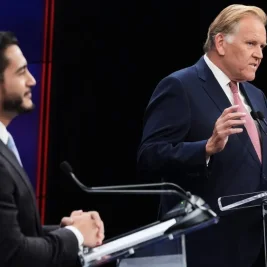
Republicans, including his Republican challenger Mike Rogers and President Donald Trump, have raised questions about possible connections between El-Sayed and the organization.
El-Sayed, who could become the first Muslim elected to the Senate, has rejected allegations linking him or his family to the movement.