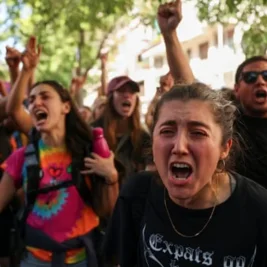
French police detained more than 400 people, most of them minors, on Tuesday as nationwide high school protests over class sizes and staff shortages escalated into violent clashes in major cities.
The French Education Ministry said demonstrations and blockades disrupted at least 400 of roughly 3,700 high schools across the country.
Violence broke out in Paris, Lille, Bordeaux, Rennes, Nantes, and Marseille, leaving 48 law enforcement officers, ten teachers, and several students injured.
Protesters vandalized bus stops, set fire to trash bins, and hurled projectiles including paving stones, bottles, and hydrochloric acid at officers, who responded with batons and tear gas.
The student movement coincided with broader nationwide strikes by public sector unions protesting government spending cuts.
Government Defends Police Response
Interior Minister Laurent Nuñez addressed the scale of the law enforcement response and the disruptions occurring outside educational institutions across the country on BFMTV.
"440 were detained across national territory. We don't have the final tally yet, but I'm told two-thirds led to police custody," Nuñez said.
Nuñez defended the actions of the police force during the widespread urban unrest and condemned the tactics used by masked demonstrators.
"There is nothing that justifies showing up at institutions to demonstrate, masked, with your face disguised, carrying projectiles, and waiting for the intervention of law enforcement just to go after them," he said.
The interior minister emphasized that officers acted within legal parameters when dealing with violent crowds gathered near public schools.
He said the operations were "carried out in an extremely proportionate manner."
Student activists cited systemic issues in public education, including overcrowded classrooms averaging 32 to 35 students and grueling daily schedules, as the primary drivers behind the blockades.
"We're here to deliver a message," a 16-year-old female student told AFP. "We're not here to smash everything up for no reason.
We're here precisely to say that the education system is completely broken."
"There are 34 of us in each class, and it's just not feasible. The teachers are overworked."
Ryad Rani, president of the Union Syndicale Lycéenne student union, called for peaceful blockades while condemning government directives authorizing police interventions near school grounds.
"We're talking about pupils of 15-18 years old and the government's only response is automatic and institutionalised repression.
It's unacceptable," Rani said.
"High school pupils are taking action to demand fairer and more equitable conditions and they're being met with the BAC [anti-criminal brigade] and the CRS [riot police]."
Rani also noted that school personnel had intervened directly during the demonstrations to shield teenagers from physical harm during police actions.
"Those are the images you should be showing," Rani told BFM TV.
Rani directly criticized the administration's stance toward protesting minors as civil unrest mounted outside campuses, describing it as "repression" to AFP.
Ministers Condemn Escalation
French Education Minister Édouard Geffray acknowledged the right to demonstrate but criticized the destruction of public property and ongoing disruptions to academic activities.
He called the destruction "indefensible" on X.
Geffray warned that expanding school blockades endangered students and school personnel across the affected regions.
"The right to demonstrate is a fundamental freedom that cannot serve as an excuse for such actions," Geffray said on social media.
"To legitimise them or, in this context, to call for extending the blockades is to endanger our students as well as public employees.
It is irresponsible."
Prime Minister Sébastien Lecornu reiterated the government's stance against the escalation, citing reports of fireworks, fires, and assaults against law enforcement near schools.
He described the situation as "irresponsible."
Lecornu urged demonstrators to cease destructive behavior and refrain from endangering public safety near high school facilities.
"Fireworks, fires, violence near high schools: nothing justifies endangering students, staff, or police officers," Lecornu said on X.
The Prime Minister pushed back against political opponents who supported the demonstrations, rejecting accusations directed at government ministers and calling it an "irresponsible escalation."
Lecornu argued that public officials must prioritize student safety rather than encouraging unrest for political leverage.
"The duty of an elected official of the republic is to protect young people and call for calm.
Exploiting their anger for partisan purposes is wrong," he said on X.
Lecornu firmly rejected allegations of bias raised by opposition figures regarding police tactics outside high schools, calling them "an insult."
Jean-Luc Mélenchon, leader of the hard-left France Unbowed party, denounced the government's security response and urged elected representatives to intervene on behalf of student protesters.
"The high school students protesting are harmless. The Lecornu government has ordered a crackdown.
This brutality is irresponsible and has a clear racist undertone," Mélenchon said on X.
"Hands off our youth. Elected officials and France Unbowed activists, step in wherever you can."
Caroline Chevé, secretary general of the Fédération Syndicale Unitaire teachers' union, expressed solidarity with the students during a protest march in central Paris.
"They're facing the same challenges as we are. They're in overcrowded classrooms.
Sometimes they don't have enough teachers because of staffing shortages," Chevé said.
"They see the same reality as we do, and they're angry."