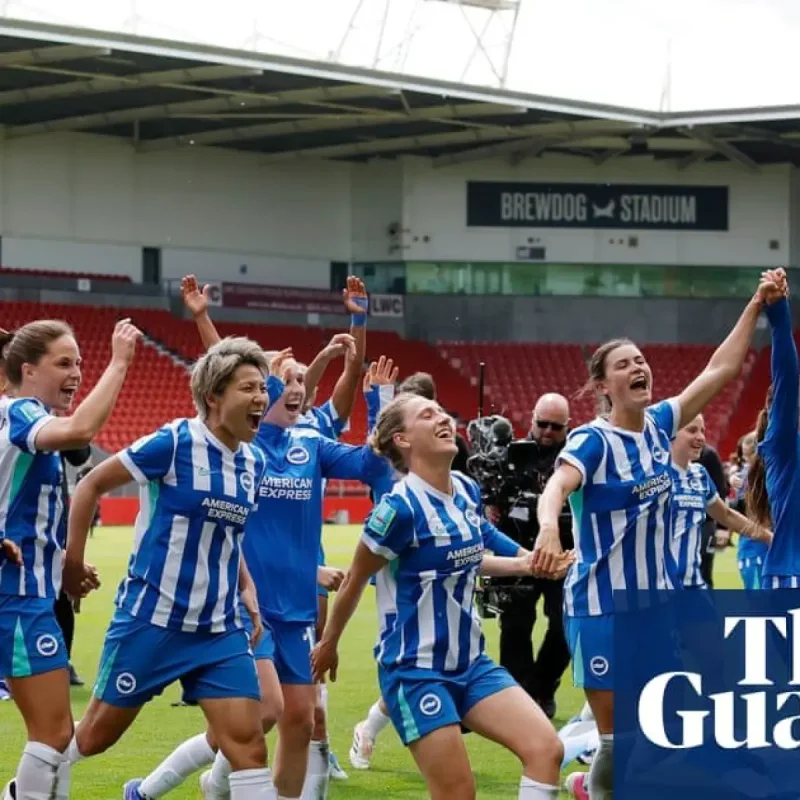
Brighton & Hove Albion and Manchester City will meet in the 2026 Women's FA Cup Final at Wembley Stadium on Sunday, May 31.
The match represents the biggest game in Brighton's history as they pursue their first major trophy.
Brighton advanced to the final by overcoming a two-goal deficit against Liverpool, securing a 3-2 victory with a 95th-minute winner from Nadine Noordam.
The club also defeated Arsenal in the quarterfinals and beat Manchester City in their most recent Women's Super League encounter in April.
Pre-Match and Post-Match Ceremonies
The Football Association announced the running order for the event.
Sammy Rowland from Leyton Orient will walk out the match ball as the prospective winner of the Mitre Golden Ball award for the tournament's top scorer.
Rowland has scored 15 goals this campaign and is the first player to win the accolade twice, having previously claimed it in the 2022-23 competition with Hashtag United.
British Army aircraft technician Staff Sergeant Amber Marsh will place the trophy on the plinth before kick-off.
Marsh has served for nearly 17 years and participated in multiple overseas military football tours.
FA Chair Debbie Hewitt MBE will guide the official presentation party, which includes Adobe Vice President of Business Operations Allison Blais and Women's Professional Game Committee Chair Nikki Doucet.
Team captains will introduce their squads to the dignitaries, and south-east London vocalist Duchess will perform the National Anthem after recording a bespoke pre-match build-up song with DJ Char Stape.
For the post-match ceremony, Royal Navy Lieutenant Commander Patricia Chatfield will place the match official and runner-up medals into the Royal Box.
Royal Air Force Squadron Leader Lisa Cavill will deliver the winner's medals, and Staff Sergeant Marsh will return to place the trophy in the Royal Box.
Brighton's Emotional Journey
Brighton head coach Dario Vidosic is leading the squad four months after his father, Rado Vidosic, died from cancer.
Rado had been serving as the head of coaching for the Brighton women's team.
The 39-year-old former Australia midfielder said his father remains central to his motivations ahead of the Wembley appearance.
"He's always in my thoughts," said Dario Vidosic. "I know he's always been there for me, from when I was a very small child.
He'd be working all day, but he'd always make effort to play with me, to be in the back garden and take me out and kick the ball around and just help me, and it was the same as a coach."
Vidosic added that his father demonstrated immense perseverance while battling his illness.
"It was very sad to see what he went through [with cancer], but even through that, he still taught me some valuable lessons," said Vidosic.
"When something feels like it's going to defeat you, he still never gave up until the very, very last moment.
He was still fighting it, still trying to get up, still trying to move, not letting it beat him.
Even in his final moments, he still taught me so much. He showed me a strength that I didn't know was possible."
The head coach intends to use these lessons during the final and throughout his life.
"I'll take that with me, not just to Wembley, but in every moment in life," said Vidosic.
"Whenever it feels like it might be a bit tough, I know I haven't gone through anything that I can say has been 'tough'.
So, irrespective of what happens [on Sunday], it's a day that I'm sure he'll be proud watching the girls and watching the game unfold, I know he'll be there with us and hopefully we can give him something to celebrate."
Vidosic emphasized that while reaching the final is a notable achievement, the squad is focused on securing the historic victory.
"It is a fantastic achievement, and [because of] the teams that we had to beat to get to the final, I think that has to be celebrated, but only the winner is remembered, so it is an opportunity for us, and I want to be the part of the history, to be the first [Brighton] team to bring a trophy back," said Vidosic.
"It's most important to enjoy it, not to feel any stress about it. And it's normal to have those nerves that matchday will certainly bring."
The club recently published plans for a dedicated £80 million, 10,000-capacity women's stadium adjacent to the Amex Stadium.
Vidosic stated that this infrastructure serves as an inspiration for younger academy players. "It was a very nice moment," said Vidosic.
"It's something for our younger players, in the academy and for girls aspiring to be professional footballers, and it just really shows them what is possible.
It now fills their dreams, that they see that stadium that they can play in.
The younger ones in particular, when they go in the garden or when they're playing football at their school, they can have these scenarios in their mind, scoring potentially the winner in their new stadium.
It's very exciting and I'm very happy to be part of a club that's really pushing the women's game and taking it to new levels."
The club traces its origins back to 1967 when a group of telephonists formed a charity team called Brighton GPO, playing during a period when the Football Association enforced a ban on women's football.
Eileen Bourne, who joined the original team as a 17-year-old goalkeeper, recalled the organic emergence of women's squads after the 1966 World Cup.
"At that time, there was no organised women's football at all... so getting a team to join, for me, was manna from heaven," said Bourne.
"We played against the postmen, that was my first game, I don't remember the score. Probably in my scrapbook."
Bourne noted that local teams eventually established leagues that united to form the Women's Football Association. "After the World Cup, women's teams were forming organically," said Bourne.
"Shops, stores, and various organisations started getting women's teams up. We played friendlies against them."
Bourne also recalled that she did not focus heavily on the official ban while balancing her early career at a bank.
"I can't remember how many founder members there were, but we were one of them," said Bourne.
"I'm not sure I thought about it that much; I was just glad to be out on the pitch and going to training sessions.
By that time, I worked for a bank. They had two pay scales, one for men and one for women.
The women's was always less. You got used to not being thought that much of."
Julie Hemsley joined the Brighton GPO team at age 14 and later negotiated the 1990 affiliation that established Brighton & Hove Albion Women & Girls' FC.
"I was spotted in the street playing with the boys, kicking a ball at a hedge, which we got told off for," said Hemsley.
"I was a kid playing with adults. We just wanted to play.
The pitches weren't that good, we started at Buckingham Park...
there was some grass, a few holes, we had this old shed that we had to change in."
Hemsley, who later became a coach for both Brighton and England, described the club's rapid progression through the league systems.
"They bought a kit... it was knitted," said Hemsley.
"But we were wearing the badge, playing for a proper football club." The former player expressed immense satisfaction with the club reaching the showpiece event at Wembley.
"We won the treble in the Home Counties league, then we went to the National League... we went on to the [Women's Super League]," said Hemsley.
"It's quite an amazing story really, with a lot of help and a lot of allies in the men's game.
To get into the FA Cup final, it's amazing."
BBC Sussex will broadcast a live stream from Wembley Way prior to the match on Sunday starting at 13:00 BST.