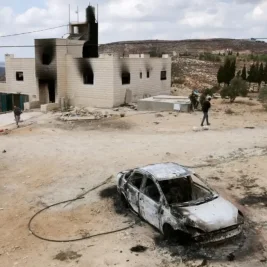
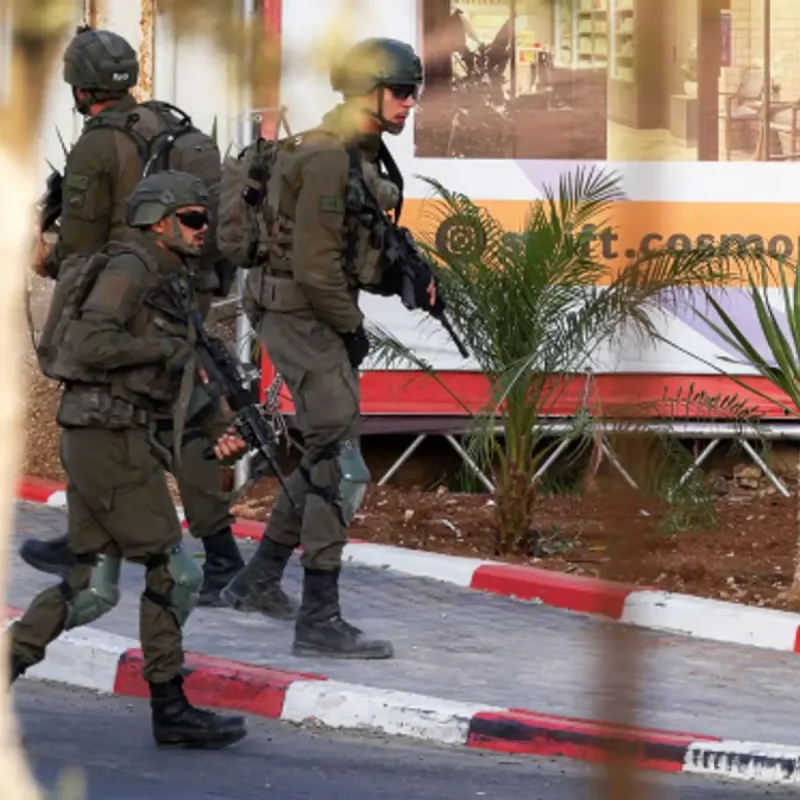
Israel ordered a security lockdown in Hebron and preparations for a wider closure of the occupied West Bank on Friday, October 23, 2026, after two Palestinian gunmen opened fire near the Yehuda Junction checkpoint, injuring five people.
Israel's military killed both attackers and launched additional searches as Prime Minister Benjamin Netanyahu vowed to pursue those responsible.
Israel's emergency medical service, Magen David Adom, said two of the injured were in critical condition, one was moderately injured, and two sustained minor injuries, according to reports from Israeli media.
The identities of the wounded, including whether they were soldiers or civilians, were not immediately clear in the initial reports.
The Israeli military said the attackers arrived in a vehicle carrying an M4 rifle or M16 rifle, according to differing accounts, and a handgun.
Authorities also reported finding a large quantity of ammunition, which Chief of Staff Lt. Gen.
Eyal Zamir said indicated preparations for an attack on a larger scale.
Netanyahu Orders Immediate Closure and Wider Lockdown
Netanyahu announced the restrictions after an emergency meeting with his Security Cabinet and senior military and security officials.
His office said the Israel Defense Forces would close Hebron and prepare a wider lockdown across the West Bank, although the precise start and duration of the territory-wide restrictions remained unclear in some reports.
Netanyahu said he had ordered the military and security services to close Hebron immediately and prepare a full lockdown of the West Bank, which his government also calls Judea and Samaria.
He added that extensive arrest operations would follow.
In a separate statement, Netanyahu pledged, "We will pursue Hamas terrorists and those who send them, wherever they are and at any time."
He also accused Hamas of planning a major attack intended to kill civilians, while Hamas praised the shooting but did not claim responsibility, according to CNN.
The military said its forces killed both gunmen and continued searches for anyone potentially connected to the attack.
Israeli authorities were also investigating whether the men operated independently or belonged to a larger network, given the quantity of ammunition found in their vehicle.
Zamir described the incident as a serious attack and said the soldiers' response had limited the damage.
"The soldiers' swift actions prevented an even more serious attack and further harm to civilians and security forces," Zamir said.
He added that the ammunition recovered from the vehicle was intended for an attack on a much larger scale.
According to accounts cited by Israeli media, the shooting continued for about 20 minutes, complicating efforts to evacuate the wounded.
Responders and nearby personnel used an armored ambulance for cover while medical teams treated casualties and transported injured people to hospitals.
The military also announced measures aimed at preventing further attacks, including searches and checks in areas around Hebron and other parts of the West Bank.
Israeli forces were expected to conduct additional arrests and intelligence operations, while authorities planned to map the attackers' homes for possible demolition, subject to legal procedures.
Political Fallout and Rising Tensions
The shooting occurred four days before Israel's October 27 election, a pivotal vote for Netanyahu, whose campaign has emphasized national security.
The incident prompted renewed calls from far-right members of his government for stronger action against the Palestinian Authority, which administers parts of the West Bank.
National Security Minister Itamar Ben-Gvir called for the Palestinian Authority to be dismantled.
Finance Minister Bezalel Smotrich also advocated a comprehensive military campaign to disarm Palestinian groups and eliminate what he described as terrorist infrastructure.
The incident unfolded amid heightened tensions during the Palestinian olive harvest, a period that has seen increased violence involving Israeli settlers and security forces.
The United Nations recorded at least 160 settler attacks linked to the harvest during the first two weeks of October, according to NBC News, with many incidents occurring under the protection of or with the participation of Israeli forces.
Al Jazeera reported that Israeli forces arrested 36 Palestinians during raids across the West Bank on Thursday, October 22.
The arrests included operations in the Jenin and Hebron governorates, as well as areas around Nablus and Jerusalem.
A Palestinian commission also documented 17 attacks by Israeli forces and settlers against farmers and their property that day, citing assaults, crop theft, damage to olive trees, threats and restrictions on access to agricultural land.
Former Israeli military chief Gadi Eisenkot, Netanyahu's main electoral rival, expressed support for the wounded and called for their recovery, according to CNN.
The competing security measures and political responses came as Israeli authorities continued searches following the Hebron shooting.