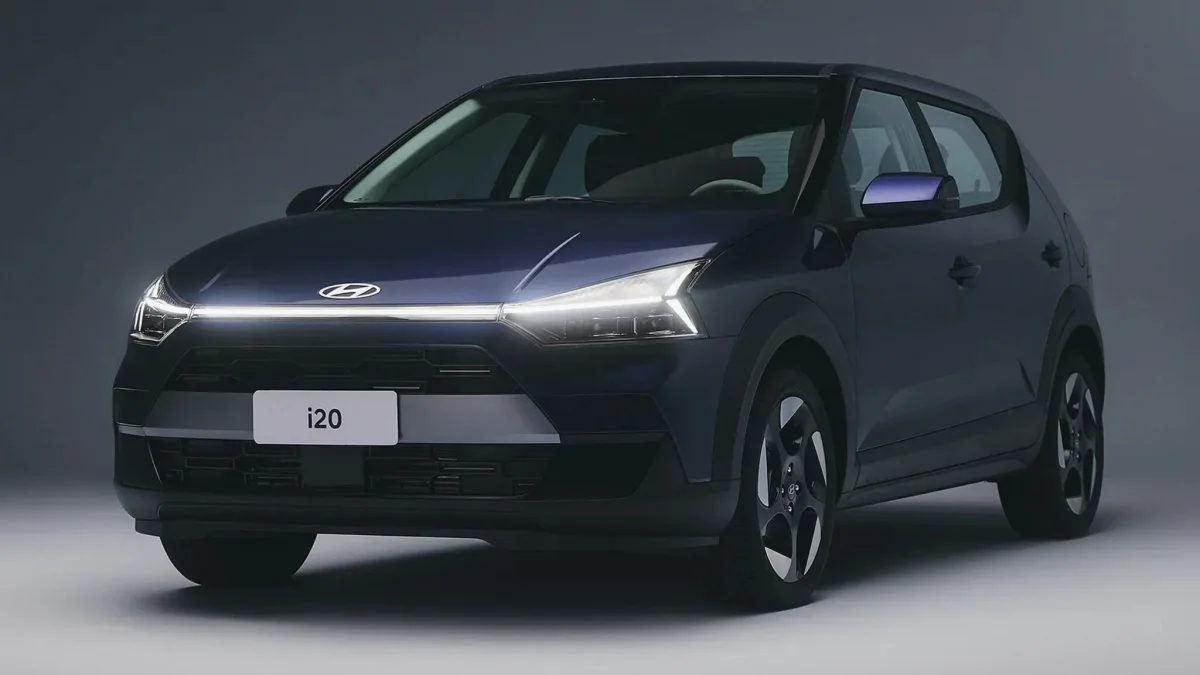
Hyundai has revealed the next-generation i20 in Brazil, transforming the subcompact hatchback into a crossover-inspired model.
The new i20 adopts a larger body and SUV styling cues, previewing elements that may appear on the global version.
The Brazilian-spec i20 features plastic cladding on bumpers and wheel arches, black pillars, and a straight roofline, giving it a baby SUV look similar to the Creta.
Other design highlights include a large grille, full-width LED lights with Lamborghini-style DRLs, sculpted side panels, and 17-inch diamond-cut alloy wheels.
Dimensions have grown: length reaches 4,130 mm (162.6 inches) and height 1,505 mm (59.3 inches), while the wheelbase remains 2,580 mm (101.6 inches) matching the outgoing European third-gen model.
Inside, the cabin features a free-standing digital cockpit with dual 12.3-inch displays.
Physical buttons and knobs sit below the touchscreen and on the steering wheel, with a separate climate control panel on the center console.
The Ultimate trim offers bi-tone synthetic leather upholstery.
Powertrain options skip electrification for the Brazilian market.
A naturally aspirated 1.0-liter three-cylinder engine produces up to 79 hp (59 kW), while a turbocharged version delivers 113 hp (85 kW).
Both run on gasoline and ethanol, paired with manual or automatic transmissions driving the front wheels.
Hyundai will build the new i20 at its Piracicaba plant alongside the HB20, HB20S, and Creta.
Pricing ranges from R$ 99,990 (US$ 19,800) for the base manual to R$ 139,990 (US$ 27,700) for the top turbo automatic.
Rivals include the VW Polo, Chevrolet Onix, Toyota Yaris, and Fiat Argo.
European Model Details
Europe currently sells the third-gen i20 launched in 2020 and updated in 2023, produced in Turkey.
A successor may arrive later this year or in 2027, but a Hyundai spokesperson told Dutch media Autoweek that the current model will continue in Europe for the near future.
The new global i20 is expected to share architecture and basic design with the Brazilian version, but European models will likely feature mild-hybrid powertrains, minor exterior and interior tweaks, and a unique suspension setup.
A sporty N Line trim and a full i20 N hot hatch with a more powerful self-charging hybrid are also anticipated.