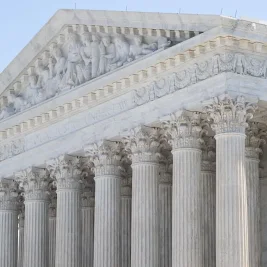
The United States Supreme Court overturned an executive order by President Donald Trump on Tuesday, ruling that children born on U.
S. soil to undocumented or temporary immigrant parents are automatically American citizens.
Chief Justice John Roberts delivered the 5-4 majority opinion, joined by Justices Sonia Sotomayor, Elena Kagan, Ketanji Brown Jackson, and Amy Coney Barrett.
Justice Brett Kavanaugh concurred with the judgment but dissented in part.
The conservative-majority court relied on the Citizenship Clause of the Fourteenth Amendment to reject the administration's restrictions, which lower courts had previously blocked from taking effect.
"Citizenship, then and now, was the right to have rights – to freely participate in our political community," wrote Chief Justice John Roberts.
The ruling emphasized that historical constitutional frameworks protect individuals born within the nation's borders.
"The Framers of the Fourteenth Amendment extended that promise to 'every free-born person in this land,'" Roberts noted.
President Donald Trump criticized the judicial rebuke via a public statement later that day, calling the decision "too bad for our Country."
Trump argued that the issue could be resolved via legislative channels rather than altering the core foundational text.
"No long and unwieldy Constitutional Amendment is necessary!" he declared.
Trump had previously criticized the practice as a financial drain on public resources, calling birthright citizenship a "scam" that "ripped off" taxpayers.
Justice Jackson's Strong Concurrence
In her concurring opinion, Justice Ketanji Brown Jackson strongly challenged the dissenting arguments regarding historical intent.
She accused Justice Clarence Thomas of echoing "one of Dred Scott's core tenets" in his opposition.
Jackson argued that the Fourteenth Amendment served as a broader protection against structural inequality. "Freed Blacks fought for the shared humanity of all people," she wrote.
She further critiqued the minority view as a regression toward outdated legal doctrines.
"Of course, the ultimate irony is that for all the talk about the detestable Dred Scott decision, the Government and [Thomas] propose a return to its core tenet," Jackson asserted.
She categorized the opposing interpretation of the post-Civil War amendments as overly restrictive, dismissing Thomas's perspective as "myopic."
Jackson detailed how the Citizenship Clause should not be interpreted purely as a specific fix for a single era.
"Despite his longstanding endorsement of a 'colorblind' Constitution, Justice Thomas now surprisingly suggests that the Citizenship Clause was a race-conscious remedial measure, relating only to 'freed slaves such as Dred Scott,'" she noted.
She rejected the argument that specific parental status disqualified children born within the territory, concluding that the Reconstruction period represented a foundational shift for civil rights.
"The Reconstruction Amendments were an anticaste, antisubordination reset for the Nation, not a mere spot treatment for the dark stain of slavery," Jackson asserted.
Dissenting Views and Broader Context
Justice Clarence Thomas countered the majority, writing a dissent focused on a narrower historical application of the Fourteenth Amendment.
He maintained that permanent residency and allegiance were prerequisites for birthright privileges.
"Both the Civil Rights Act and the Citizenship Clause guaranteed citizenship to persons born and domiciled in the United States regardless of their race.
Neither guaranteed citizenship to persons who were not domiciled in the United States," Thomas argued.
He drew a legal distinction between freed slaves and short-term foreign residents, stating that temporary visitors did not share the same domestic obligations.
While losing the birthright case, the Trump administration secured other major legal victories regarding border enforcement from separate 6-3 decisions written by Justice Samuel Alito.
"The three rulings from the Supreme Court this week are all victories for enforcing our nation's immigration laws," said Homeland Security Secretary Markwayne Mullin.
Legal experts observed that these rulings signaled strong judicial support for the administration's broader enforcement policies.
"I think that with these last decisions ruling in favor of the Trump administration on his immigration policies, it seems very clear that the court is going to give very wide and broad deference to the Trump administration's mass deportation agenda," said Nicole Hallett, University of Chicago law professor.
However, other legal scholars argued that the administration's loss on birthright citizenship eclipsed its policy victories. "It doesn't stack up against the other immigration cases.
It was not a close case," said Amanda Frost, University of Virginia law professor.
The official ruling explicitly affirmed the citizenship status of children born to temporary or undocumented inhabitants.
"Children born in the United States to parents unlawfully or temporarily present are 'subject to the jurisdiction' of the United States and are citizens at birth under the Fourteenth Amendment's Citizenship Clause," reads the Supreme Court ruling.