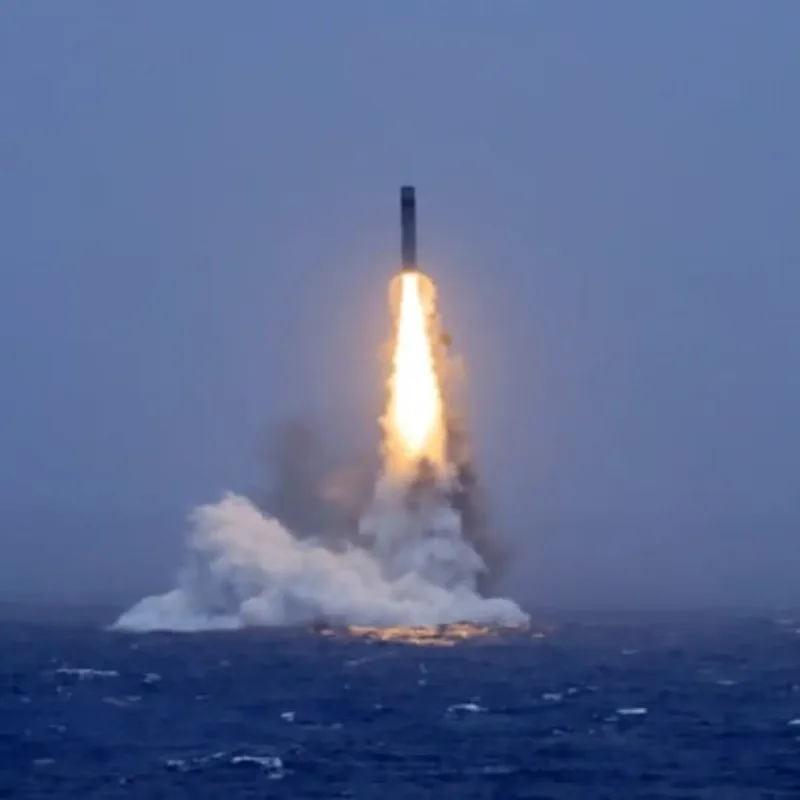
The United States, Australia, and New Zealand swiftly condemned China following its short-notice missile test in the Pacific on Monday, July 6, 2026, accusing Beijing of destabilizing the region, as reported by The Guardian.
The strategic weapon flew thousands of kilometers across the Pacific during what Beijing described as a routine military exercise, sparking widespread alarm among regional leaders and defense experts regarding China's rapid nuclear expansion.
Regional neighbors expressed frustration over receiving insufficient notification prior to the launch, while uncertainty remains over whether Washington was briefed beforehand.
"China is a good friend of Solomon Islands, but this is not something a friend does," said Matthew Wale, the prime minister of the Solomon Islands.
The test occurred just hours after Australia and Fiji signed the Ocean of Peace defense alliance, a pact designed to counter Beijing's growing geopolitical influence in the South Pacific.
Foreign nations have grown increasingly anxious over China's efforts to expand its military footprint and nuclear capabilities in the traditional spheres of Western influence.
"This very high-profile test is really lifting the curtain on a potential new era of massive nuclear submarine expansion," said Tong Zhao, a senior fellow at Carnegie Endowment for International Peace.
Zhao noted the high-profile demonstration was likely intended to force Washington to treat Beijing as an equal partner and "severely undermine" America's military security in the Asia Pacific.
The test marked China's second publicly acknowledged long-range missile launch into the Pacific Ocean in less than two years, following an intercontinental ballistic missile test in September 2024, "sending a pretty clear signal" to the US and Taiwan that it "means business."
Security analysts pointed out that the primary concern stems from the lack of transparency surrounding Beijing's rapidly expanding nuclear program.
"We, the US, have been putting pressure on China to agree to an arms control agreement, more transparency behind their nuclear program.
They're not giving that to us, so it's definitely going to ratchet up the tension," one analyst said.
A Chinese navy statement confirmed that a nuclear submarine deployed the weapon, which carried a training simulation warhead and landed accurately within its designated sea zone.
Chinese officials maintained that the military exercise adhered strictly to established international frameworks and was not aimed at any specific country, describing it as "a routine part of China's annual military training, in accordance with international law and practice, and is not directed against any specific country or target."
The Chinese foreign ministry asserted that the appropriate nations were informed prior to the operation, which was carried out safely and professionally.
"Relevant countries were notified in advance, and it complies with international law and practice. The launch activity was conducted safely, systematically, and professionally throughout."
While the Chinese defense ministry withheld specific details about the weapon, state media indicated the system was likely a JL-3 submarine-launched ballistic missile, which has a range exceeding 10,000 kilometers.
"The launch reflected Beijing's shift from maintaining a minimum nuclear deterrent to developing a more coercive nuclear posture capable of influencing other countries' strategic decisions," said Su, a Chinese analyst.
Taiwanese security officials published a map indicating the missile's trajectory traveled southeast of China, crossing over the Philippines, Micronesia, and Palau, before landing south of Nauru.
"These tests are usually organised months in advance and require a whole lot of things to fall into place," said David Capie, the director of the centre of strategic studies at Victoria University of Wellington.