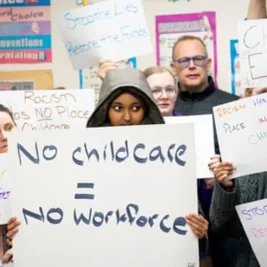
Early childhood educators and childcare advocates urged Indiana state regulators during a public hearing on Monday to reject a proposed rule that would eliminate the high school diploma requirement for licensed childcare center caregivers.
The sweeping regulatory overhaul proposed by the Family and Social Services Administration (FSSA) aims to lower entry barriers for employment in the state's childcare sector.
Under the draft standards, general caregivers would no longer need secondary education credentials, while lead caregivers would require at least a high school diploma or a GED.
Daily operations management would still necessitate specialized associate degrees or a Child Development Associate credential alongside practical experience.
Advocates Voice Strong Opposition
Advocates and consultants strongly opposed the changes, arguing that lowering qualifications threatens professional standards and child safety.
Independent early childhood consultant Cori Kerns expressed concern over the message the revision sends to the industry.
"Indiana’s workforce challenges will not be solved by lowering expectations," said Kerns.
Kerns noted that the rule implies anyone with casual babysitting experience could qualify for formal employment at licensed facilities.
"You’re saying, ‘here, she used to babysit in high school, she can be hired’… that’s what that is saying to our profession right now," said Kerns.
Kerns later extended an invitation to state leadership to experience classroom demands firsthand to reassess compensation and standards.
"I would invite Gov.
Braun into a classroom, and do what these people do every single day, and see what he thinks they should be paid, and see what educational requirements they should have," said Kerns.
Industry leaders emphasized that professional competence must remain a core requirement for early learning environments.
"Sensible regulations should require that early learning professionals demonstrate basic competency," said Erin Kissling, President & CEO of Early Learning Indiana.
Longtime provider Kelly Jones, founder of Love Your Child’s Care, expressed deep frustration regarding the proposed adjustments.
"Complete kick in the gut," said Jones.
Jones described the proposal in stark terms, warning that weaker safeguards could directly endanger vulnerable children.
"Just disgusting," said Jones.
She stressed that untrained staff might fail to identify or report critical signs of maltreatment.
"Potential fatalities — not having a qualified educator that is required to understand child abuse, neglect and detection," said Jones.
Jones insisted that financial savings for businesses should not come at the expense of safety.
"This isn’t a subject to be played around with—this is the lives of very young and very vulnerable people, and not a single child in the state of Indiana should have to suffer because somebody wants to save a buck," said Jones.
She added that the sector is already struggling with structural issues related to training and retention.
"Educators without appropriate training and education and high turnover already plague our field," said Jones.
Jones warned that the policy change would ultimately degrade the quality of care and suppress professional growth.
"Lower expectations for training and preparation will lead to stalled wages, less opportunities for credentials, and lower overall quality," said Jones.
Other directors raised alarms about classroom supervision and foundational learning, pointing out that untrained workers might compromise safety protocols.
"If they don’t have the proper training, they could possibly put a child at risk," said Jacqueline Strong, director of Little Duckling Early Learning.
Strong explained that the change could also hinder early language and literacy development among children under their care.
"If I’m not educated, and don’t know how to do that—this child is with me five days a week, eight hours a day—that child is not learning or progressing at the rate that they should," said Strong.
Furthermore, Strong argued that reducing educational benchmarks could inadvertently accelerate employee turnover.
"The idea is…you’re going to get higher turnover because now you have people that aren’t really vested in the programming itself," said Strong.
She explained that educational background fosters professional pride and a long-term commitment to the field.
"The education aspect really is more of: ‘How do I feel about myself as a professional? How much time am I going to invest in my profession?’
—those things lend [themselves] to people that stay on the job longer because they have personal investments in what they’re doing versus those that may not," said Strong.
Strong emphasized that the underlying issue driving staffing shortages stems from inadequate compensation rather than educational requirements.
"Wages themselves in early learning are a lot lower than they are in other professions," said Strong.
State Administrators Defend Proposal
State administrators defended the proposed reforms, asserting that the adjustments will cut unnecessary red tape and reduce childcare expenses for families.
"These reforms will increase affordable child care capacity statewide, making it easier for providers to serve families and for new businesses to enter the market.
This is a bold step toward making child care more attainable for Indiana families and ensuring our workforce can thrive," said Adam Alson, director of the FSSA’s Office of Early Childhood and Out-of-School Learning.
Indiana Governor Mike Braun also supported the policy shift, framing childcare access as a vital economic driver for the state.
"Child care is not just a family issue—it’s a business concern that impacts every corner of our economy.
Affordable, accessible childcare is essential for Hoosiers to go to work, improve their lives, and build stronger communities.
By reducing administrative burdens and unnecessary expenses, Indiana is empowering child care businesses to grow and innovate," said Gov.
Mike Braun.
FSSA officials have until October to modify the proposal before it proceeds.
If the final framework receives approval from Indiana Attorney General Todd Rokita, the regulations will go into effect in January 2027.