It has been a terrifying few weeks in South Africa.
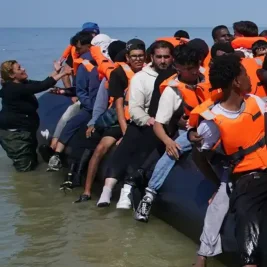
A campaign against African immigrants has resulted in at least four deaths and the mass fleeing of thousands.
Mobs and protesters have terrified African migrants, leaving thousands to sleep on pavements in fear of being attacked in their homes.
Many hope for repatriation to their home countries.
Governments from Malawi, Ghana, Nigeria, and Zimbabwe have begun arranging for tens of thousands of their citizens to return.
This is a distressing state of affairs for a country that many African migrants once saw as a place of hope and opportunity.
A New Kind of Xenophobia
While mass xenophobic violence has occurred in South Africa before, with riots dating back to 2008 and 703 people killed in xenophobic incidents since the end of apartheid, this current wave is different.
It is well funded, legitimized by mainstream media coverage, and has received engagement from the highest levels of government.
President Cyril Ramaphosa met and shook hands with protest leaders last week.
“This is a new moment,” says Mthonti, an analyst. The root of this crisis traces back to a fragile sense of belonging.
Black South Africans became citizens in 1994, but that citizenship has always felt precarious, particularly for poor, rural populations who have not seen the promises of a transformed post-apartheid life come to fruition.
“When there’s a particular global economic crisis – we see this across the world – there’s a turn to fascism, to conservative values, to scapegoating politics,” says Mthonti.
This turn becomes sharper given South Africa’s history and contemporary political failures.
The state has increasingly abdicated its role in providing economic security and services, leaving both poor South Africans and migrants to fend for themselves.
“It is why [this] xenophobia is more troubling,” says Mthonti. “The violence is more intimate.
These are people who are next door to one another, who are suddenly turning on each other, because now there are these conversations about ‘us v them’.”
There is a sad irony in this division.
South Africa's modern infrastructure and legendary wealth, including the Sandton area in north Johannesburg, were built on the backs of migrant labor drawn from across the continent for capitalist enterprises like mining.
“The reason we have Joburg is because of indentured labour,” says Mthonti.
The Long Shadow of Apartheid
As a recently post-colonial society, South Africa remains deeply marred by three distinct systems of historical violence: apartheid, colonialism, and slavery.
Because South Africa did not end apartheid until 1994, it missed out on the decades of racial self-esteem and post-colonial coherence that other African nations experienced in the 1960s.
“We are deeply marred by three systems of violence,” says Mthonti. “Not every country can say they have had apartheid, colonialism and slavery.
Inherently, that violence meets itself in different ways. The anti-Black racism that South Africans have had to deal with is quite profound.”
Historical amnesia has further complicated the nation's healing.
Following the transition to democracy, there was an attempt to fit into the global neoliberal order without resolving the deep-seated tribal and ethnic chauvinisms that existed before, which are now being repackaged into anti-migrant sentiment.
“In the 1960s, [when] African countries were cohering around post-coloniality, racial self-esteem was developing. South Africans were left out of that,” says Mthonti.
The consequences of this unresolved past are evident today as even ethnic minority populations who have lived in South Africa for centuries face modern backlash because they are not considered part of the national project.
“South Africa is a profoundly new nation that still needs to resolve a lot of these issues,” says Mthonti.
This exclusionary logic continues to manifest in targeted violence against marginalized groups across the country.
“What we are seeing is the same logic that was used to divide South Africans being repackaged around xenophobia,” says Mthonti.
This systematic exclusion serves a very specific, historical purpose in the region. “This is a function of apartheid,” says Mthonti.
The Illusion of Affluence
While this crisis has unique domestic roots, it aligns with a global trend of anti-migrant politics seen across various nations.
However, it is exacerbated by a profound psychological and material distance between South Africa and the rest of the continent, driven by the country's status as Africa's richest nation and the expansion of its Black middle class.
“Oh my gosh, a profound distance,” says Mthonti.
Yet, the reality on the ground contradicts the imagery of widespread prosperity.
The GDP growth rate hovers just over 1%, and the majority of the population lives materially insecure lives.
“GDP [growth rate] is just over 1%, and that devastation is real. People are living materially insecure lives.
There’s a huge chasm between the South Africa people imagine and the one people are experiencing,” says Mthonti.
Ultimately, responsibility for the current unrest lies not with an inherently reactionary working class, but with systemic political scapegoating and state failure.
“I want to stress that poor people are not inherently xenophobic. Poverty doesn’t equate to bigotry.
More South Africans are open to pan-African unity than are not,” says Mthonti.