A new satirical play in Hamburg transforms the story of a stranded humpback whale into a modern passion play, exploring how the animal became a vessel for public hopes and anxieties.
Titled Timmy: Hope Dies Last, the production premiered at Hamburg’s Ernst Deutsch theatre.
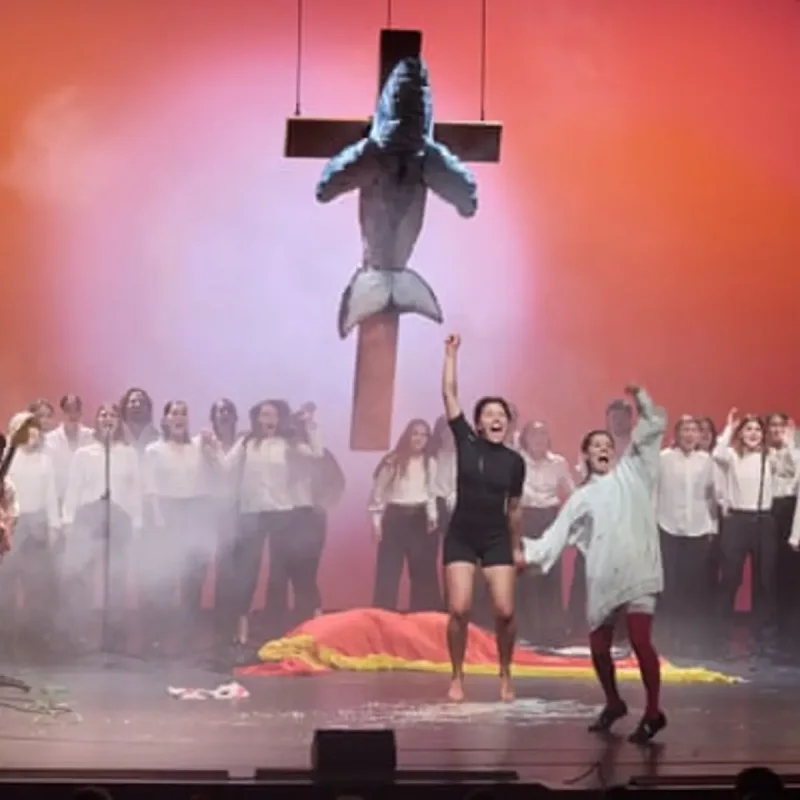
It reimagines the media frenzy around the whale as a quasi-religious spectacle where the creature is worshipped, crucified, and even consumed as sacramental blubber bites.
In one scene, actor Noah Tomiak, dressed in liturgical robes, stands behind an altar with a blow-up replica of the whale.
He recites: “In his immeasurable kindness he became a vehicle to us.” The line reflects how people projected their fears, guilt, and desires onto the animal.
The play has drawn criticism from Catholic theologians but earned praise from Der Spiegel, which noted that a secularized public increasingly seeks refuge in quasi-religious structures for hope.
The real humpback whale was first spotted in German waters in March and stranded at the Timmendorfer resort.
It was nicknamed Timmy, though the animal was female. An earlier nickname, Hope, better captured the emotional pull on the national consciousness.
Director Alexander Klessinger incorporates audio snippets from interviews with people who traveled to Timmendorfer to connect with the ailing mammal.
One woman says: “I felt like he was waiting for me, I can’t explain it but he wanted me.”
Over the one-hour show, adoration takes on a cultish fervor with songs and placards.
A recording features a woman who traveled to the Baltic Sea to help the whale with an Aboriginal chant to plug energetic holes.
The media reaction triggered a boom in whale and sealife-themed book sales, alongside sentimental and satirical songs.
At the premiere, rock band Tulpe performed their hit Sprengt den Wal! (“Blow up the whale!”
), with a chorus of “Let it rain whale salami and cutlets.”
An AI-generated song that went viral on social media mixes populist resentment against experts. The actors perform it as a rock number.
The lyrics include: “While he is still breathing, they are already talking of what happens afterwards / of tests and numbers / as if he was only an empty body without a heart.”
A risky attempt to transport the whale back to the open sea on a water-filled barge was privately funded by two millionaires and cleared by authorities, despite expert advice that the animal was unlikely to survive.
The play restages a press conference where biologists proposing to let the whale die in peace were criticized by hangers-on as wanting to “murder” the animal.
One woman called a death in the bay undignified.
The rescue effort seemed driven by populist resentment against elites, reflecting political fractures in Germany.
In the play, an actor in a wetsuit rails against officials and calls for ordinary people to wake up while a large German flag is raised.
On May 14, nearly two weeks after the release, the whale was found dead near the island of Anholt in the Kattegat.
The fallout over the estimated €2 million rescue mission continues.