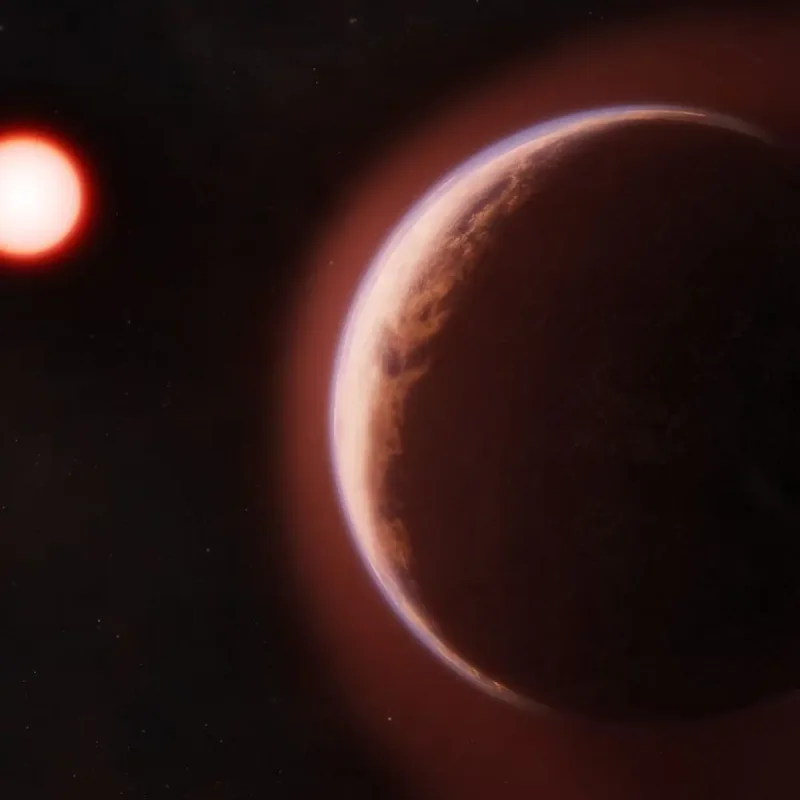
Astronomers have found evidence of an atmosphere on LHS 1140 b, a rocky exoplanet located 49 light-years from Earth within its star's habitable zone.
The discovery, published in the journal Science, marks the first time an atmosphere has been detected on a rocky world where liquid water could exist.
Researchers identified the atmosphere by observing helium escaping from the planet using the Magellan Clay telescope at the Las Campanas Observatory in Chile.
The exoplanet is about six times the mass of Earth but only 1.7 times larger, orbiting a red dwarf star at a distance that allows for Earth-like temperatures.
Because the exoplanet is estimated to be five billion years old, its continuous helium emissions indicate an existing atmosphere is actively slowing the leak of gas into space.
Atmospheric protection is considered essential for shielding a planet from cosmic radiation and maintaining stable surface temperatures required for liquid water.
“An atmosphere is essential for a planet to support life as we know it,” said Dr. Collin Cherubim of Harvard University, the lead author of the new research.
“This is the first time anyone has found an atmosphere on a rocky planet in the habitable zone of another star.”
Robin Wordsworth, professor of environmental science and engineering and professor of Earth and planetary sciences at Harvard, highlighted the progression of astronomical discoveries.
“Twenty years ago, we wondered whether other terrestrial-type planets even existed. Then we learned they’re common, and found some in the habitable zone.
The next question was whether any of them had managed to keep an atmosphere. Now we know at least one has.”
Independent Experts Weigh In
Dr. Jo Barstow, an expert in exoplanet atmospheres from the Open University, called the discovery a milestone.
“This discovery of escaping helium on a rocky world is a really important milestone,” she said.
However, she cautioned that high-energy radiation driving the helium escape might make surface conditions inhospitable.
“It doesn’t mean that it is necessarily habitable, and the same X-ray and ultraviolet radiation driving the helium escape may make conditions on the surface inhospitable.”
Dr. Barstow outlined the next steps: “What it does tell us is that rocky planets in close orbits around red dwarf stars can retain an atmosphere.
The next step in evaluating the habitability of LHS 1140 b is to learn what its atmosphere is made of, and for that we need more observations.”
Researchers have selected the exoplanet, originally discovered in 2017, for further study under the Rocky Worlds program using the James Webb Space Telescope and the Hubble Space Telescope.
Dr. Jason Dittmann, assistant professor of astronomy at the University of Florida, posed the key question: “Because there’s helium there, and because the helium is escaping, the question is: is it a bare rock with no atmosphere that sometimes burps up some gas that then immediately escapes, or is there a steady-state atmosphere there that will leak out stuff like the Earth does from time to time?”
Dr. Dittmann noted that future space telescope data will provide clarity within five years.
“JWST data over the next four to five years will look for water, and if there’s water in the atmosphere, then it’s probably a stable atmosphere that will persist.”