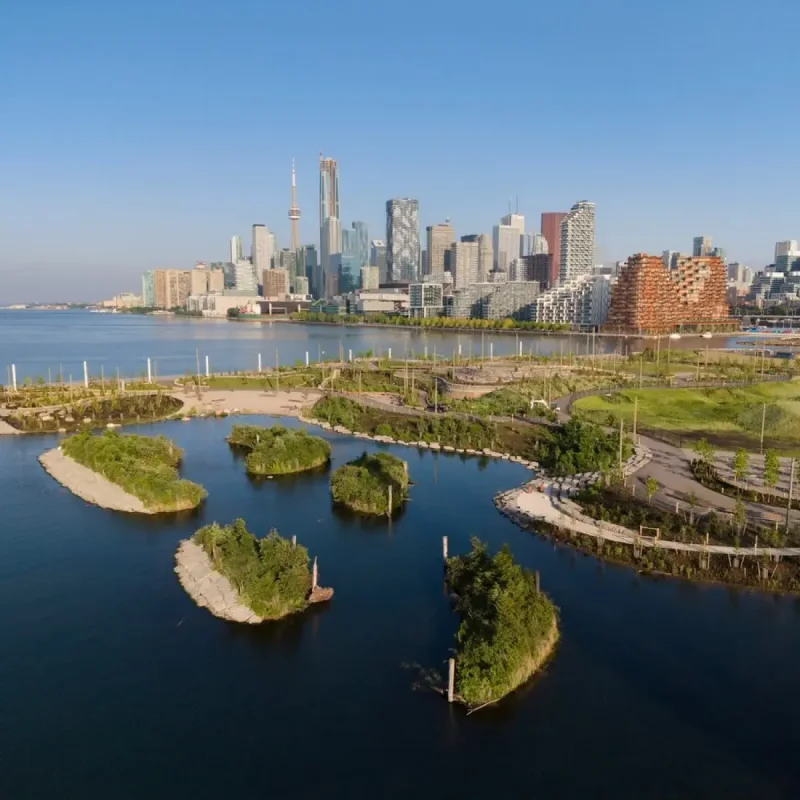
Toronto officials officially opened a 10-acre waterfront expansion of Biidaasige Park in the Port Lands area on July 25, 2026.
The new four-hectare space includes a public promenade, an event lawn, and a canoe launch along Lake Ontario.
The expansion is the latest phase of a $1.4 billion tri-government initiative managed by Waterfront Toronto.
The overarching project has revitalized polluted industrial land, naturalized the Don River mouth, and established flood protection for nearby neighborhoods.
The newly opened western section features Canoe Cove for watercraft access, a lookout promontory built from excavated earth, and a preserved 40-meter-tall industrial crane.
A sloping lawn facing the downtown skyline can accommodate up to 3,000 people for public events.
Public art installations line the site as part of the Lassonde Art Trail, including works by Alexa Kumiko Hatanaka, Hank Willis Thomas, and Ryan Gander.
Steel columns along the promenade mark the former footprint of Marine Terminal 35.
Transformation from Contaminated Port Lands
City leaders and community partners gathered ahead of the opening to highlight the site's transformation from heavily contaminated port lands into an accessible natural space.
"40 years ago this land was industrial, fenced off, forgotten, polluted," said Olivia Chow, Mayor of Toronto.
Chow noted that community advocacy drove the revitalization efforts and pointed to future development phases on the adjacent Ookwemin Minising island, which will feature 14,000 new housing units alongside light rail transit access.
Indigenous representatives who collaborated on the park design since 2019 emphasized the cultural significance of the restored land.
"This park represents more than a new public space, it represents an opportunity to … reconnect people with the land, the water and the stories that have existed here for many, many generations," said Margaret Sault, Chief of the Mississaugas of the Credit First Nation.
Federal representatives highlighted the intergovernmental funding and environmental rehabilitation that enabled the new riverbed and shoreline design.
"It was unbelievable what we accomplished.
The land we are on today was contaminated land when we were standing in these spaces only 10 years ago," said Julie Dabrusin, Federal Minister of Environment.
Urban planners noted that the project demonstrates the impact of long-term design competitions and sustained agency leadership in municipal planning.
"There are many kinds of time on this site," said Chloe Catan, Executive Director of the Lassonde Art Trail.
"Ecological, geological, and human. This place is layered with histories."
"We should be driven by processes that, first and foremost, try to get the best possible design," said Jason Thorne, Toronto Chief Planner.
"This is a good example of what can happen."
Waterfront Toronto officials stated that the agency maintains its focus on landscape-driven infrastructure despite potential future challenges, such as proposed airport expansions nearby.
Additional amenities, including equipment rentals at Canoe Cove, are scheduled to launch next year.