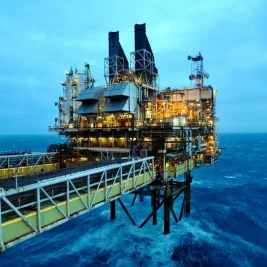
Prime Minister Andy Burnham is under mounting pressure from both climate scientists and energy industry leaders as public consultations continue over the approval of the Rosebank and Jackdaw oil and gas fields in the North Sea.
A group of leading climate academics, led by Professor Kevin Anderson from the University of Manchester, sent an open letter urging the prime minister to reject the proposed projects.
The scientists warned that authorizing the developments would undermine international climate commitments.
“They represent a profound departure from the principles you promoted as Mayor of Greater Manchester,” the letter stated.
The academics highlighted that global greenhouse gas emissions must fall by nearly 8% annually to meet climate targets, while global temperatures continue to rise.
“The scientific evidence has only strengthened since those earlier commitments were made,” said Anderson and his colleagues.
The scientists emphasized that expanding fossil fuel developments cannot be reconciled with existing climate commitments, especially as severe weather events become more frequent.
“Against that backdrop, approving the further development of oil and gas fields cannot be reconciled with the UK’s repeated commitment to honour its international climate obligations,” they stated.
They urged the prime minister to demonstrate political leadership by adhering to scientific evidence rather than short-term political pressures.
“It would suggest that, on climate change, the UK is prepared to step back from obligations it has repeatedly urged other nations to uphold,” the letter said.
The letter concluded with a reminder of how future generations will judge current environmental leadership.
“Future generations will not judge governments by the ingenuity with which they justified expanding fossil fuel production,” the scientists wrote.
“They will judge whether, when faced with unequivocal scientific evidence and clear international commitments, they had the courage and compassion to act in a manner consistent with the obligations they had freely entered into.”
Industry Calls for Approval to Secure Energy Supplies
On the other side, trade body Offshore Energies UK submitted responses to the public consultations on July 28, 2026, advocating for accelerated regulatory approval of the two field developments.
The organization argues that the projects are vital for safeguarding domestic energy supplies and economic output.
According to Offshore Energies UK, the £8.7 billion Rosebank project near Shetland and the £2.1 billion Jackdaw project east of Aberdeen will support over 3,500 peak construction jobs and contribute £28.7 billion in Gross Value Added over their lifespans.
“Permission for these two projects would help clear the log jam preventing development of other projects in the North Sea,” said David Whitehouse, chief executive of Offshore Energies UK.
Whitehouse noted that UK domestic natural gas production currently meets 39% of national demand and that new domestic production remains vital alongside renewable growth.
“These projects are coming at a time when domestic gas production is declining and import dependence is growing, even as we increase production of energy from wind and other renewables,” he said.
He emphasized that gas demand forecasts show stable consumption patterns over the next decade.
“UK production meets only 39% of UK gas demand according to latest figures, and without new investment, the UK’s reliance on imported gas will continue to increase,” Whitehouse stated.
The chief executive added that domestic natural gas production retains strategic importance for meeting energy demand.
“This matters because UK gas demand is expected to remain broadly unchanged over the next decade, according to forecasts from the National Energy System Operator (NESO),” he said.
Whitehouse also called for broader regulatory reforms to stimulate overall sector investment across the UK offshore energy industry.
“A positive decision on Rosebank and Jackdaw will play a part in restoring investor confidence, demonstrating that the revised regulatory regime is functioning effectively.
We need a regulatory framework that enables projects to move forward,” he said.
He concluded by urging the implementation of tax mechanisms designed to manage windfall periods.
“However, to unlock the wider pipeline of 111 offshore energy projects needed to support domestic production, jobs, tax revenues and economic growth, the accelerated implementation of the Oil and Gas Revenue Levy (OGRL) is required – a permanent windfall tax which is triggered during periods of high prices and is essential to boost investment in the North Sea,” Whitehouse said.
Public consultations for the Jackdaw field run until August 10, 2026, while the consultation period for the Rosebank development concludes on August 17, 2026.