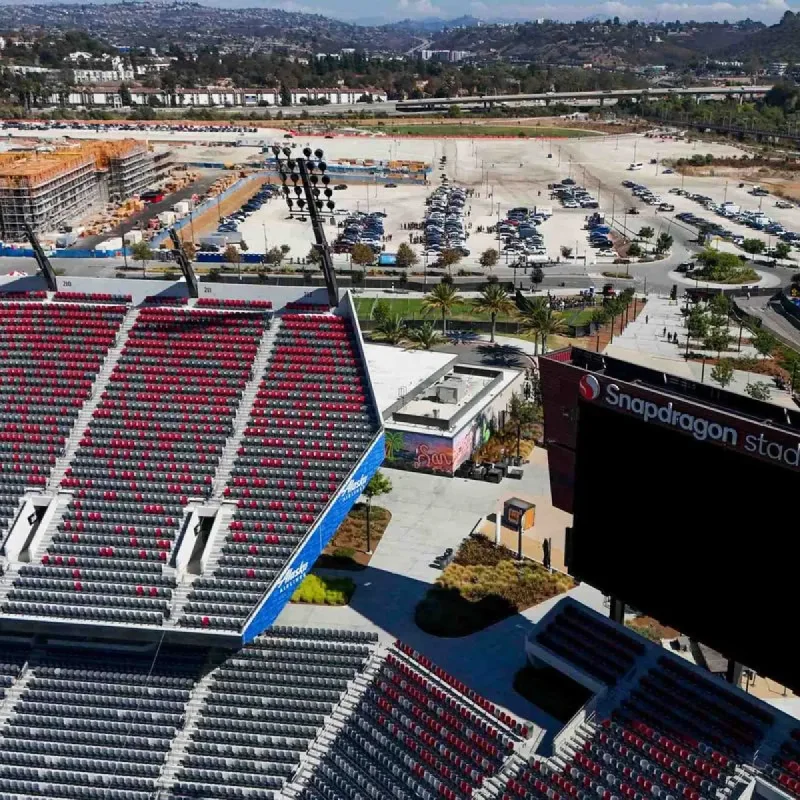
San Diego is reshaping the former Qualcomm Stadium property into a mixed-use district nearly a decade after the Chargers moved to Los Angeles.
San Diego State University is leading the redevelopment of the 135-acre site in Mission Valley, which the city already owned before the NFL team left in 2017.
The plan combines public green space, sports venues, housing and transportation infrastructure, according to The San Diego Union-Tribune.
It includes a 34-acre public river park, Snapdragon Stadium, planned residential communities and new road connections.
River Park Reconnects Residents to Waterway
The transformation reconnects residents with the San Diego River, a 52-mile waterway whose surroundings were previously separated from much of the public by parking lots and fencing.
The former stadium landscape allowed polluted runoff to reach the river, while thousands of vehicles occupied the site during sporting events.
Rob Hutsel, co-founder, president and CEO of the San Diego River Park Foundation, described the site's former condition and limited public access.
"There was a fence and then there was some green thing behind it," Hutsel said.
He recalled that people sometimes crossed the river after parking on the opposite side to avoid parking fees, before a fence restricted access.
The redevelopment has since created trails, playing fields, native vegetation, playgrounds and landscaped basins designed to filter stormwater.
Hutsel described the new green space as a major improvement for the river.
"It is wonderful to see … dozens of acres of green space where there once was a sea of cars," Hutsel said.
He also characterized the ecological changes as significant for the waterway.
"a game changer for the river," Hutsel said.
Voters selected the university-led development plan in 2018 after a contentious ballot campaign.
Measure E, the SoccerCity proposal, was rejected by 67.4% of voters, while Measure G, known as SDSU West, received 54.5% support.
SDSU purchased the property at fair market value in 2020, and Snapdragon Stadium opened in 2022 with 35,000 seats.
Gina Jacobs, SDSU's associate vice president for Mission Valley Development, said the university initially explored ways to help keep the Chargers in San Diego before pursuing the property after the team's departure.
"I think we were in the 'How can we help you stay?' camp," Jacobs said.
The stadium was designed to accommodate more than college football.
It now hosts San Diego Wave FC, San Diego FC, rugby matches, concerts and festivals.
The river park opened in late 2023, ahead of the deadline established for the stadium project.
Jacobs said the venue was intended to serve several sports and community activities.
"We talked about it, not just as a football facility, but as something that was going to support soccer as well," Jacobs said.
SDSU estimated that the park received more than 400,000 visits in 2025, using cellphone-location data.
Visitors included event attendees as well as people using the trails, playgrounds and athletic fields.
An existing Metropolitan Transit System trolley stop also provides access without a car.
Jacobs said attendance at the park had surpassed expectations, even before residents and businesses began occupying the surrounding development.
"It has exceeded my expectations in terms of usage," Jacobs said.
The university plans up to 4,600 homes across the site, with at least 10% designated as affordable housing.
The first affordable project, Addison, comprises 126 units and is being developed by SDSU and Chelsea Investment Corp.
Twenty units are reserved for people with intellectual or developmental disabilities, and the development will remain income-restricted for 55 years.
Construction on Addison began in May 2026.
Avalon Mission Valley, which broke ground in August 2025, will add 621 apartments and approximately 30,000 square feet of retail space, including a planned grocery store.
Both projects are expected to receive their first residents in early 2028.
Other infrastructure work is progressing alongside housing.
Construction began in September 2026 on the Fenton Parkway Bridge, a crossing intended for motorists, pedestrians and cyclists, with completion scheduled for fall 2027.
Jacaranda Street reopened in July 2026.
Jacobs said the university intends to keep advancing projects while addressing development challenges.
"The transformation is taking place," Jacobs said.
Rising construction costs and financing difficulties have delayed some projects and required design changes, according to Jacobs.
The development plan also includes another affordable housing phase and a proposed senior community.
Businesses Adjust to Life After the Chargers
The Chargers' departure has had a different effect on the wider economy.
A separate San Diego Union-Tribune analysis found that regional economic indicators continued to grow after the 2017 relocation, although businesses that relied on football crowds experienced more immediate losses.
From 2016 through 2019, San Diego County's inflation-adjusted gross domestic product increased 8.6%, compared with 10.3% in the Los Angeles metropolitan area, according to the Bureau of Economic Analysis.
San Diego metropolitan employment grew 5.7%, exceeding Los Angeles' 4.2%, while taxable transactions rose 10.3% in San Diego County and 11.4% in Los Angeles, according to the California Department of Tax and Fee Administration.
San Diego's leisure and hospitality employment grew 11.4% during the same period, compared with 6.7% in Los Angeles.
Tourism Authority figures also showed visitor spending in San Diego rising from approximately $10.4 billion in 2016 to $11.6 billion in 2019.
Andrew Zimbalist, professor emeritus at Smith College, said broader research has generally found little evidence that professional football teams substantially increase metropolitan economic growth.
"The general finding of economists who have looked at this is that adding an NFL team to your city doesn't have a positive economic impact," Zimbalist said.
He explained that losing a team does not necessarily eliminate the money residents spend locally, because customers can redirect spending toward other entertainment and businesses.
"And therefore, if you lose an NFL team, it won't have a negative impact," Zimbalist said.
A 2023 survey covering more than 130 studies over three decades similarly found limited metropolitan economic effects from professional sports teams and stadiums.
Economists describe the redistribution of spending between activities and locations as the substitution effect.
Zimbalist explained how that process affects local spending.
"The substitution effect means that the activity is displaced," Zimbalist said.
He added that spending can move between different parts of the same city rather than disappear from the local economy.
"It's displaced from one area of the city to another," Zimbalist said.
Individual businesses nevertheless experienced losses after the Chargers moved.
The newspaper reported that downtown's Barleymash lost $1 million in revenue in 2017, Sports Fever recorded a $250,000 decline, and the Handlery Hotel in Mission Valley estimated that losing NFL games cost it between $50,000 and $75,000 that year.
Restaurants also had to replace the customer surges that accompanied home games.
Shawn Walchef, owner of Cali BBQ in Spring Valley, recalled that sales rose 30% to 40% when the Chargers played.
At McGregor's Bar & Grill near the former stadium, owner Ian Linekin said the business could not depend on a handful of football games alone.
"Anybody that bases their business off of eight games a year shouldn't be in business," Linekin said.
McGregor's opened in 1996, when the Padres and Chargers both played near Qualcomm Stadium.
After the Padres moved downtown following the 2003 season, the bar adjusted to losing 81 baseball dates and built a broader neighborhood customer base.
The Chargers' departure reduced its game-day windfall, but the business retained regular customers and 30 televisions.
Linekin acknowledged that the former football crowds have not been fully replaced.
"I wouldn't say it's on par," Linekin said.