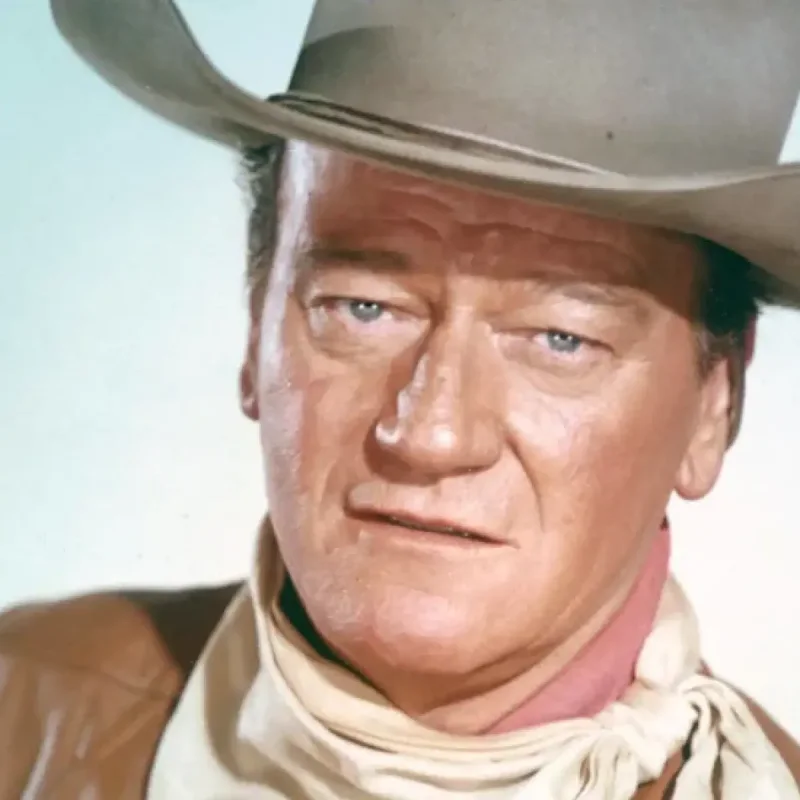
John Wayne's place in American Western cinema rests on two contrasting chapters.
One is a comedy he refused to join, and the other is an early Western that initially failed but later received preservation recognition.
According to Yahoo's October 9, 2026, report, Mel Brooks approached Wayne about playing the Waco Kid in the 1974 film Blazing Saddles.
At a 50th-anniversary screening, Brooks explained he wanted an established Western performer to bring authenticity to the role.
"I wanted authenticity.
I wanted the Waco Kid to actually have been a Western movie actor, so that he would lend a kind of authentic character to the movie," Brooks said.
Brooks recalled how he pitched the project to Wayne and why he thought the actor might accept.
"Mr. Wayne. I made a movie called Blazing Saddles.
It's a comedy, but it has a lot of heart. There's a great part in it that I wish you would play," Brooks recalled telling Wayne.
Wayne responded positively to Brooks' earlier comedy, The Producers, and agreed to read the screenplay before deciding against the role.
"OK. You know what?
I know you. I saw The Producers and I laughed my head off.
You are a very funny guy. I'd love to read it," Wayne replied, according to Brooks' recollection.
Brooks later remembered Wayne's explanation for declining the part.
"I met him, he said, 'I laughed my ass off, but I couldn't make it. It's too dirty,'" Brooks recalled.
Gene Wilder ultimately played the Waco Kid alongside Cleavon Little, Slim Pickens, and David Huddleston.
Gig Young had initially been selected for the role but was replaced after collapsing on set.
Set in 1874 on the American frontier, Blazing Saddles became a major commercial success, earning more than $120 million and receiving three Academy Award nominations, according to Yahoo.
In June 2026, the American Film Institute moved Blazing Saddles to the top position on its 100 Years...
100 Laughs list.
Brooks had previously expressed his view of the film's standing in a 2014 interview with Entertainment Weekly.
"I think the AFI number one all-time comedy is Some Like It Hot, which I like. I thought it was really terrific.
But it's certainly not half as funny as Blazing Saddles. I mean, it can't compare," Brooks said.
The Big Trail and Its Widescreen Gamble
Wayne's earlier career also included The Big Trail, directed by Raoul Walsh and released in October 1930.
Wayne played Breck Coleman, a scout guiding a wagon train west while pursuing revenge.
The production used both standard 35mm film and the experimental 70mm Grandeur widescreen format, according to Turner Classic Movies.
The widescreen presentation proved difficult to exhibit because few theaters had compatible equipment.
Turner Classic Movies reported that only two theaters in the United States could screen the Grandeur version when the film was released.
Theater owners were also reluctant to finance another technical conversion during the Great Depression, and the standard release failed to recover the production's investment.
The Library of Congress selected The Big Trail for the National Film Registry in 2006, recognizing its historical significance and visual scale.
The Library of Congress highlighted the film's cinematographic achievement.
"The majestic sweep provided by the experimental Grandeur wide-screen process used in filming," the Library of Congress stated.
Film historian Marilyn Ann Moss also assessed the film's significance in an essay hosted by the Library of Congress.
"A simple story of adventure and romance that grows into a large historical cinematic document," Moss wrote.
The Museum of Modern Art later restored the widescreen version. Curator Charles Silver described the limitations of the technology used for the production.
"A process that proved commercially untenable in an industry that was still in the midst of conversion to sound," Silver said.
According to Turner Classic Movies, the film's commercial failure sent Wayne back to lower-budget productions before Stagecoach established him as a major Western star in 1939.
Walsh later reflected on the actor's ability to inhabit his roles in his autobiography, as quoted by John Wayne Enterprises.
"His acting was instinctive, so that he became whatever or whoever he was playing," Walsh wrote.
Walsh also summarized his assessment of Wayne's potential.
"I discovered a winner," Walsh wrote.
Wayne went on to receive three Academy Award nominations and won the Oscar for Best Actor in 1969 for playing Rooster Cogburn in True Grit.
He died of stomach cancer at age 72, a few months after attending the 51st Academy Awards ceremony.