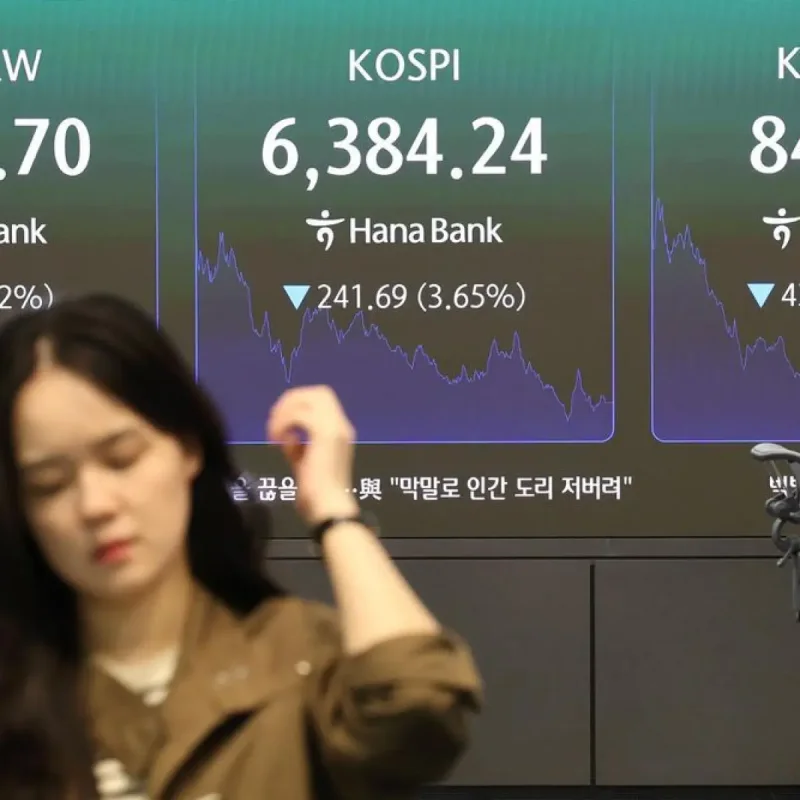
South Korea's benchmark KOSPI plunged 7.4% to 5,914.35 on Tuesday, Oct. 13, 2026, as semiconductor shares tumbled and foreign investors intensified selling.
The decline followed a rally driven by artificial intelligence demand and spread across major Asian markets as investors reassessed technology shares and broader economic risks.
According to market data reported by The Associated Press, the KOSPI reached its lowest level since late July after climbing above 9,000 to an all-time high in June.
Samsung Electronics shares fell 7.7%, while SK Hynix plunged 8.8%, reflecting concerns that advances by China's memory chipmaker CXMT could intensify competition for established manufacturers.
Regional Markets Slide as Tech Shares Retreat
The broader regional downturn extended to Japan, where the Nikkei 225 dropped 2.5% to 67,292.39.
Tokyo Electron fell 6.6%, and SoftBank Group, an investor in OpenAI, lost 8%.
Hong Kong's Hang Seng declined 1% to 24,033.51, while the Shanghai Composite slipped 1.1% to 3,754.82.
Australia's S&P/ASX 200 edged down 0.2% to 8,767.40, and Taiwan's Taiex fell 1.9%, with Taiwan Semiconductor Manufacturing Co. losing 1.6%.
A separate analysis published by iM Securities economist Park Sang-hyun on Tuesday identified currency movements and deteriorating market conditions as additional sources of pressure on South Korean equities.
The analysis said the KOSPI had fallen 24.7% from the end of June, while the Nasdaq had gained 3.9% over the same period.
Japan's market declined 1.4%, and Taiwan's rose 6.8%.
Park's analysis attributed the weakness to profit-taking after an earlier rally, outflows of retail investment following leveraged single-stock exchange-traded fund activity, and renewed foreign selling that accelerated from September.
Foreign investors had shown signs of easing their sales in July and August before selling pressure increased again.
The South Korean won's movement has added another complication.
According to iM Securities, the currency weakened 7.6% in the first half of the year before appreciating 13.8% in the second half through Oct.
12.
By comparison, the dollar gained 1.4% and the yen strengthened 2.4%, while the Taiwan dollar weakened 0.2% over the same period.
Park said the stronger won could give overseas investors an additional incentive to realize currency gains while selling shares during a market correction.
"In a stock market correction phase, currency gains from the won's strength are strengthening foreign investors' inclination to sell," Park said.
However, Park cautioned that exchange rates alone could not explain the scale of foreign outflows.
The historical relationship between a stronger won, foreign capital inflows and rising South Korean share prices has weakened, making currency volatility a key concern alongside semiconductor demand.
Park said a recovery in the global semiconductor cycle and more stable currency movements would be necessary to improve the KOSPI's performance relative to other markets.
"The global semiconductor cycle needs to regain momentum for the KOSPI's divergence to narrow," Park said, adding that easing concerns over oil prices and Treasury yields was also necessary.
He said reduced currency volatility and fewer external risks could eventually ease foreign selling, although a recovery might take time.
"If won volatility subsides and external uncertainties ease, foreign investors' aggressive net selling of South Korean stocks should lose steam," Park said, while cautioning that "this is a phase that will require more time."
Outside Asia, US stock indexes ended Monday mixed.
The S&P 500 slipped 0.1%, the Dow Jones Industrial Average gained 0.4%, and the Nasdaq Composite declined 0.4%.
Semiconductor shares also weakened, with Nvidia down 1.3%, Advanced Micro Devices falling 2.3%, Micron Technology losing 3.9%, and Broadcom declining 1.9%.
Investors were also monitoring upcoming earnings reports from major US companies, including Citigroup, JPMorgan Chase and Wells Fargo.
Meanwhile, Brent crude fell 1.4% to $105.20 a barrel, and US benchmark crude dropped 1.5% to $92.34, as markets weighed developments in the Middle East and risks to oil shipments through the Persian Gulf.