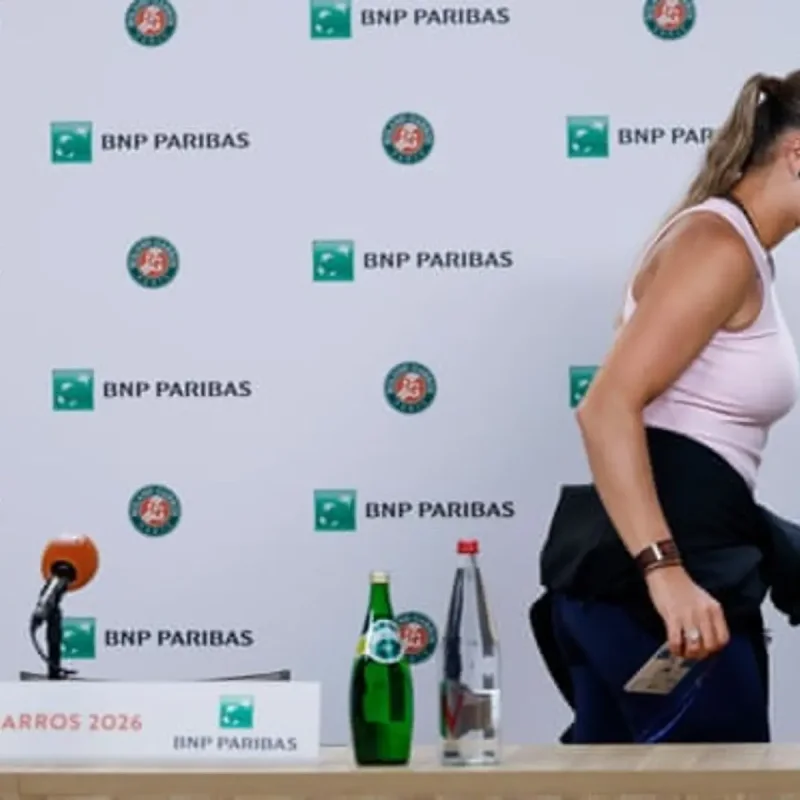
Top-ranked tennis players staged a coordinated protest during media day at Roland Garros by limiting their interviews to the mandatory minimum requirements, as reported by The Guardian.
The athletes restricted their media appearances to 15 minutes, dividing the time between a 10-minute press conference and a five-minute host broadcast interview.
This symbolises the estimated 15 percent average revenue that grand slams allocate to prize money.
The protest follows a year-long dispute stemming from a signed letter in which players requested larger revenue shares, better welfare initiatives like pensions, and the creation of a grand slam player council.
World No. 1 Aryna Sabalenka advanced the protest alongside top-10 players including Jannik Sinner, Iga Swiatek, Coco Gauff, Jessica Pegula, Mirra Andreeva, Felix Auger-Aliassime, Ben Shelton, Daniil Medvedev, and Taylor Fritz.
"I feel like the whole point here, it's not about me," said Sabalenka. She emphasised that her leadership aims to establish fair conditions for the broader tennis community.
"As the world No 1, I feel like I have to stand up and to fight for those players, for lower-level players, for players who are coming back after injuries, the upcoming generation.
I feel like our point is pretty clear and pretty fair to everyone. That's what we are all about."
The Belarusian athlete managed the conclusion of her own media appearance once the restricted timeframe elapsed.
"And now it's time for national language, and thank you so much for being here, for asking questions," said Sabalenka.
She expressed appreciation for the media while maintaining the protest boundaries.
"As I said a thousand times today, I have huge respect [for you], but we know what's happening here, so thank you so much."
Other participants handled the time restriction strictly. American player Coco Gauff used a digital timer on her phone during the questions.
"I have about, like, one minute left," said Gauff. She confirmed her strict adherence to the player strategy when asked about the device.
"Yes, I've got to be strict," said Gauff.
Men's world No. 12 Andrey Rublev, who serves on the ATP player advisory council, noted that the core issues extend beyond financial compensation to communication breakdowns with grand slam organisers.
"It's not only about the money and stuff like that. There are many aspects.
They don't hear you. They don't answer," said Rublev.
Rublev cited specific communication delays to illustrate the difficulties players face when attempting to reach out officially.
"Just to give you an example: when you send the mail, no one responds to official mail for months.
It's like, 'Come on, guys.' We are together, or you completely don't care that much that you cannot even communicate," said Rublev.
Despite the strict guidelines, some press conferences ran slightly over schedule, including that of Daniil Medvedev, who answered two extra questions from a journalist.
"It's good, because probably the first time, at least in my span on the tour, where players are kind of really united," said Medvedev.
The most prominent absence from the protest was Novak Djokovic, who opted out of the action despite his extensive history with player advocacy bodies like the PTPA.
"Let's try to be a bit more united and have a unifying voice into finding better structure and a better future for our sport, because now is the right time," said Djokovic, a 24-time Grand Slam winner.
Djokovic, who turned 39 on Friday, affirmed his ongoing alignment with player interests and suggested tennis learn from the structural challenges recently observed in professional golf.