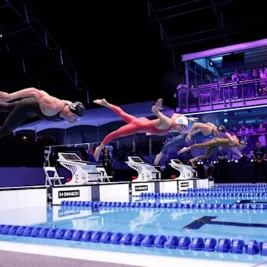
Former Team GB swimmer Ben Proud has defended his decision to compete in the Enhanced Games, rejecting claims that his participation encourages young athletes to use performance-enhancing drugs.
The 31-year-old athlete receives a mid six-figure salary for the controversial event and could earn an additional $1.25 million if he breaks the 50m freestyle world record on Sunday night.
The World Anti-Doping Agency (WADA) has condemned the event, arguing it may entice more individuals to dope. Proud addressed this directly during a pre-event press conference.
“There is a blurry line. I can’t argue against it.
But to me, if you understand the stories of the people who are here, you’ll understand that we’ve done our career clean and we’re doing this for a very good reason.
And more importantly, under the safest environment possible,” he said.
The event has faced widespread condemnation from international athletic bodies and anti-doping organizations, but the Paris 2024 50m freestyle silver medallist remains confident in his choice.
“I’m not worried about my reputation.
I knew stepping over to the Enhanced Games was going to change a lot about my image and what people think about me.
But if you understand me and my career, the 10 years that I had were all clean. That is in the past.
And what I do now is a very different Ben Proud,” he stated.
Performance Enhancements and Safety
Proud acknowledged that using performance-enhancing substances and polyurethane skinsuits, both banned in traditional competitions, allows him and Greek competitor Kristian Gkolomeev to achieve unprecedented speeds.
“They’re both extremely valuable when it comes to racing. As a matter of percentage, it could be anywhere between one to two per cent each.
I wouldn’t be surprised if both of us go under the official world record,” he said.
British 100m sprinter Reece Prescod also defended his decision to end his retirement and compete in Las Vegas.
“I’m not a bad boy, and I’ve not broken any rules.
If you look at my actual career, I have not got one naughty X next to my name, not one missed test, not one violation.
So when I got my email from Wada, they said thank you Reece, you’ve now come off the list, I was good to go,” he said.
Prescod confirmed that private discussions about future editions are taking place, but doubted other British track and field athletes will follow immediately.
“I think people want to join. There are some that whisper, what’s Enhanced like?
What’s your contract like? There’s always that kind of secret inquiry.
I don't think anyone's brave enough,” he added.
Event organizers emphasized that all infrastructure, including swimming pools, running tracks, and timing mechanisms, will meet global regulatory standards.
“We have the best timing systems in the world. We have the best officials in the world.
These venues are to world and Olympic standards,” said Rick Adams, the Enhanced Games’ chief sporting officer.
CEO Max Martin compared the event structure to major entertainment broadcasts, describing it as a one-night Super Bowl of weightlifting, swimming, and sprinting, designed for internet-first social media consumption.
Martin argued that young people are already aware of substances like peptides and testosterone due to internet access, and that the real danger lies in unregulated use.
“It’s not the use of performance‑enhancing substances that’s dangerous, it’s the misuse.
Our approach is not to be naive and pretend it’s not happening, but to take what’s happening in the shadows, put it in the open, and put the right clinical and medical supervisory framework around it.
That’s the way to make it safe for people who choose to do it,” he said.
WADA dismissed this framework entirely, labeling the Enhanced Games as a dangerous and highly irresponsible concept.
“Over the years, there have been many examples of athletes suffering serious long-term side-effects from their use of prohibited substances and methods.
Some have died,” WADA stated.