The FIA has implemented unprecedented circuit-specific engine restrictions and banned active aerodynamics ahead of the Monaco Grand Prix this weekend to prevent safety hazards caused by excessive electrical energy regeneration on the tight street circuit.
Formula 1 hybrid power units utilize a mandatory 50-50 power split between the internal combustion engine and the electric MGU-K.
While teams face battery drain at most circuits, the 3.337-kilometre Monte Carlo layout features 15 braking zones and 19 seconds of heavy deceleration per lap, causing cars to regenerate energy faster than they can spend it.
According to an official FIA document shared by Spanish outlet SoyMotor, the maximum battery recharge limit per lap has been increased to 9 megajoules for qualifying.
To prevent violent acceleration into narrow braking zones, the governing body is enforcing a bespoke "Rev 1" engine map that forces electrical power to taper off starting at 200 km/h, dropping to zero by the time a car hits 300 km/h.
Active aerodynamics, which allow front and rear wings to toggle between Corner Mode and Straight Mode, have also been disabled for the weekend.
The FIA confirmed that no Straight Mode activation zones will be designated in the Principality, locking wings into their high-downforce configurations.
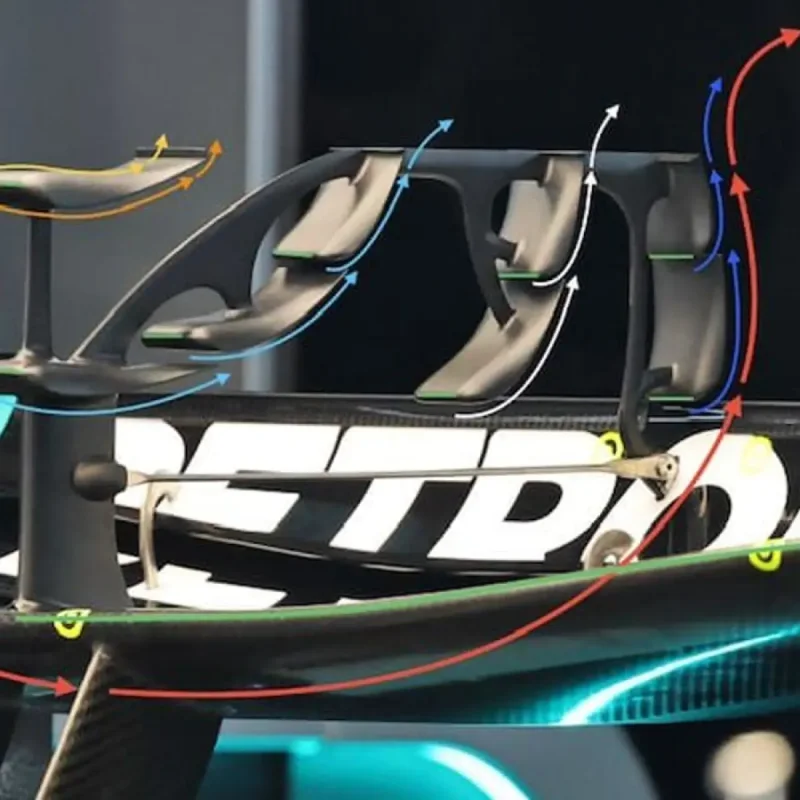
The removal of the Straight Mode actuators prompted Mercedes, Red Bull, and McLaren to introduce large, mainplane-mounted winglets in the vacant space on the center of the upper wing elements, exploiting a regulatory loophole that exempts the small center section from standard wing height limits.
As reported by formula1.
com, all these steep-angled winglets sit higher than the main wing to benefit from cleaner airflow, providing extra downforce on a circuit where drag is unimportant.
Mercedes introduced a highly complex set of winglets after removing its actuator pod entirely, while Red Bull repurposed its pod as a mount for two simpler winglets.
Technical analyst Gary Anderson noted that these developments optimize airflow consistency across the rear-wing undersurface.
Utilizing current 3D printing machines, manufacturing these components costs approximately £250 to £500 per unit while adding valuable kilograms of rear-end downforce to improve braking stability.
The unique physical traits of the Monaco Grand Prix further alter standard racing dynamics.
Running over 78 laps, the event features a unique minimum race distance of 260 kilometres—specifically 260.286 kilometres—making it nearly 45 kilometres shorter than any other grand prix on the calendar.
Drivers have expressed varying expectations regarding how the energy abundance and the new regulations will impact the competitive landscape during the upcoming sessions.
"It's the one track where power is not king," said Lewis Hamilton, Ferrari driver.
Hamilton noted that engine power deficits will be less pronounced on the narrow streets, shifting the competitive focus toward chassis compliance and mechanical grip.
"Our car could be really strong there," says Hamilton, Ferrari driver.
Ferrari teammate Charles Leclerc, who has secured pole position at Monaco three times in the past six years, enters the weekend alongside a grid expecting full power availability throughout qualifying laps.
"We'll be at full power everywhere, as far as I'm aware, or very close to it on all straights, which is good," said Oscar Piastri, McLaren driver.
Piastri also addressed the tire choices for the upcoming race weekends, suggesting that the choices remain balanced.
McLaren enters the event celebrating its milestone as the second team to compete in 1,000 grands prix.
"Monaco in 2026 is about the driver more than the machinery," stated a report by RacingNews365.
The unique track parameters mean that overtaking will rely heavily on mechanical capabilities, while teams will likely opt for a single pit stop due to minimal tire degradation and low fuel consumption.
Official on-track sessions will determine the final grid order ahead of the Sunday grand prix.