Ismail Elfath was taking his children to the park near his home in Texas when a message arrived.
“Congratulations,” it read. Elfath hugged his wife.
Fifa had selected him for his second World Cup. Relief and pride swept over him.
“Going to a World Cup is the dream of every referee, but going to a second one means you have stayed consistent for eight years plus,” said Elfath.
For referees, the World Cup is the pinnacle. The tournament comes around only every four years, and only a tiny number make the cut.
“First you have to be the best in your own country, and even then you might not be selected,” said Urs Meier, a former Swiss referee.
From a few countries, Fifa may take two referees, but elsewhere even the finest officials miss out.
Uefa selected Germany’s Daniel Siebert to referee the Champions League final on 30 May, yet Fifa overlooked him for the World Cup, taking his compatriot Felix Zwayer instead.
The Selection Gauntlet
Between World Cups, Fifa instructors draw up a list of candidate referees and monitor them closely.
At Fifa matches, former referees file reports from the stands; in other games, instructors watch remotely.
After watching the Premier League referee Anthony Taylor in a European match, Pierluigi Collina, Fifa’s refereeing chief, texted Taylor to encourage him to improve his movement.
Kathryn Nesbitt, the first woman to officiate a men’s World Cup knockout match, recalled Fifa instructors asking about decisions she had made months earlier in Major League Soccer.
One mistake can cost you your place on the plane. Before the 2010 World Cup, Tom Henning Øvrebø was one of Europe’s best referees.
But in 2009 he denied Chelsea at least one clear penalty in their Champions League semi-final second leg against Barcelona and his World Cup was gone.
José María Sánchez Martínez appeared set to represent Spain at the 2026 World Cup, but a run of shaky performances meant his compatriot Alejandro Hernández Hernández was selected instead.
Miss out and you might never get another shot.
In June 2025, Marco Guida, a top Serie A referee, was fighting to regain fitness after a hamstring injury.
He told me the fear of missing the World Cup had affected his mental health.
“If I’m not refereeing in Italy or the Champions League, I won’t be selected,” said Guida. Fifa left him out.
By the next tournament, he will be in his late 40s, which he feared would be too old.
“That’s what happened to Øvrebø. The pain still lingers.
The margins are so small,” said Guida.
For much of the selection cycle, Elfath doubted whether that message would arrive. During the 2024 Copa América, he sustained a serious knee injury.
He returned to the pitch a year later, after two operations.
Before he could think about the World Cup, he needed to pass Fifa’s fitness test.
To referee internationally, officials must complete 40 timed 75m sprints, with only 18 seconds of recovery. World Cup candidates also face additional tests for agility, speed and strength.
A certified representative from US Soccer flew to Texas to oversee the test, as did Elfath’s assistant referees.
If he failed, they would miss the World Cup too. He passed, but still had to prove himself again.
After matches and workouts, he uploaded GPS tracking data from his training devices to apps monitored by Fifa.
“They knew every time I accelerated and decelerated,” said Elfath. He also shared his sleep and recovery data.
In December 2025, Fifa cut three names from its list of North American referees under consideration.
Elfath survived and was invited to Rio de Janeiro for the final pre-tournament selection seminar, where candidates underwent further evaluation.
A sports scientist measured how their bodies responded under simulated stress, tracking their heart rate and breathing.
They reviewed clips of possible penalties. A doctor checked the stability of Elfath’s knee.
“As you get closer to the World Cup, we are tracked to a level people don’t realise,” said Elfath.
For months, every phone ping brought anxiety. Then, that morning, Fifa’s announcement finally came.
Soon, texts poured in from friends all around the world.
Elfath barely had time to respond.
He is one of Major League Soccer’s top referees, with a relentless schedule that has taken him from the Tokyo Olympics to the 2022 World Cup, where he was fourth official for the final.
Now, with a day off, he had promised his children his full attention.
“I’d told them I wouldn’t be on the phone, and there I was looking at my phone. They called me out!”
said Elfath.
Pressure on the Pitch
The anxiety of World Cup selection is nothing compared to the pressure of being there, Meier says. You’re managing history, not just a game.
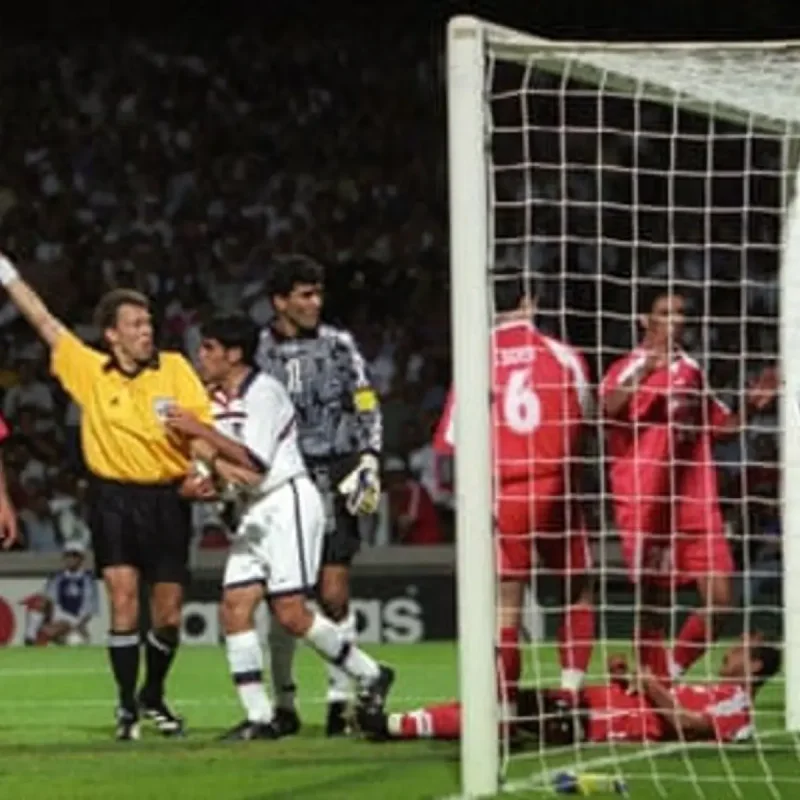
At France 1998, Meier took charge of USA v Iran, the first meeting between the teams since the 1979 Iranian revolution and the hostage crisis.
Protocol required the Iranian players to approach the US team to shake hands, but Iran’s supreme leader Ayatollah Ali Khamenei forbade it – so the US team approached.
Before kick-off, the teams posed for a photograph together. “It was so emotional.
I had tears in my eyes,” said Meier. It’s the highlight of his career.
Nine days later, Argentina faced England in the last 16.
Referee Kim Milton Nielsen remembers the simmering tensions before the match, ignited by memories of the Falklands war and contentious moments including Diego Maradona’s “Hand of God” goal.
This kind of historical baggage can make even obvious decisions harder to make. In that match, Nielsen sent off David Beckham for kicking Diego Simeone.
It was a clear red card offence, which he saw perfectly – but, being human, he hesitated.
“I knew I couldn’t close my eyes just because it was David Beckham in a World Cup,” said Nielsen.
Nearly 30 years later, people still approach him with the same question: “You’re the man who sent off Beckham?”
Not every World Cup match carries such political weight, but the pressure rarely eases. “People who don’t watch football still watch the World Cup,” said Elfath.
Darren Cann retired in 2025 after assistant-refereeing 579 Premier League matches.
As part of Howard Webb’s officiating team, he worked at two World Cups: 2014 in Brazil and 2010 in South Africa, where he was chosen for the final.
“It’s the culmination of four years of hard work and sacrifice, and you know you might never experience it again,” said Cann.
Wrong calls become more painful, but correct ones are more euphoric.
In South Africa, Cann officiated Brazil v Chile in the last 16.
The previous day, Jorge Larrionda’s assistant failed to spot that Frank Lampard’s goal had crossed the line in England’s defeat against Germany, and Roberto Rosetti’s assistant had allowed a clearly offside Carlos Tévez goal.
Before kick-off, Fifa chiefs delivered a stern message: “There can be no more mistakes.”
With Brazil leading 1-0, Kaká slipped the ball through to Luís Fabiano, who rounded the goalkeeper and scored.
The Chile defenders appealed for offside, but Cann kept his flag down. Fabiano had been marginally onside.
Cann had tears in his eyes.
“It was one of those beautiful moments where I knew that decision was correct,” said Cann.
Even supposedly routine games place referees under huge strain, according to Slavko Vincic. “There is more emotion, because the national flag is behind it.”
In 2024, the Slovenian took charge of the Champions League final – but nothing compares to his first World Cup match, in 2022: Argentina, the tournament favourites, against Saudi Arabia.
Sensing a historic upset after taking a shock lead early in the second half, the Saudis ran ferociously, cheered every tackle and hounded Vincic.
The Argentinians ramped up their efforts too, pushing Vincic into the red zone.
“All the players were doing 150%, so as a referee you need to be 150% inside.”
As full time approached, Vincic’s legs felt heavy, his mind foggy, and he fought to maintain composure.
“When everything around you is so chaotic, the challenge is to remain calm and credible.”
The Saudi goalkeeper collided with a teammate, knocking him out. Vincic missed it.
He sometimes wonders whether the strain contributed to the error.
In Nesbitt’s experience, the intensity of World Cup football heightens her senses on the field. “You can see the pass before it happens,” she said.
Elfath agrees, but stressed another challenge: managing players from radically different cultures.
“The way you talk to a Japanese player is different from how you talk to a Cameroonian, and if you don’t adapt, you will run into problems,” said Elfath.
He finds the hours immediately before a match psychologically tough. The mind races, conjuring up potential catastrophic errors.
Before his first game, Portugal v Ghana, he walked the pitch. Fans held up Cristiano Ronaldo jerseys.
He felt his stomach tighten.
“What I remember is how magnified everything was. Every steward, every logo, every moment … it’s like life is slower and bigger,” said Elfath.
He only settled after his first whistle. “It’s 22 players – and that, I know.”
The hours after matches can be difficult, too.
After Portugal beat Ghana, the Ghana coach Otto Addo called Elfath’s decision to award Ronaldo a penalty a “special gift”, igniting a storm of debate online.
Family sent Elfath screenshots. He felt anxious despite the video assistant referee confirming the call.
After Ghana fans trolled him on LinkedIn, his chief executive at a software company he works for asked him if he needed to sue somebody.
Elfath reassured him it was part of being a World Cup referee. “Small moments become huge moments,” said Elfath.
For most referees, the gaps between matches are the hardest moments. At first, the atmosphere is “almost celebratory”, Meier recalled.
“We’ve all gone through this process together, so there’s this bond amongst us that only we can understand,” said Nesbitt.
But that changes as the group stage nears its end.
Referees find themselves competing with each other, with the best performers in training and on matchdays earning appointments in the knockout rounds.
The rest are sent home.
“If you’re not giving your all, that’s noticed,” said Nesbitt. “The end of the group stage is the worst.
You can end it all by having a bad game,” added Elfath.
Even a correct call can earn you a ticket home.
At Qatar 2022, in Uruguay’s final group match against Ghana, Siebert denied a late penalty appeal by Edinson Cavani, which would probably have been enough to send Uruguay through.
Instead, they were eliminated. Fifa supported Siebert’s decision but sent him home because keeping him would have prolonged the controversy.
After his second match in Qatar, Vincic received an email from Fifa with his flights home.
He wondered whether the chaos of Argentina v Saudi Arabia had been a factor.
“You never know, but if you think about these things you will destroy yourself,” said Vincic.
For referees there are “three tournaments within the tournament,” Elfath said. The second begins after the group stage: the last 16 and the quarter-finals.
By this point, the hotel hallways are quieter, dinner time more subdued. Confined to the team hotel, away from family, some referees begin to feel isolated.
Referees arrive weeks before the first match to acclimatise, Nesbitt explained, and the only place you can go is the hotel or the training pitch.
The mental toll is constant.