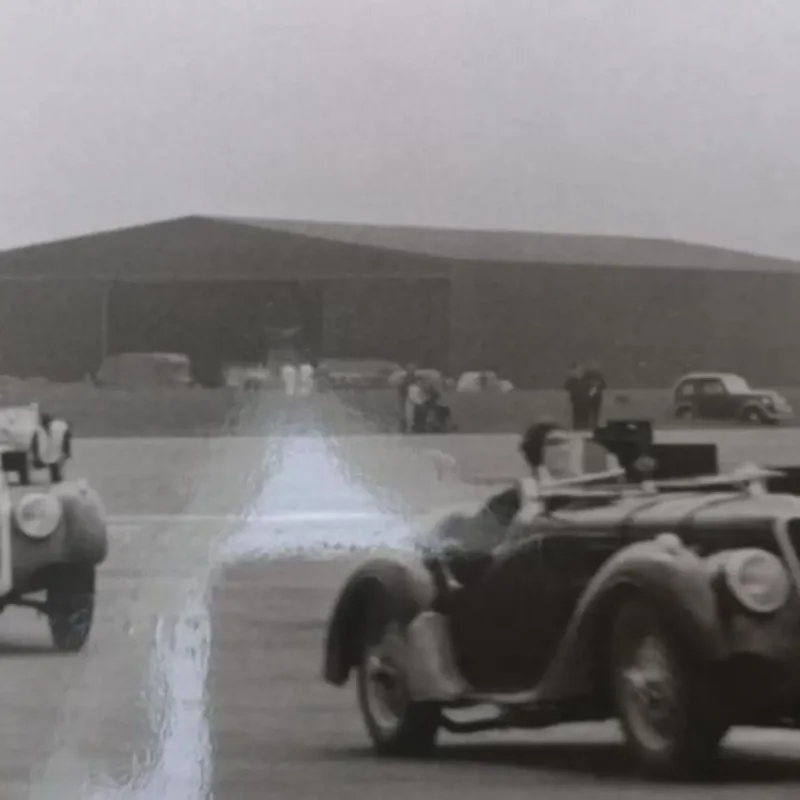
Decommissioned military airfields across Britain facilitated the resurgence of national motor racing after World War Two. They established a foundational blueprint for modern motorsport venues like Silverstone.
British motor racing officially restarted nearly 80 years ago on June 15, 1946, at RAF Gransden Lodge.
This wartime airfield is located west of Cambridge, as reported by bbc. co.
uk.
Before the conflict, the nation lacked public road circuits. Established tracks like Donington Park and Brooklands remained unavailable due to military storage and structural changes.
The abundance of more than 700 airfields by 1944 offered ideal racing conditions.
Concrete runways and perimeter roads were particularly suitable at Gransden Lodge, where operational flying had ceased in March 1946.
According to bbc. co.
uk, automobile club president David Hodkin bypassed the Air Ministry. He secured direct permission from Air Commodore David Atcherley to establish a 2.3-mile anti-clockwise circuit.
"I think by setting a template, it was showing people just what was wanted," said researcher Roger King.
King noted that European circuit racing had been permitted for several years, whereas Britain had traditionally banned racing on public roads.
"Circuit racing had been allowed in Europe for several years, but we had always banned racing on public roads, so we had no circuits," said King.
The researcher explained that pre-war venues could not be utilized immediately after the conflict ended.
"Donington Park was still being used as a massive storage depot by the Army, who wouldn't let go of it," he said.
King stated that the other major pre-war venue faced permanent structural limitations.
"And Brooklands had been partially built on with aircraft hangars and would never come back to being a full circuit," he said.
During his investigations, King documented correspondence from a former student competitor. The letter described the intense enthusiasm among post-war racing drivers.
"He said, the double-dyed racing stalwarts, having been starved of motorsport over the war years, were waiting with their tongues hanging out for something, or anything, to happen," King recalled.
The letter detailed how prominent racing officials thoroughly enjoyed testing the newly acquired Cambridgeshire airfield circuit.
"'This included Earl Howe, who was president of the RAC permit committee, who, on the pretext of testing the suitability of the circuit for granting the permit to race, kept scorching round and round, enjoying himself to such an extent that it was with the greatest of difficulty we were able to stop him."
The Royal Automobile Club introduced a policy change in 1948 that prohibited casual airfield meetings. The shift focused toward a centralized agreement with Silverstone.
"[The Air Ministry] had made this deal with Silverstone to permit more meetings there, and I guess as far as Gransden Lodge was concerned, it couldn't compete on that level," he explained.
King maintained that the early airbase races accelerated the timeline for the sport's domestic return.
"Withal... motorsport would have come back to Britain without Gransden, it certainly wouldn't have in 1946," he added.
Historical records from autocar. co.
uk indicate that prospective racers similarly utilized RAF Silverstone in 1947. They eventually secured official access to host a Formula 1 Grand Prix by 1950.
Chris Sullivan, Gransden Lodge historian, provided context regarding the wartime origins of the site.
"was originally built as part of several airfields, external to carry out some fairly secret trials of radar and similar technologies," said Sullivan.
Decommissioned military airfields provided the crucial infrastructure for the rebirth and eventual global dominance of British motorsport after 1945.