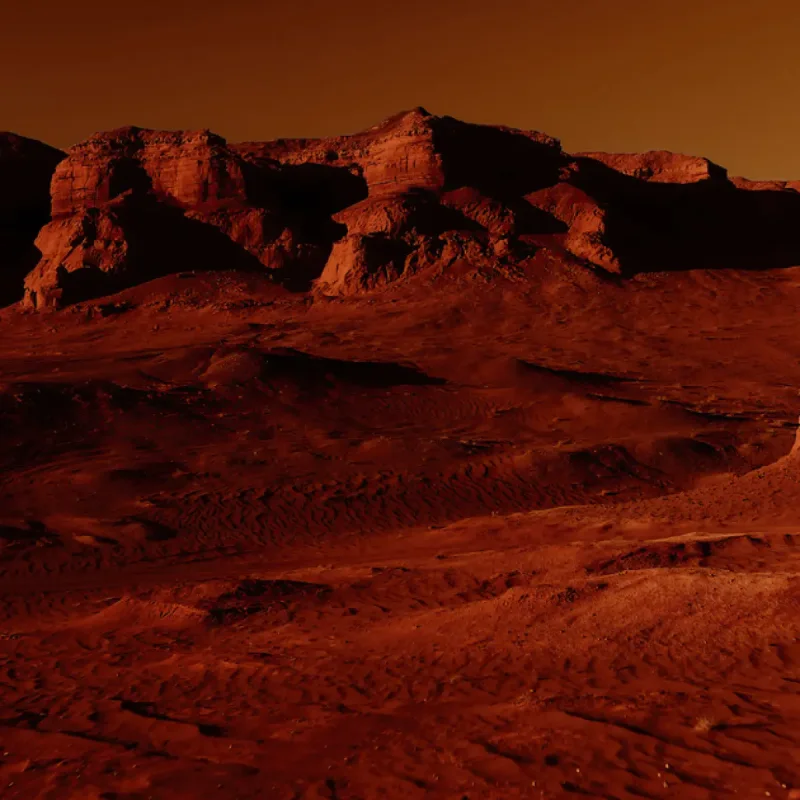
A Brazilian cosmologist has identified a potential 153-day round-trip trajectory to Mars by analyzing preliminary orbital data from asteroid 2001 CA21.
Marcelo de Oliveira Souza, a professor at the State University of Northern Rio de Janeiro, made the discovery while studying the asteroid's path.
The flight path could reduce typical Mars mission durations from several years to just five months.
Souza used standard astrodynamics tools to project the trajectory across future Mars opposition windows, finding that the 2031 window aligns closely with the asteroid-derived plane.
"I do not work at a space agency," said Souza, a professor at the State University of Northern Fluminense.
"I am a professor here ...
and I achieved a new result that allows for a faster trip to Mars, using the trajectory of an asteroid as a basis."
The study, published in the journal Acta Astronautica, notes that reaching Mars on a 33-day outbound leg would require a departure speed of 27 kilometers per second, far exceeding current human technology.
Souza emphasized that the theoretical route demonstrates geometric possibilities rather than an immediate blueprint for spacecraft engineering.
"Maybe this can change the idea that we need more than two years to go to Mars and return," said Souza.
Planetary Defense Remains a Priority
While asteroid data offers new navigational pathways, global experts warn that identifying near-Earth objects remains a critical security priority.
The United Nations established International Asteroid Day to commemorate the 1908 Tunguska event, highlighting the ongoing threat posed by unidentified space objects.
"There's an 100% chance that if we don't do something, a dangerous asteroid will hit and people will be hurt and killed," said Bruce Betts, chief scientist and LightSail program manager for The Planetary Society.
Betts noted that a significant impact could happen at any moment.
According to a NASA Office of the Inspector General report, astronomers have cataloged nearly 40,000 near-Earth objects, though many remain untracked due to limitations in telescope sensitivity.
"It's more important to find them, because you can't do anything about it if you don't know it's there," said Betts.
He emphasized that tracking infrastructure must expand to identify objects when they are still far from Earth.
"The key reason that we haven't met that, we as humanity, and we as NASA, is that we haven't had the telescopes with sufficient sensitivity to detect all of these asteroids, particularly when they're far from Earth," said Betts.
Planetary defense groups are working to find these hidden objects, as darker space rocks do not generate their own light and reflect very little sunlight.
"I think one of the biggest risks for us in planetary defense is that we don't know where all of these objects are," said Katie Kumamoto, head of the planetary defense group at Lawrence Livermore National Laboratory.
"And we're doing a lot of work to find them."
Previous operations like NASA's Double Asteroid Redirection Test successfully altered the orbit of the asteroid Dimorphos, proving that physical redirection is possible.
However, Kumamoto noted that our physical interactions with celestial bodies remain very limited.
"The number of asteroids we've actually touched, you can count on your fingers," said Kumamoto.
Spotting these objects requires specialized technology, as their non-reflective surfaces make them difficult to isolate against the backdrop of space.
NASA plans to launch the Near-Earth Object Surveyor space telescope to find at least two-thirds of potentially hazardous asteroids during its five-year mission.
The mission will utilize sensitive infrared detectors to flag asteroids approaching a one percent probability threshold for Earth impact.
"Zero is where we want to be," said Kumamoto. She added that increased telescope sensitivity will inevitably reveal more space rocks that require close monitoring.