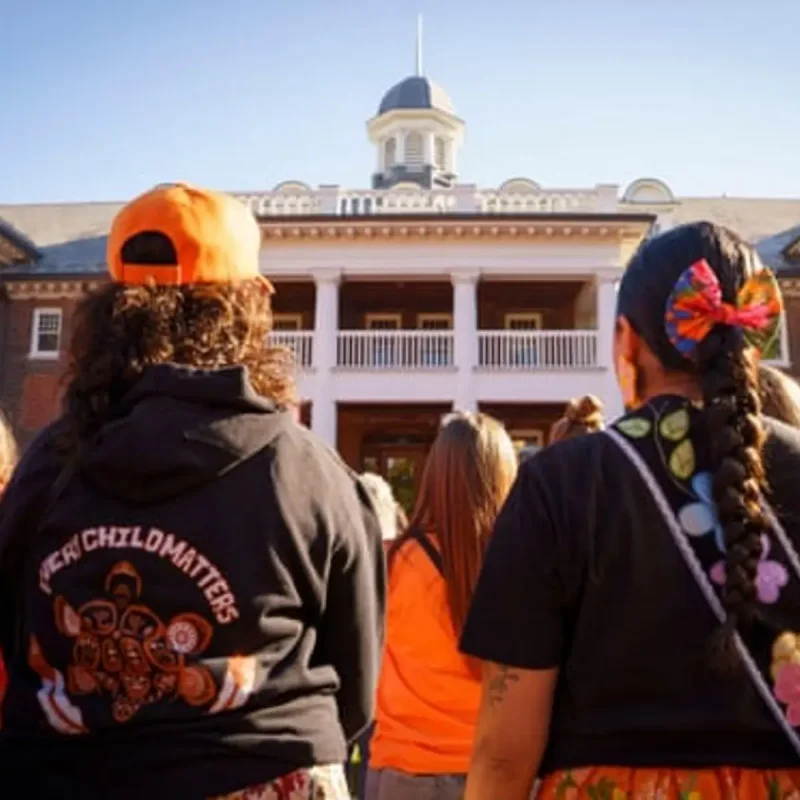
A plaque in the foyer of the former Mohawk Institute residential school asks visitors to help identify unnamed survivors in exhibition photos.
"We do not know the names of some of the people in the photos used in the exhibition.
If you recognize someone, please share that information," the plaque reads.
The building operated as a residential school from 1828 to 1970, part of a Canadian policy to eliminate First Nations as a distinct cultural group.
Historical records describe brutal conditions where children faced physical punishments for speaking Indigenous languages and suffered rampant sexual abuse by staff.
Meals were strictly limited to watery oatmeal, and escape attempts led to solitary confinement for days.
The building reopened last year as a museum tasked with documenting the realities of the residential school system and colonial structures.
Thousands of children passed through the institution during its 140 years of operation, and many individuals in the photographs remain unidentified.
Survivors across Canada face ongoing decisions regarding physical school spaces, mirroring global memorial efforts seen in Poland and Cambodia.
In 2013, survivors in Brantford voted to reclaim the school site rather than demolishing the physical structure.
"I am really grateful that the decision was made to keep the building," said Heather George, executive director of the Woodland Cultural Centre.
George noted that the center uses Indigenous art, languages, social dancing, and the museum itself as forms of protest against the original system.
The transformation occurs amid what activists describe as a backsliding in reconciliation, where deniers claim the institutions benefited Indigenous children.
Fast-tracked infrastructure legislation threatens First Nations sovereignty, with groups reporting a lack of consultation over major construction projects.
Sean Carleton, an Indigenous studies professor at the University of Manitoba, highlighted that commemoration serves as a public education tool against denialism.
"If we look at other contexts of genocide, commemoration has played a really important role in facilitating that public awareness to combat things like denialism," he said.
Canada retains close to 140 former residential school sites, with the final facility closing its doors in 1997.
While some locations like the Shingwauk centre became education hubs, survivors at the Lower Post residential school voted for complete demolition.
Doug George-Kanentiio, a survivor of the Mohawk Institute, now works as an educator at the newly opened museum.
Federal employees took him from his home in 1967, making him a ward of the state confined to the school for over a year.
He remembers encountering asbestos around heating ducts, drinking water from lead pipes, and experiencing severe malnourishment from the restricted diet.
George-Kanentiio stated that people must be immersed in historical atrocities to truly understand the residential school system.
"Why do I keep coming back? The basic reason is, inside the confines of that building, there are still remnants.
There's still children that are held, their spirits imprisoned," he said.
In 2021, ground-penetrating radar identified over 1,000 anomalies at former school sites in British Columbia and Saskatchewan, suspecting unmarked graves.
Church records, government documents, and survivor testimonies confirm that children died at these sites, prompting community debates over potential excavations.
In 2007, the Canadian government established the Common Experience Payment, requesting survivors to recount experiences to receive financial compensation.
However, survivors report that many individuals were denied compensation due to strict requirements for proof of abuse.
"How do you expect an 11 or 12-year-old kid to have evidence that they were sodomised?" George-Kanentiio said.
He emphasized that displaying these historical accounts inside the museum prevents the stories from being erased.
"I can still hear the echoing of the children as they go up the stairwell.
And I can still hear the remnants of the predators who used that same stairwell," he said.