As the United States approaches its 250th anniversary, descendants and winemakers are reflecting on the complex history of Thomas Jefferson.
They grapple with the contradictions between his revolutionary ideals and his personal actions regarding slavery and agriculture.
Jefferson famously declared "that all men are created equal" as a foundational pillar of the nation.
He further asserted that citizens possess inherent rights, including "Life, Liberty and the pursuit of Happiness" within the historic text.
However, Jefferson owned more than 600 people throughout his lifetime. This included Sally Hemings, an enslaved woman who bore several of his children.
Shannon LaNier, Jefferson's sixth great-grandson, noted the profound hypocrisy of this dual existence.
"I wish he would have done more to free the enslaved people and practise what he actually preached," LaNier said.
LaNier expressed mixed emotions about his lineage during a phone interview from New York. He recognized the historical weight of his ancestor's decisions.
"I know he tried to but he was the most powerful man in the country and he could have done more and he was living a double life so it's unfortunate," LaNier said.
"Sometimes I appreciate what he's done for this country and how much of a genius he was."
He emphasized that the failure to abolish slavery at the nation's founding hindered societal advancement for generations.
"Other times I hate what he did and that he didn't do more, and the hypocritical aspects, because we could have been so much further along as a society if he would have done what was right instead of what was profitable," LaNier added.
LaNier recalled a painful childhood memory from the second grade when he shared his lineage with his classmates.
"Sit down and stop telling lies!" a school teacher told him.
The incident deeply impacted the young student before his mother corrected the educator the following day. "That was a hurtful moment in my life," LaNier said.
The experience ultimately strengthened his resolve to understand and preserve his family identity.
"That helped me understand the importance of knowing who I am, being strong in the belief of who I am and don't let others define me," he said.
LaNier also credited Sally Hemings for her resilience and her success in negotiating the freedom of her children upon reaching adulthood.
"We know more about Jefferson but we have to give credit to Sally Hemings.
It's because of her that we know who we are today, that she didn't hide the story from her children, that she was able to negotiate for her kids to have freedom at the age of 21, that she was able to tell her story and make sure we were able to tell our stories," LaNier said.
He views the history of enslaved Americans as a testament to their strength and survival under brutal conditions.
"I commend all those who were enslaved.
A lot of people like to think of slavery as only a horrific experience but it was also an experience that proves that we come from a very powerful people, that we were able to survive the most horrible conditions on the planet, that we survived and we thrived and we still are surviving.
Slavery is just a moment and life is a journey," LaNier said.
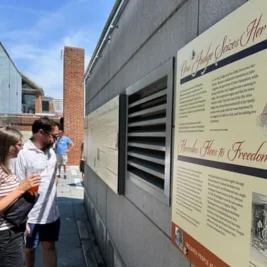
LaNier praised the Monticello estate for opening exhibits in 2018 that detail the lives of the enslaved families who built and maintained the property.
"A lot of historical institutions can learn a lot from Monticello … they're telling what happened: the good, the bad and the ugly, because you can't have one without the other.
You need a full story and context," he said.
The anniversary brings historical questions to the forefront, echoing old inquiries about the true meaning of freedom. "What to the Slave is the Fourth of July?"
asked Frederick Douglass in an 1852 address.
LaNier explained that celebrating Independence Day remains vital to honoring the contributions of Black Americans.
"Some people in the Black community don't want to celebrate July 4 because they say we have Juneteenth and we weren't really free then.
But it's just as important to celebrate July 4 because, if we did not, it would make all the blood, sweat and tears of our ancestors in vain," he said.
He noted that people of color played an indispensable role in the manual labor that constructed the early republic.
"It's important that people know how involved people of colour were in the founding of this country, that we would not have a 250-year anniversary without people of colour slaving and labouring constantly," LaNier said.
He stressed that key national landmarks and presidential documents relied heavily on enslaved labor. "Who do they think built the White House?
Who do they think was helping Jefferson with everything when he was writing the Declaration of Independence? He had people running and controlling his …" LaNier said.
Jefferson's Agricultural and Winemaking Legacy
In addition to political philosophies, Jefferson's agricultural pursuits also drew heavy influence from international figures, including Italian patriot Philip Mazzei.
John F.
Kennedy wrote in his book A Nation of Immigrants: "The great doctrine 'All men are created equal' incorporated into the Declaration of Independence by Thomas Jefferson, was paraphrased from the writing of Philip Mazzei, an Italian-born patriot and pamphleteer, who was a close friend of Jefferson."
Jefferson maintained a documented fascination with winemaking, allocating land at Monticello for Mazzei to plant European grapevines.
The estate continues to highlight the third president's "abiding and evolving interest" in viticulture.
Centuries later, Italian winemakers revived Jefferson's viticultural ambitions in Virginia during the 1976 bicentennial.
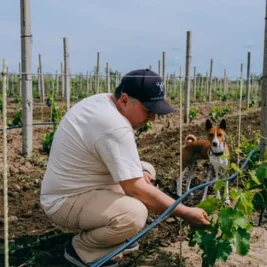
"When I planted the first 5 acres in Barboursville Vineyards in April of '76, who do you think came to see me?
Do you know?" asked Gabriele Rausse, founder of Gabriele Rausse Winery.
Agricultural officials initially discouraged the effort, unaware that historical failures were caused by the phylloxera pest rather than climate.
"It was the USDA, and they told me the most stupid thing you can do is to plant European vines in Virginia.
And I said, 'They pay me every month to do a stupid thing. So I don't mind to do a stupid thing.'
Right? That was the beginning of my story," Rausse said.
Rausse recalled that local dining habits were entirely different when he first arrived in the region. "When I came here, nobody was drinking wine," he said.
He observed that standard restaurant tables rarely featured wine bottles during the 1970s.
"I would go to a restaurant for dinner, and the man was always drinking only beer.
The lady was drinking a glass of wine occasionally, but there was never a bottle on the table," Rausse said.
Other winemakers confirmed that regional tastes favored traditional local beverages during that era.
"I was asked by people what was it like in Virginia in the 1970s for an Italian family to establish a vineyard.
And I say, 'Well, I think at that time, people were mainly drinking sweet tea and bourbon,'" said Luca Paschina, Barboursville Vineyards estate director.
Modern vineyards continue to honor the exploratory spirit of early American viticulture by testing various European grape varieties.
"I love that Jefferson was also on the side that it makes sense to try to see what grows," Rausse said.