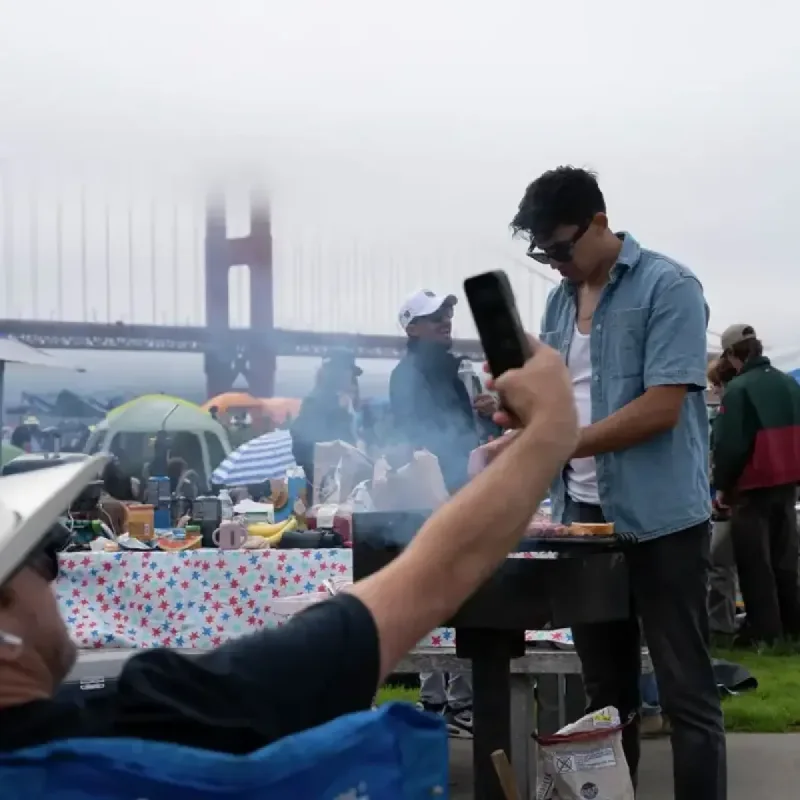
Tens of thousands gathered along the San Francisco waterfront on Saturday night for a historic Fourth of July fireworks display launched from the Golden Gate Bridge, marking America's 250th birthday.
However, dense fog and severe traffic congestion dampened the experience for many attendees.
The landmark event drew massive crowds to the northern waterfront, Crissy Field, Marina Green, the Marin Headlands, and surrounding areas.
People brought grills, chairs, and blankets to endure the chilly night, while hundreds of watercraft idled beneath the bridge.
Thick marine layer clouds completely enveloped the iconic structure, blocking the expected colorful visual spectacle for many onlookers.
"Well, we tried," said one young couple as they arrived at the Presidio, turned around, and left.
Bumper-to-bumper traffic gridlocked the entrance to the Presidio, prompting some motorists to drive on the wrong side of Lake Street to find viewing spots.
Park police attempted to clear vehicles parked illegally along the 1.6-mile Presidio Parkway stretch of Highway 101.
Many attendees opted to leave early to escape the worsening congestion.
"You just have to imagine something amazing happening," said one attendee.
To facilitate the pyrotechnic operations, Caltrans shut down Highway 101 in both directions starting at 8 p. m.
Authorities closed the Golden Gate Bridge to all traffic for one hour beginning at 9 p. m.
, while restricting access to parts of the Marina and Fisherman's Wharf.
The local transit agency, Muni, operated special shuttles from downtown BART stations but became overwhelmed by unprecedented crowds, ultimately advising passengers to travel by foot, bicycle, scooter, taxi, or ride-hailing services instead.
Fireworks Display Partially Visible Through Fog
Meteorologists had anticipated a spectacular show despite the heavy fog, predicting that the largest fireworks shells would explode at 1,000 feet and spread up to 1,600 feet, successfully bursting through the 800-foot-tall marine layer.
However, the display proved less impressive from water-level barges near Crissy Field and Pier 39, where only the highest shells managed to break through the fog, leaving most of the show visible only as pulses of color shifting through the mist.
The semiquincentennial celebration represented the first time in history that Independence Day fireworks were launched directly from the 90-year-old Golden Gate Bridge, marking only its third fireworks display overall following its 50th and 75th-anniversary events.
"As stewards of this iconic structure and symbol of our community, we are honored to help celebrate our nation's 250th anniversary," said Denis Mulligan, general manager of the Golden Gate Bridge, Highway and Transportation District, in a statement before the show.
The intricate launch was largely automated, utilizing six field controllers to ignite the explosives remotely alongside two additional controllers submitting time codes to synchronize the effects, according to Pat Dyas of Pyro Spectaculars.
"Launching the fireworks was largely a computerized operation, with six field controllers igniting the fireworks remotely and two others submitting time code to ensure the effects fire on cue," said Dyas, who ran Saturday's show as well as the bridge's 75th anniversary display in 2012.
To secure the airspace, the bridge district banned all drones from flying near the span, and federal authorities designated the area a no-drone zone, warning unauthorized operators of potential fines, criminal charges, or aircraft confiscation.
The bridge display concluded a full day of Bay Area festivities, which featured the longest Fourth of July parade in the country in Alameda, a dog costume contest in Golden Gate Park, picnics, concerts, pub crawls, and World Cup watch parties.