Little-known abroad, Andy Burnham has a chance to define a new era of US-UK relations.
Should he seek to charm or bargain with the bully in the White House – or treat him 'like a poorly informed constituent'?
If, as expected, Burnham becomes British prime minister later this month, one of his first calls will likely be with Donald Trump.
Trump's mother was Scottish and he has a nostalgic fascination with Britain.
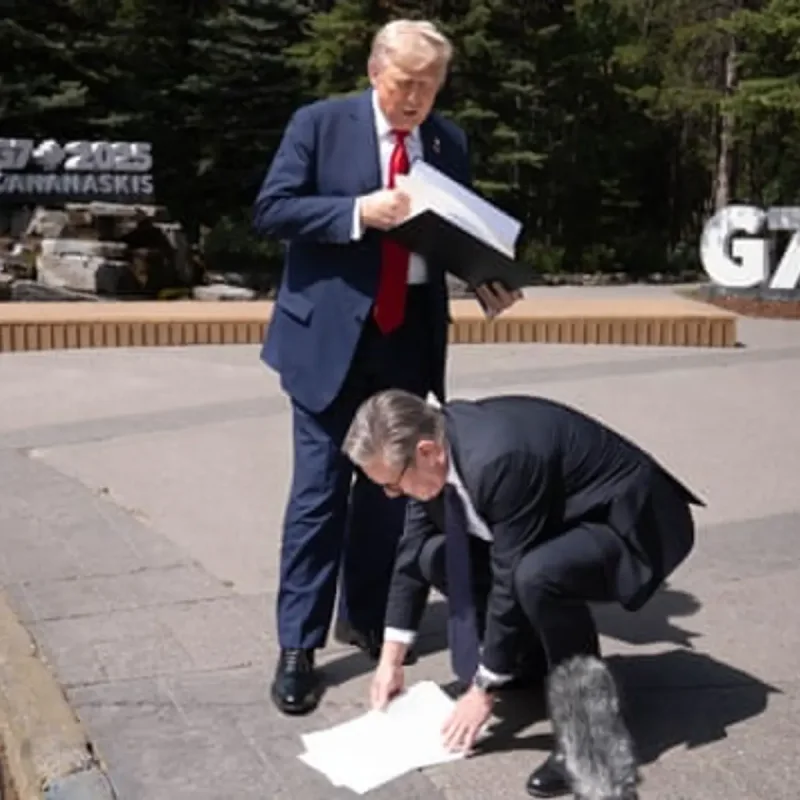
But managing a relationship with the erratic, transactional and demanding US president has been a diplomatic minefield for Burnham's predecessors.
Trump has encountered three British prime ministers in five and a half years.
When Trump returned to power in January 2025, Keir Starmer pulled out all the stops to burnish the special relationship.
But their bond soured over Trump's threats to Greenland, denigration of British troops in Afghanistan, and perception that Britain failed to support its war in Iran.
“This is not Winston Churchill that we're dealing with” became Trump's go-to insult. Now, with Starmer having resigned, Trump will meet his fourth British PM.
Like most Americans, Trump appears to have never heard of Burnham, who was until recently mayor of Greater Manchester.
Asked what he knew about Burnham, Trump replied: “I don't know, I think I see that he was, I guess, the mayor of a town.
I hear he's extremely liberal, extremely, so that means he probably won't open up the North Sea.”
Burnham has held high office – heading two big government departments under Gordon Brown in 2008 and 2009 – but the world has changed dramatically.
He has warned about the “poisonous” nature of US-style politics and said Trump brought “instability” to the world.
In his victory speech, Burnham urged voters to turn away from the path that “takes us to a divided, dark politics of the kind we see in the United States.”
Experts Weigh In: Charm, Distance, or Deals?
In Washington, longtime watchers of the alliance do not expect a new face to make a difference.
Sidney Blumenthal, former senior adviser to President Bill Clinton, warned: “Prime Minister Andy Burnham will be treated like other British prime ministers by Donald Trump.
The special relationship has been replaced by the abusive relationship.”
“He shouldn't take it personally. Keir Starmer was treated abusively but so was Theresa May.
Trump has very low esteem for British prime ministers and extreme deference to the King of England.”
Burnham has near zero name-recognition in the US – but political strategists and foreign policy experts agreed this clean slate could be an asset.
Frank Luntz, a consultant and pollster, said: “They'll probably think he's a football star. No one in America is going to know who he is.
But that's an opportunity to start afresh.”
Larry Jacobs, professor of political science at the University of Minnesota, added: “Burnham is as unknown a high-level British politician as we've seen in decades.
From the man in the street to most people in Congress, he is a nobody.”
As mayor of Greater Manchester since 2017, Burnham is out of practice in international diplomacy. His main opponents have been London's civil servants and parochial town hall leaders.
Nina Sawetz, a communications adviser who worked with Burnham's mayoral team, said his instinctive reaction to any Trump provocation would be to focus on “outcomes and interests for the UK, rather than compete on personalities.”
“My expectation is that Trump will initially interpret Burnham's refusal to engage in a running public battle as a sign that he has the upper hand.
I think that would be a misreading,” she added.
“The greater opportunity for the president lies in Burnham's tendency to wear his frustrations on his sleeve more than many political leaders.”
How to navigate the notoriously mercurial, thin-skinned and volatile Trump?
Many foreign leaders have been desperate to avoid the fate of Volodymyr Zelenskyy, who was berated by Trump in the Oval Office last year.
Jacobs said: “The starting point for dealing with Trump is to accept you're dealing with an aberration, a highly unstable, erratic president who has very low self-esteem.
If you do anything that kind of disrupts Trump's sense of himself, the relationship is over.”
“My advice to Burnham would be treat Donald Trump like a constituent back home who is poorly informed and quite emotional.
How would you deal with that person?”
Burnham faces an uphill struggle since Trump has shown more interest in oil-rich Gulf Arab nations than traditional allies in his second term.
For a Labour prime minister there are yawning policy gaps on every issue from climate and immigration to Iran and Nato.
One intriguing blueprint is offered by another mayor: Zohran Mamdani of New York.
A democratic socialist, he is ideologically opposed to Trump yet has got on well with the president, who appears to respect him as a charismatic populist – and a winner.
Philippe Dickinson, deputy director of the transatlantic security initiative at the Atlantic Council, said: “Mamdani is obviously on a very different side of the political spectrum but his identity isn't 'I'm the anti-Trump guy'.
It's about his policy platform domestically in New York. For Andy Burnham, there are potentially some lessons there.”
Among them, Dickinson said, are the charm offensives by Mamdani and Mark Rutte, the secretary general of Nato.
“It's politicians who convey an aura of confidence and ease in their own skin and can present themselves as people who are eye-to-eye with Trump on certain things.”
One clear commonality between Burnham and Trump is their shared view that mainstream politics has not worked for ordinary people.
Trump may admire Burnham's desire to shake up the staid British political establishment.
Sawetz said Trump's approach had long been to “establish the power dynamic quickly, whether through public criticism, personal remarks or by goading new counterparts into a very public response.”
“Burnham won't take that invitation,” she said.
“He may brush off the occasional quip, but we know he doesn't favour open political confrontation or the kind of prolonged exchanges we've seen with Sadiq Khan in London.”
Dickinson suggests defence spending could be an early potential win.
“I don't expect he will be coming to Washington any time soon but, when he does, he could come with a story to tell that says, this is my approach to defence investments and this is how it is helping solve a problem for you: we are going to go further on defence.”
Others believe Burnham should be prepared to cut deals.
Joel Rubin, a former deputy assistant secretary of state, advised: “Burnham needs to come in with an agenda of what he needs from the US to advance his domestic goals, and to be ready to offer up tangible goodies to the US that will help Trump and the American people.”
Conversely, other experts warn that bowing to Trump would be a diplomatic failure and domestic suicide.
Brendan Boyle, a Democratic congressman from Pennsylvania, notes that “any leader who takes on Trump benefits domestically from doing so,” whereas if Burnham says “absurd, obsequious things in public, he would get absolutely hammered by his electorate.”
Richard Stengel, a former undersecretary of state in the Obama administration, urges Burnham to maintain a distance and adopt a “tough love stance.”
He cautioned: “First of all, I wouldn't wear a red tie under any circumstances. A red tie signals that you're lying down.”
“That universal European response of kowtowing to him and sucking up to him just turns out to be a poor strategy.
He turns on everybody so even if he forms an early 'Oh, he's my friend', he'll eventually turn on you.
Burnham needs a certain distance.”
Stengel added: “I would no longer mention the special relationship.
That is a dog that doesn't hunt any more and Americans don't get it and I don't know if the Brits do and it also seems to someone like Trump like you're being deferential.”
Some analysts point to Mark Carney, the Canadian prime minister, as the gold standard.
Earlier this year Carney delivered a speech at Davos that did not mention Trump by name but declared that the US-led “rules-based international order” was facing a permanent rupture.
Steve Schmidt, a political strategist and former adviser to Senator John McCain, said: “There are many people who would look at the state of the world and hold the view that Mark Carney is the most serious and important leader in the English-speaking world and is the person who has most fundamentally and substantially understood Trump and drew a line that other world leaders have rallied around.”
Blumenthal, who introduced Clinton to Blair before the latter became prime minister, has further advice based on November's midterm elections.
“Unlike Starmer, Burnham will very likely have at least one Democratic counterpoint in the Congress, either the House and/or the Senate to deal with.”
“Burnham represents the parliament himself and he should deal with them extensively.
If the Democrats get control of either house, they are his allies and they can help him in innumerable ways.
His government should establish extensive relationships with a new Democratic Congress to the benefit of Britain. That did not exist for Starmer.”
The phrase “special relationship” was coined by Winston Churchill during a lecture tour of the US after the second world war.
Churchill and Franklin Roosevelt had been allies against Hitler, setting the bar for future double acts including Harold Macmillan and John F Kennedy, Margaret Thatcher and Ronald Reagan, Blair and Clinton, and Blair and George W Bush.
Gordon Brown had a less happy experience with Barack Obama, who was evidently more at ease with Angela Merkel of Germany.
Brown tried five times to get a meeting with Obama on the fringes of the 2009 UN general assembly but was merely granted a “snatched conversation.”