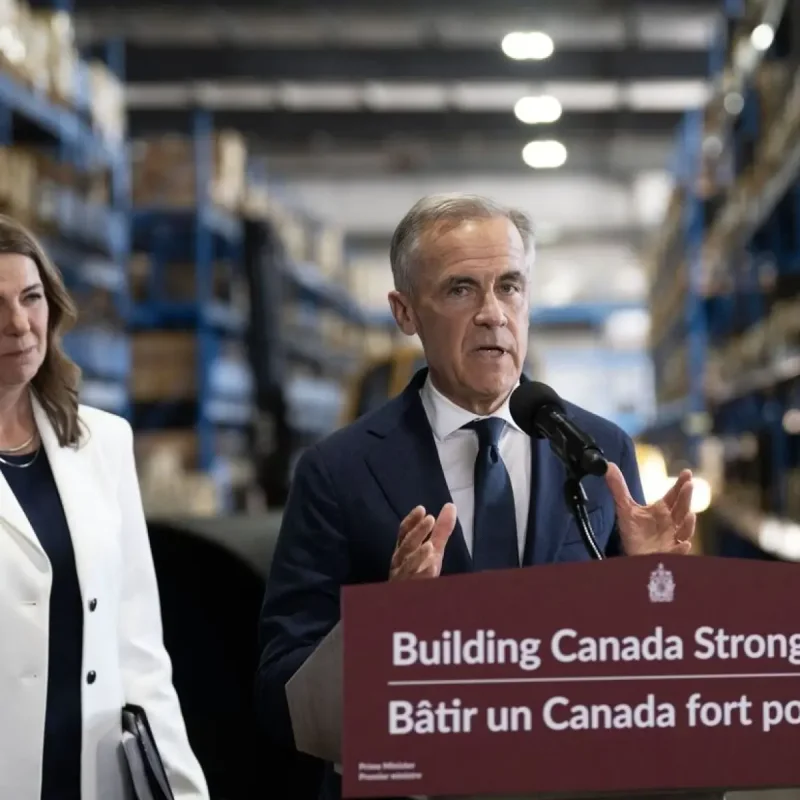
Alberta Premier Danielle Smith and Ontario Premier Doug Ford proposed a new 3,300-kilometer pipeline route on Monday during a news conference in Calgary.
The joint proposal, named the Northern Shield Energy Corridor, aims to transport crude oil across four Canadian provinces.
The proposed line would move crude from Hardisty, Alberta, to Sarnia, Ontario, traveling east through Regina and Winnipeg.
Initial capacity is set at 500,000 barrels per day, with potential expansion to 800,000 barrels daily.
Interprovincial Energy Cooperation
The announcement coincides with ongoing discussions regarding a separate $35-billion West Coast pipeline partnership between the federal government and Alberta.
That project would transport one million barrels of oil per day from Bruderheim, Alberta, to Roberts Bank, British Columbia.
Ontario Infrastructure is serving as a commercial advisor to complete a feasibility study on the Northern Shield corridor by the end of 2026.
The exact cost and funding mechanisms for the massive cross-provincial project remain undetermined.
"Our plan to build the Northern Shield Energy Corridor is a plan to protect workers in Ontario, Alberta and every part of the country," stated Premier Doug Ford.
The Ontario premier expressed strong support for the infrastructure development, citing recent federal backing for the West Coast route as a precedent for inter-provincial energy cooperation.
"I think it's a great investment, no matter if it's the government that will get a good ROI over a certain period of time.
Always prefer looking at the private sector investing, and I think it's going to be an incredible project," said Ford.
Alberta Premier Danielle Smith emphasized that modern pipeline developments generate significant revenue and create opportunities for equity stakes among First Nations groups.
"I always hope that we can have private partners come forward on this, because that also allows us to have the market discipline.
But I'm grateful that Premier Ford is willing to look at all the options," said Smith.
The Alberta premier noted that domestic economic priorities have shifted public sentiment surrounding major energy infrastructure investments. "Pipelines have gone from impossible to a national imperative.
The Alberta oil sands have gone from a target to a national treasure," said Smith.
Industry and Expert Reactions
Industry insiders expressed mixed reactions regarding the broader pipeline expansions.
Paul Colborne, chief executive of Surge Energy Inc., said that market diversification provides critical leverage for Canadian producers.
"We've opened up a market.
We now take another million barrels of our oil, and we have negotiating power to take it to China, India, Africa, Asia," said Colborne.
Some regional producers cautioned that regulatory and political hurdles continue to cast doubt over whether these mega-projects will ever reach final construction.
"Optionality is king.
The ability for us to chase the highest price for our crude is critical," said Del Mondor, chief executive of Aldon Oils Ltd. The Saskatchewan-based executive noted that historic challenges surrounding major line construction remain a persistent threat.
"I'm giving this less than 50 per cent chance of happening," said Mondor.
Financial experts point out that additional pipeline capacity is a prerequisite for renewing capital spending.
Mark Parsons, chief economist at ATB Financial, explained that despite multi-billion dollar export growth recorded in 2025, financial models require firmer commitments.
"We just want to see a little bit more certainty that this is indeed going ahead," said Parsons.
He emphasized that the oil and gas sector needs new infrastructure to break a decade-long stagnation in greenfield expansions.
"The reason this is so important is because, for the oil and gas industry to get that next leg of growth, they need new pipeline capacity," said Parsons.
Analysts questioned whether high construction costs might translate into expensive shipping tolls that could deter private energy producers.
"If that is the case, then you won't get shippers to sign up for that. It's not competitive," said Richard Masson, industry consultant.
Public policy researchers suggested that government involvement could mitigate these risks.
"It makes sense for government to make the real money off the taxes and the royalties," said Heather Exner-Pirot, senior fellow at the Macdonald-Laurier Institute.
The senior fellow expressed surprise at the sudden alignment between federal and provincial leadership.
"It was so improbable that we could find a middle ground on a pipeline in Canada. You would never have thought it possible two years ago," said Exner-Pirot.
Market intelligence analysts concluded that securing long-term commitments from commercial oil producers represents the final major barrier.
"You need the oil to flow and producers to kind of get behind it. So that's kind of the last major hurdle," said Kyle Bertamini, analyst at Enverus.