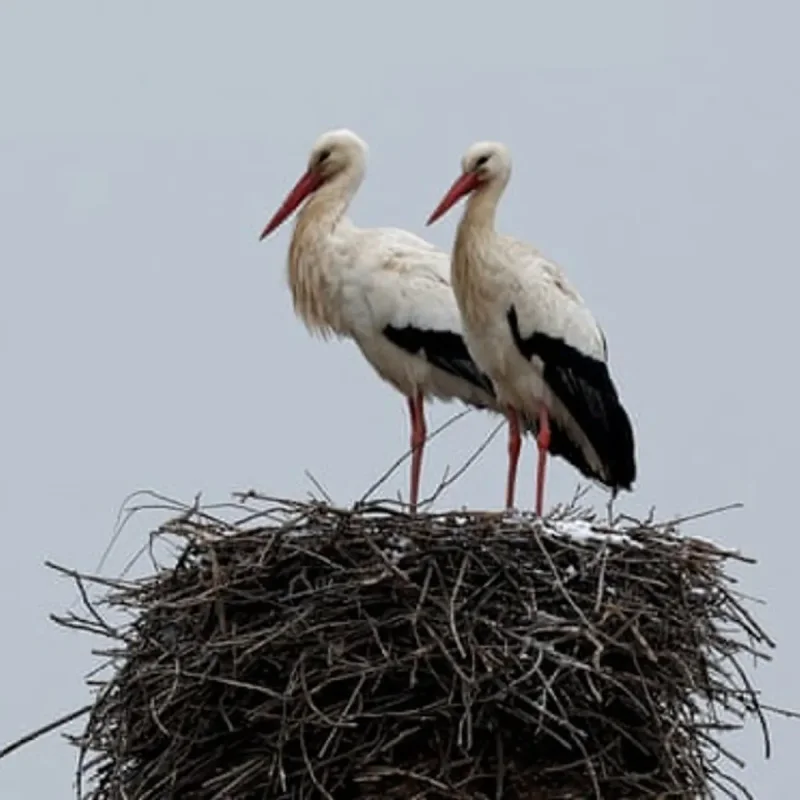
European white storks that forage in landfills gain short-term benefits but face serious long-term health risks, according to new research presented at the Society for Experimental Biology conference in Florence.
The study, conducted on white stork populations in Poland, found that birds feeding on discarded food waste have greater body mass and higher energy stores compared to those relying on natural prey.
Anustup Bandyopadhyay, a PhD student at the University of Veterinary Medicine Vienna, explained that landfill foraging allows storks to spend less time searching for food and potentially channel that time into breeding.
“Our partners from Poland have also found that white storks use landfills mostly in the middle of the breeding season, when the food demands of nestlings are at its peak,” Bandyopadhyay said.
However, the convenience comes at a cost.
The research detected evidence of DNA damage in young chicks just one week old, linked to a landfill-based diet.
Migration Shifts and Population Impacts
The availability of landfill food subsidies is also altering migration patterns. Some white stork populations are becoming partially migratory or even entirely sedentary.
“The Iberian peninsula white storks have shifted from being wholly migratory to partially migratory, or even sedentary, largely due to favourable weather conditions and, importantly, the availability of landfill food subsidies,” Bandyopadhyay added.
Prof Aldina Franco, an ecologist at the University of East Anglia who was not involved in the research, described landfill food as “junk food” for birds.
“It’s food that is rotting and it’s poor quality, and probably highly energetic.
So, they can get leftover steaks or leftover fish, everything we throw away to landfill sites,” Franco said.
Franco noted that while individual storks face risks from contaminants and diseases, the extra food resource benefits the wider population.
“It is true that it can be damaging for individual storks to eat these types of food that can have contaminants and diseases.
But from a population perspective, if you’d have 500 storks going to a landfill site, maybe a few will die from eating these contaminated items, but the majority will actually benefit from having extra food,” she explained.
This reliance on landfills faces disruption as stricter EU waste management policies reduce open landfill access across Europe.
Franco questioned whether completely preventing storks from accessing organic waste could lead to population declines, noting that white stork populations were declining until the 1980s and have since been reintroduced in Sweden and the UK.