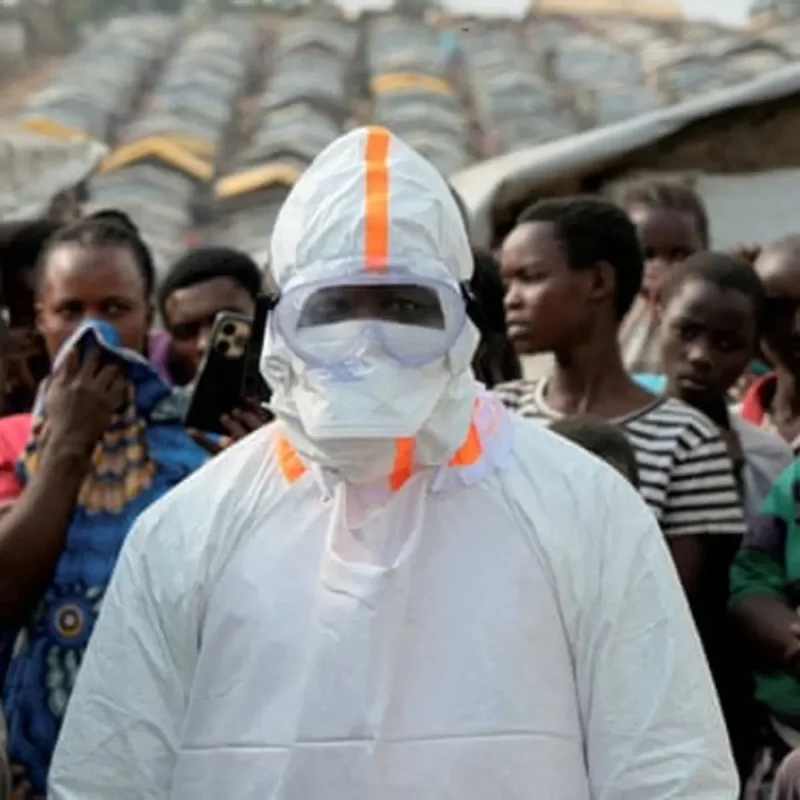
The rare Bundibugyo Ebola variant is spreading rapidly across the Democratic Republic of the Congo and into Uganda, causing 1,759 cases and 600 deaths as of July 8, according to government data cited by The Guardian.
The Africa Centres for Disease Control and Prevention described the outbreak as the fastest-growing ever recorded for this variant, which currently lacks any approved vaccine or treatment options.
Suspected cases have extended beyond the initial center in Ituri province into Tshopo and Haut-Uélé provinces, exacerbated by regional conflict, reduced international aid, and violent attacks against health workers.
Militia conflicts over mineral resources in Ituri and clashes with the M23 rebel coalition in North and South Kivu have severely restricted humanitarian access and medical coordination across the region.
"The overlap between militant activity, population displacement and weak state control could significantly complicate efforts to contain the outbreak," said Ladd Serwat, a senior analyst at the Acled conflict monitoring group.
A sharp decline in humanitarian funding during 2025, driven by frozen foreign assistance from the United States, forced more than 10 aid organizations to downsize or halt operations completely.
"The Ebola outbreak is a stark reminder that when humanitarian systems are underfunded, they become more vulnerable to new emergencies," said Carla Martinez, the DRC head at the UN’s Office for the Coordination of Humanitarian Affairs.
Martinez explained that these budget cuts severely compromised local surveillance networks and healthcare systems, making rapid containment of new health crises much more difficult.
"Without additional resources, both the public health response and broader humanitarian operations will come under increasing strain, with potentially serious consequences for the DRC and the wider region," she added.
Mistrust fueled by misinformation has led to frequent community resistance, including attacks on 10 Red Cross volunteers during safe burial procedures in the affected provinces.
"An immobilised colleague means a direct reduction in response capacity," said Alex Lock, a spokesperson for the International Federation of Red Cross and Red Crescent Societies.
Lock noted that four volunteers sustained injuries, with two requiring an airlift to Kinshasa, which continuously disrupts critical containment efforts and elevates community risks.
"This hinders our operational effectiveness and benefits no one, neither the community in need nor those of us working tirelessly to support them in containing and eradicating the virus," Lock said.