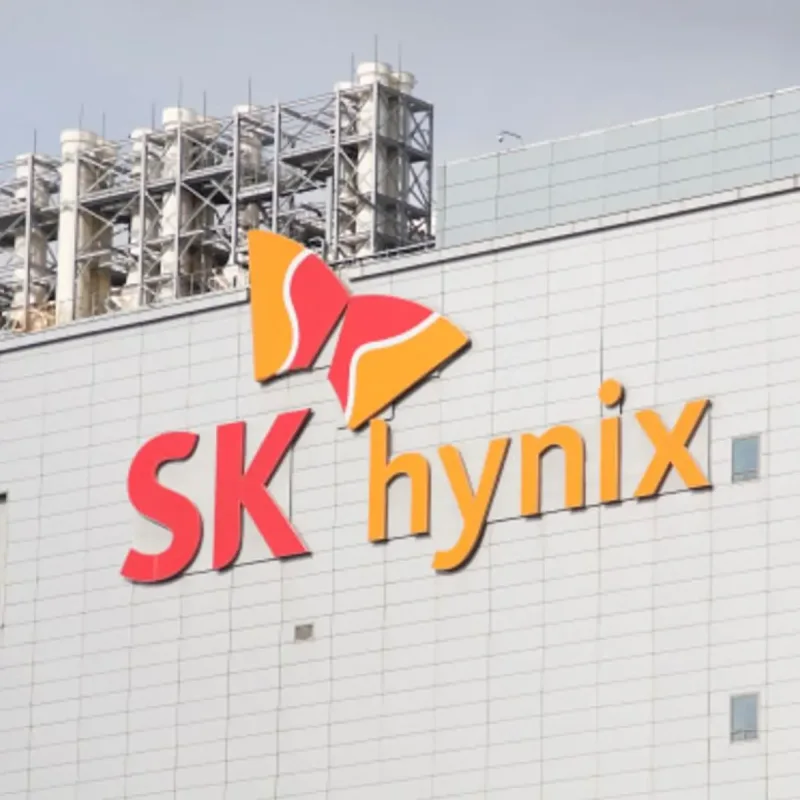
South Korean semiconductor giant SK Hynix listed its American depositary shares on the Nasdaq stock exchange on Friday, July 10, 2026, after raising $26.5 billion to fund expansion amid soaring global demand for artificial intelligence memory chips.
The company sold 177.9 million American depositary shares (ADS), equivalent to 18 million ordinary shares, at $149 each.
The shares trade under the temporary ticker SKHYV before switching to SKHY on Monday.
According to filings and reports, the historic sale stands as the largest-ever US equity debut by a foreign company and the world's second-largest stock sale on record, trailing only SpaceX's Nasdaq listing.
The chipmaker intends to utilize the proceeds to finance a new fabrication plant, an advanced packaging facility in South Korea, and 11.9 trillion won in new EUV lithography equipment by the end of 2027.
SK Hynix currently commands 56.4% of the global high-bandwidth memory market, supplying critical components for Nvidia's AI processors.
This helped drive its first-quarter net income to 40.34 trillion won.
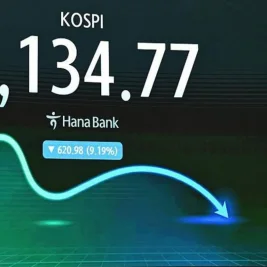
Bookbuilding reports indicated that demand ran seven times the available supply, drawing massive interest even as the domestic Kospi index faced severe weekly volatility.
Analysts note the listing could narrow the valuation gap between SK Hynix and its primary US rival, Micron Technology.
Market Reception
Research strategist Dilin Wu at Pepperstone highlighted the exceptional market reception amid broader semiconductor sell-offs.
"Seven times oversubscribed, about $171bn in orders for a $24-28bn deal, and this happened while the semiconductor sector was actively selling off and the Kospi was in a circuit breaker week," said Wu.
Wu added that the pricing clearly reflects the strength of the current technology cycle.
"I think the SK Hynix ADR pricing says one thing very clearly: the AI memory cycle is real, the earnings are real, and global capital has simply never had easy access to the best pure memory play in the space," said Wu.
However, an industry caution remains regarding the cyclical nature of the semiconductor industry, as noted by an analyst report.
"This is how memory always acts in any megacycle or supercycle... The problem is, it always crashes hard," according to a market commentary.
Global portfolio managers observed that the listing capitalized on aggressive investor positioning within the tech ecosystem.
"Clearly there’s huge amounts of capital chasing the AI opportunity," said Cameron Robertson, a portfolio manager at Platinum Asset Management.
Robertson stated that the market momentum reflects a combination of structural shift and retail enthusiasm.
"Investors around the world are scrambling to find ways to profit from it.
I think what we are seeing is a mix of genuine confidence and speculative activity," said Robertson.
Robertson further noted that the domestic market environment has aligned with this momentum.
"Korea has absolutely been swept up in the excitement over the past year – you can see that in the rapid growth in margin lending in the country, the rise in popularity of single stock levered ETFs, and retail participation in the stock market," said Robertson.
Regional experts pointed out that capital has rotated directly into hardware infrastructure suppliers due to valuation adjustments among major software and cloud firms.
"Within tech, the [Magnificent Seven] have underperformed, and growth has instead concentrated in the semiconductor supply chain.
In the US that’s firms like Micron … In Asia, SK Hynix and Samsung have been big winners," said Alex Holmes, regional director for Asia Pacific at the Economist Intelligence Unit.
The strategic expansion follows an announcement by South Korean President Lee Jae Myung regarding a $1 trillion AI investment initiative, under which SK Hynix and Samsung Electronics pledged to invest $518 billion with local suppliers.