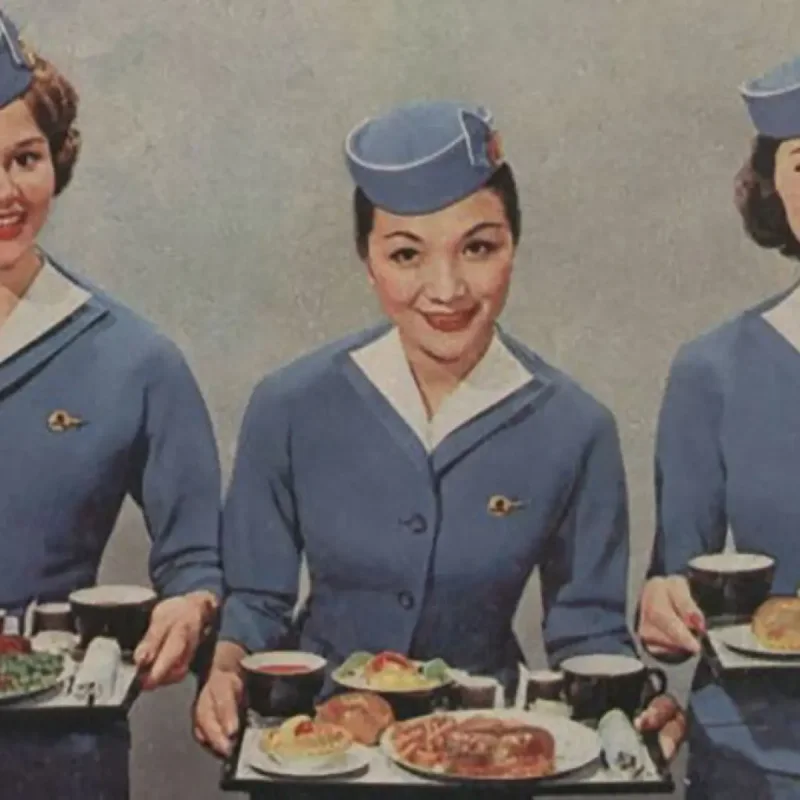
Ann Hood, a New York Times best-selling author, takes readers back to the end of aviation's Golden Age in her memoir "Fly Girl."
The book chronicles her adventurous years as a flight attendant for Trans World Airlines (TWA), a career that began in 1978.
Growing up, Hood was inspired by a 1964 book titled "How to Become an Airline Stewardess." Despite its sexist undertones, the promise of seeing the world captivated her.
After college, she applied to airlines during a transitional era for women in the workforce.
"I think 1978 was a really interesting year, because many of the women I went to college with had one foot in old ideas and stereotypes, and the other foot in the future," Hood said.
Strict Rules and Weight Policies
By the late 1970s, some of the worst hiring requirements—such as age limits and dismissal for marriage or pregnancy—had been lifted.
However, other policies remained firmly in place, including a strict weight rule.
"All airlines sent a chart with your application, you looked at your height and the maximum weight and if you did not fall within that, they wouldn't even interview you," Hood recalled.
Once hired, TWA required flight attendants to maintain their exact hiring weight, not just the maximum.
Hood's roommate was fired for failing to meet this standard, a policy that persisted until the 1990s.
Hood was one of 560 flight attendants selected from 14,000 applicants in 1978.
Training took place in Kansas City, where cadets learned about seven different aircraft, including the massive Boeing 747.
"It was kind of terrifying, because it was so big – and the stairs, the spiral stairs that led to first class that you had to go up and down not infrequently," she said.
Luxury and Cabin Realities
Hood preferred working on the Lockheed L-1011 TriStar, a widebody plane with a comfortable cabin.
Flying during this era felt like being in a fine hotel or cruise ship, with passengers dressing up and enjoying quality meals.
However, smoking on board was a major challenge.
"If you went on a five-day trip, which wasn't uncommon, you had to pack a separate whole uniform because you just would smell so much like smoke," Hood said.
Separating smoking and non-smoking sections did little to improve air quality.
"The whole plane was filled with smoke because you couldn't keep it from going backwards, it was ridiculous."
International flights often had lower passenger volumes, leading to unusual behavior. Hood recalled seeing passengers disappear under blankets or enter bathrooms together.
One encounter in 1982 led to a five-year relationship with a passenger in seat 47F.
Other bizarre sights included a passenger breastfeeding a cat, a man flying in his underwear to avoid wrinkling his suit, and a man riding a bicycle down the aisle of a 747 in Frankfurt.
An Empowering Legacy
Despite the eccentricities, Hood described the job as 80% fun and 20% boring. She loved talking to people and the feel of flying.
She left TWA in 1986 to focus on writing, just as deregulation shifted the industry toward higher capacities and fewer amenities.
"Flight attendants are a force. They're highly unionized.
They're independent. In the cabin, they make all the decisions," Hood said.
She views the profession as contradictory: empowering yet sexist. "It's such an empowering job, yet it's a sexist job.
In itself, it is as contradictory today as the time in which I started it."
The job gave her confidence, poise, and the ability to think on her feet.
"To take charge on that airplane, and once I got off, to walk into a city and feel completely at home – or at least figure out how to feel at home in it."
Hood believes that even a few years as a flight attendant can change a person's life.
"I don't know if it should be someone's life's work – if they want it to be that, great.
But I think a few years working as a flight attendant could change your life."