The ambitious blueprint for reconstructing the entire Gaza Strip has been dramatically scaled down.
Donald Trump's Board of Peace (BoP) is now pursuing a limited pilot project in the south, near Rafah.
The plan involves a temporary camp for a small fraction of Gaza's 2 million displaced people.
It would include a Palestinian administration, police, and an international security force, but is not expected to be operational before the end of 2026.
Incremental Steps and Delays
Recent weeks have seen small advances, such as the arrival of Moroccan and Kosovar officers in Israel.
These officers are meant to form the core of an International Stabilization Force (ISF) to protect the pilot camp.
A logistical base for the ISF is nearing completion at the Kerem Shalom crossing.
However, preparatory work on the Rafah camp itself has not started, nor has construction of its support base.
Satellite images show disturbed earth but no new structures. Substantial progress is unlikely before Israel's elections on October 27.
Western diplomats believe a new Israeli government offers the best hope for progress, though any successor's flexibility is uncertain.
Israel has repeatedly violated the Trump-brokered ceasefire since last October, blocking reconstruction and limiting humanitarian aid.
One diplomat in Jerusalem said the BoP had to make the most of limited progress to prevent extreme factions from taking over.
"The aim is just to keep something going, keep the ball in play," the diplomat said, warning that others with a more extreme agenda are waiting to jump in.
There is growing fear that Prime Minister Benjamin Netanyahu, facing electoral defeat, may launch a new offensive in Gaza before the vote.
Israel has conducted frequent strikes, killing over 1,100 Palestinians since the ceasefire.
The Israeli army now occupies more than 60% of Gaza and has created a buffer zone beyond the agreed ceasefire line.
A return to full-scale war would likely sweep away even the modest pilot plan.
Israeli officials suggest war is inevitable because Hamas has refused to disarm, though Hamas participated in Cairo talks on disarmament mechanisms.
Progress on decommissioning weapons remains unlikely while Israel continues airstrikes and advances into Hamas-held territory.
A Palestinian source told Haaretz that without Israel committing to a gradual withdrawal and changing the reality in Gaza, there is no basis for talks.
Pilot Plan Details and Criticism
The pilot program near Rafah is a far cry from the BoP's initial aspirations. In January, Jared Kushner promised basic infrastructure across the strip within 100 days.
The scaled-down plan was finalized two weeks ago at meetings in Cyprus, attended by BoP officials and advisers from the Tony Blair Institute.
Members of the National Committee for the Administration of Gaza (NCAG), a body of 13 Palestinian professionals, also attended.
The NCAG has been barred from entering Gaza by Israel and is based in Cairo.
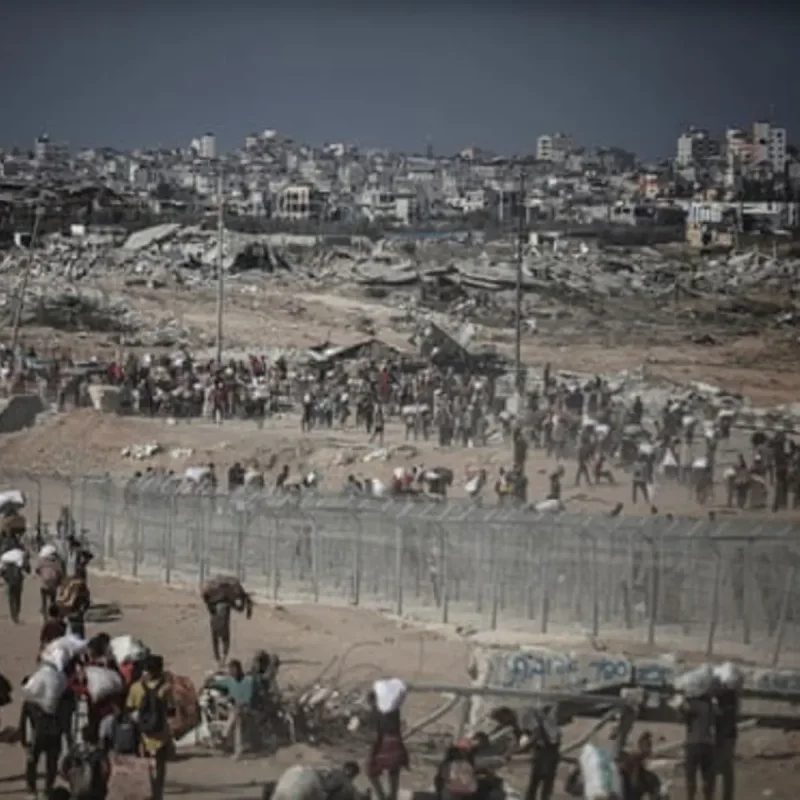
The pilot camp would consist of portable cabins for tens of thousands of displaced people in the buffer zone near Rafah.
Israeli troops would withdraw from the line, and security would be overseen by the ISF and a specially trained Palestinian police force.
Training for that force in Egypt has not begun and is expected to take months.
The ISF is hoped to be about 5,000-strong, with troops from Morocco, Kosovo, and possibly Albania and Kazakhstan.
An official familiar with the planning said late 2026 is the target, adding, "If we got this done by December, I'd be very happy."
Preference for settlement in the pilot camp would be given to former residents of the Rafah area.
Critics, including former Israeli Prime Minister Ehud Olmert, have denounced the scheme as a potential concentration camp, though BoP officials deny this.
A wider range of relief items would be allowed in, but Israel insists on permitting only humanitarian aid, not reconstruction materials.
It remains unclear where funding will come from, as very little of the original $17 billion pledge has materialized.
The EU's Palestine Donor Group raised €883 million for Gaza, intended for complementary water and sanitation infrastructure.
The BoP is negotiating to divert some of the $11 billion in Palestinian tax revenue and frozen bank assets withheld by Israel to project funds.
This suggestion has angered the Palestinian Authority (PA) in the West Bank. "These are not Israeli funds to withhold or bargain with," said PA Foreign Minister Varsen Aghabekian.
"These funds must be released immediately and unconditionally."
Aghabekian said the shift to a small pilot project presents a dilemma for Palestinians. "The humanitarian catastrophe cannot be managed through fragmented or partial measures.
At the same time, every effort that genuinely saves Palestinian lives deserves careful consideration."
She added, "Our concern is that temporary arrangements must never become a substitute for a comprehensive solution or serve to normalise an unacceptable reality."
According to an official familiar with the Cyprus talks, the NCAG was split over whether to go along with the Rafah pilot scheme.
Members feared it would prove divisive within Gaza's 2.1 million Palestinian population, placing the majority on a lower priority tier for humanitarian relief.