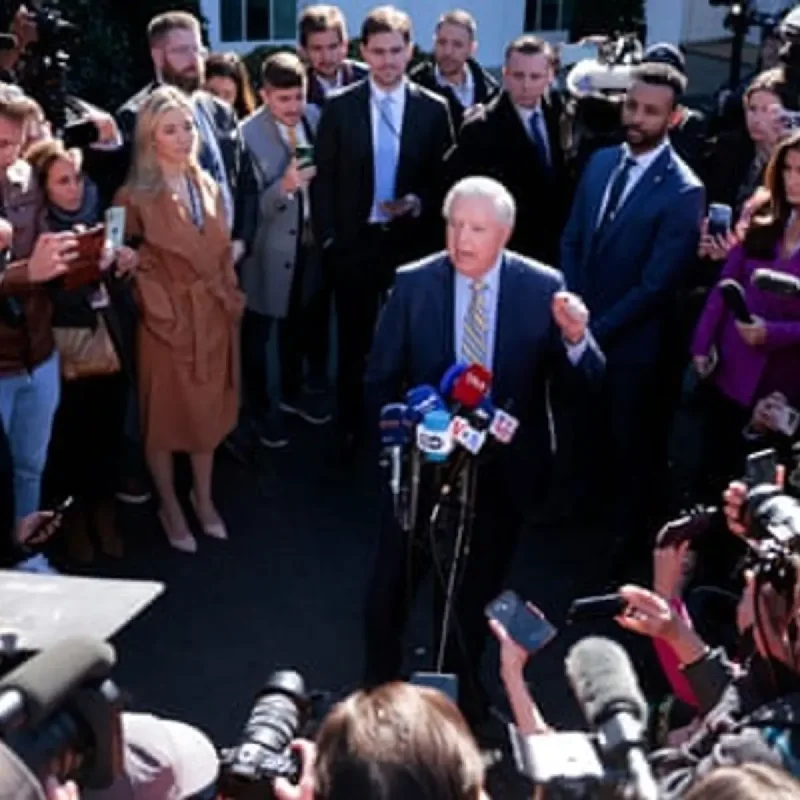
South Carolina Republicans are scrambling to organize a primary within one month to find a candidate to replace long-serving Senator Lindsey Graham, who died last Saturday at the age of 71.
As reported by The Guardian, the sudden death of the four-term Republican senator has left a significant political void in Washington and his home state, where his sister, Darline, has been sworn in to temporarily serve out his remaining term.
Graham's Legacy and Local Reactions
The death of Graham has prompted widespread reflection from South Carolina residents, politicians, and analysts regarding his decades-long career and complex political legacy.
"He was our senator longer than I've been alive.
He served us in the legacy of the great Strom Thurmond and whether I liked the man or his politics hasn't got much to do with it.
He was truly great and his shoes are gonna be some big ones to fill," said Caleb Davis, an air force enlistment candidate.
Davis also addressed local rumors regarding Graham's personal life as a lifelong bachelor. "It definitely bothered people.
I remember my old supervisor would say Lindsey's gay and a lot people did. People would call him Lady Lindsey.
Of course, there's no doubt in my mind that he was a true man," remarked Davis.
Graham began his rise in politics during the 1994 "Republican Revolution" after serving as an Air Force judge advocate general, eventually taking over the Senate seat of Strom Thurmond in 2002.
"Anything from a federal military issue to a passport issue to a letter of recommendation for a kid trying to go to the military, you go to two people in South Carolina.
You go to [Congressman] Jim Clyburn or you go to Lindsey Graham.
We're going to miss him for that, truly," observed Bakari Sellers, a political commentator and former state representative.
Sellers noted Graham's approachable demeanor and distinct personal style. "He never had his shirt buttoned all the way up.
His tie was always hanging down. He would always ask me about my dad and be like, 'You running against Clyburn yet?'
, and then he would laugh and walk away.
He was always a funny type of individual who kept his pulse on the heartbeat of South Carolina," recalled Sellers.
Political observers credit Graham's initial success to his deep understanding of communication and media dynamics.
"He very quickly figured out, even as a House member, that media could compensate for a lack of institutional power in some situations.
This was a man who was willing to sit down on the Sunday morning talkshows, any Sunday. 'Christmas Eve?
Fine, I'll be there. Thanksgiving weekend?
I'll be there.'
He told me, I've learned that it's one way to get my message out and gain credibility," said Danielle Vinson, a politics professor at Furman University.
Vinson emphasized that Graham's charismatic personality made him highly accessible. "He was so quotable – that part was just his personality.
He's somebody who enjoyed dealing with people. He liked to talk.
He could tell a good story. He didn't mind making self-deprecating jokes and putting people at ease in that way," added Vinson.
Vinson also explained how Graham navigated questions about his bachelorhood by highlighting his family duties.
"There was all kinds of speculation but he always countered it by reminding people of his close relationship with his sister and the fact that he had taken over as her guardian and took care of her after their parents passed away when she was quite a bit younger than him.
The only time we saw her was out on the campaign trail or in campaign ads reminding people that he might not have the traditional wife and kids that so many of our elected officials have but he understood the responsibilities of a family and therefore it inoculated him a bit," believed Vinson.
Political Evolution and Bipartisan Views
Over his career, Graham transformed from a bipartisan moderate who opposed Donald Trump to one of the former president's closest allies.
"You know, run for president, but don't be the world's biggest jackass," declared Lindsey Graham during the 2016 primaries.
Despite this early friction, Graham became a crucial ally, defending Supreme Court nominee Brett Kavanaugh in 2018.
"There was Lindsey Graham before Donald Trump, and then there was Lindsey Graham after Donald Trump," viewed Antjuan Seawright, a Democratic strategist.
Seawright argued that the transition was driven by a desire to maintain political influence.
"He felt like he had to remain relevant and remain at the forefront of the conversation at top of mind.
He had to, in some cases, strengthen his position within the party, but also with the leaders in charge, and in many ways he served as a translator for Trump, like a liaison, if you will," added Seawright.
However, close associates view Graham's shifting alliances as standard political pragmatism. "I don't think it was a change.
He would tell you to your face, look, to wield power, you gotta be close to power.
He had a real political nose for where power was, where it resided, and so he got close to McCain because that was a power node.
He got close to Trump because that power node.
A lot of that was based on his growing up in a very simple setting, a pool hall, and so he got a nose for people and who was the alpha in the room and where was the power and how do you disarm this person, how do you calm the situation?
I don't think that that was a case of two different people.
It was a continuation of his desire to be relevant," said Mark Sanford, a former South Carolina governor.
Many conservative voters in the state accepted Graham's strategic decisions as necessary. "He knew how to play the game.
Politics, that's the game, so he did what he had to do.
He believed in the Republican party and Donald Trump was leading the Republican party so he knew where the bread was buttered," said Miriam Rhett, a 72-year-old retired estate agent.
Even political rivals recognized Graham's work ethic. "He was always a mixed bag of politics.
You loved him and you hated him and it could all be in the same month.
But although I'm a Democrat and Lindsey was a Republican, I was always impressed with his constituent services.
It's amazing to think how much time he actually spent on the job.
He was 100% a senator for the state of South Carolina," said Roger Kirby, a state representative.