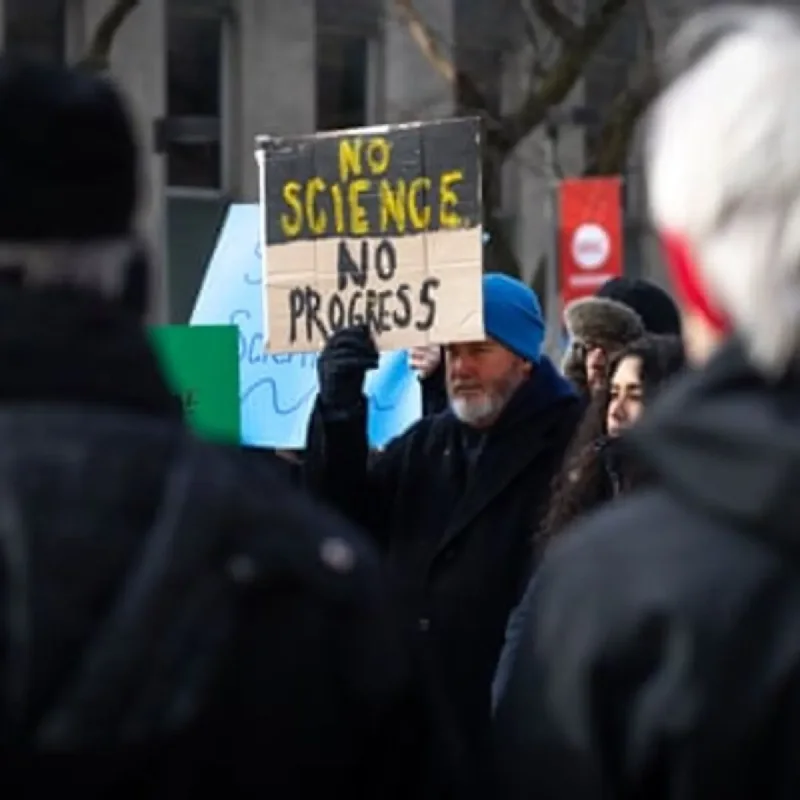
The US Office of Management and Budget proposed a 400-page overhaul in May to place nearly $1 trillion in federal grant-making under the authority of political appointees, as reported by The Guardian.
The administrative shift follows previous cancellations of federal research grants concerning disparate impacts and gender during the spring of 2025.
The new policy, now informally called "the OMB rule," drew approximately 500,000 public comments before the closing of its 45-day public feedback window.
The proposal restricts international scientific collaboration, bars diversity, equity, and inclusion initiatives, and prohibits undefined anti-American values.
Out of the total affected funds, $150 billion is typically allocated toward science and technology fields, including the $47 billion budget of the National Institutes of Health.
Scientists and Experts React
Harvard School of Public Health professor Nancy Krieger spoke out against the proposal after her own $1 million research grant on discrimination was terminated by the National Institutes of Health.
"I’m like, what? What does this mean?
I don’t understand? My grant has another year in it.
I immediately reached out to the office that helps with grants to find out what was going on, and it led to a flurry of emails over the weekend – just trying to even find out what was happening.
It was complete shock and dismay," remarked Krieger, describing her initial reaction to the sudden cancellation.
The professor explained that the unexpected funding disruption forced her to balance academic duties with sudden litigation while attempting to manage dropping staff morale.
"Groups studying 'the farthest reaches of the galaxy to the deepest depths of the sea to everything in between, including those of us who wander around predominantly on plants,' have come together," Krieger said.
"That’s because, yes, we have experienced censorship. We have experience with blunt use of power to put forward the ideological agenda."
Legal and policy experts have expressed strong concerns regarding the scope of the administrative rules, noting that the regulations extend well beyond scientific fields.
"It’s the entirety of the federal grant-making process," said Sara Rosenbaum, professor emerita of health law and policy at the Milken Institute School of Public Health at George Washington University.
Rosenbaum noted that the upcoming rule will alter funding structures for healthcare, education, social services, and environmental protections.
"In the normal course of events, an administration faced with 500,000 comments – virtually all of which will be in opposition to the rule … would withdraw the rule," said Rosenbaum.
The professor added that there remains a low expectation that the current administration will choose to withdraw the proposal despite the volume of public pushback.
Political and Legal Challenges
Congressional representatives have also challenged the legality and safety implications of the proposed funding framework.
"President Trump and [OMB director] Russell Vought are not only breaking the law, but they are also once again endangering the health and safety of Americans," Tammy Baldwin, a Democratic senator of Wisconsin, said in a statement.
The senator added that citizens expect taxpayer funds to support medical breakthroughs rather than serve as political tools.
"Americans expect their taxpayer dollars to be put to research that has the best chance at delivering a breakthrough or cure for a disease, not wielded like a cudgel to punish the president’s perceived enemies and score political points," Baldwin stated.
State legal officials have initiated joint actions to stop the implementation, with 22 state attorneys general formally opposing the measure.
"The Trump administration is once again attempting to weaponize essential federal funding to advance its policy priorities.
Except this time, it’s not just one agency, it’s almost all of them," said California’s attorney general, Rob Bonta, in a statement.
The attorney general warned that the regulatory rewrite threatens nearly every public service reliant on federal aid.
"This proposal aims to undermine practically every industry and public service supported by federal funding," Bonta stated.
Legal scholars anticipate that the conflict will inevitably move toward the court system once specific grant denials occur.
"Basically, in my mind, the notice and comment is just a subterfuge for moving ahead when they’re really not interested in what the comments say," said Lawrence Gostin, a professor of global public health at Georgetown Law.
Gostin noted that finding legal standing might require an individual plaintiff to be denied a grant first.
"[It] seems to me one of the big questions is: would a lawsuit actually succeed?" said Gostin.
The professor suggested that while lower district courts might issue injunctions against the policy, the ultimate outcome in higher conservative courts remains uncertain.
"But as it goes though highly conservative courts of appeal and the conservative supreme court, the outcome is less uncertain.
Whether the government attempts to mount an emergency appeal and get, ultimately, the supreme court moving forward is anybody’s guess," Gostin said.