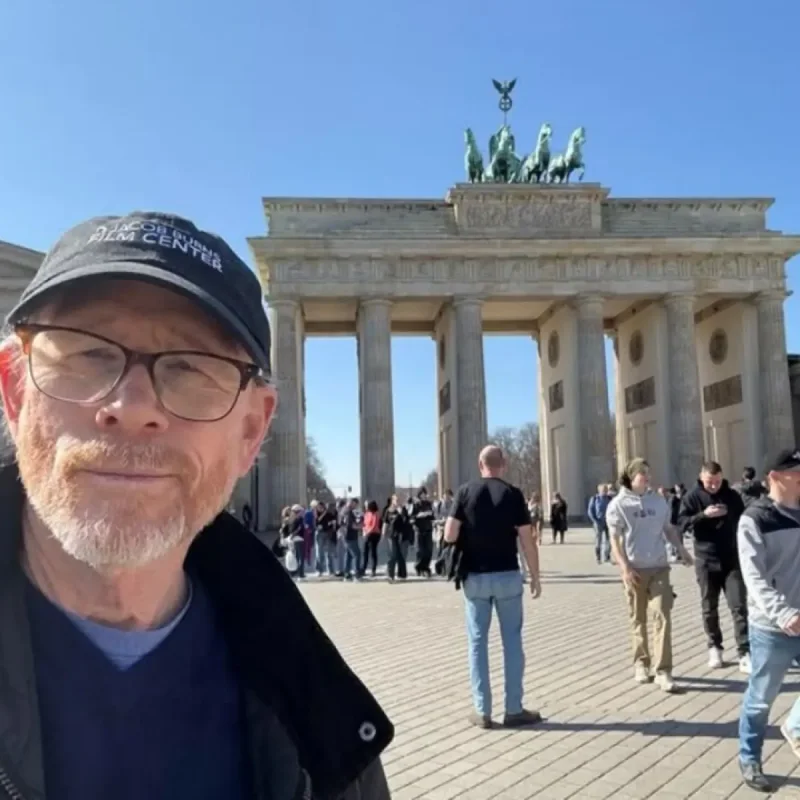
Filmmaker Ron Howard revealed on the 'Talking Pictures' podcast with Ben Mankiewicz how clashing personalities on the set of the 1976 Western film 'The Shootist' shaped his approach to directing and conflict management.
Howard, who was 22 years old and studying at the University of Southern California while co-starring in the film, found himself navigating the strained relationship between veteran actor John Wayne and director Don Siegel.
Behind-the-Scenes Tensions
Reflecting on the overall quality of the production, Howard highlighted the craftsmanship that went into making the film despite the friction behind the scenes.
"'The Shootist' still holds up well. It's paced slowly, deliberately, but it builds beautifully.
The acting is good," said Howard.
"Don Siegel was a very strong director. I really went to school on Don Siegel there.
That was just great, and learned so much from him," he added.
The underlying hostilities between the lead actor and the director created a difficult working environment throughout the shoot.
"Wayne and Siegel were feuding. They did not get along," Howard said.
To build rapport, Howard engaged Wayne directly between scenes while learning the ropes of filmmaking.
"I also had the guts to sort of say, 'Hey, do you want to run lines?' No one really would talk to him in between setups.
It was John Wayne. It was Duke," Howard recalled.
While Wayne worked through his scenes, he routinely vented his frustration regarding Siegel's directorial choices to the young actor.
"Throughout the process, I'd get an earful about his dissatisfaction with Don Siegel and the way he was shooting it," Howard said.
Siegel offered Howard candid advice regarding the power dynamics between a movie director and a major Hollywood star.
"Siegel told me... 'After about two weeks, if you're the director and it's you or the star, you're gone.
They can't afford to go back and reshoot. I don't care how much they love what you're doing.
You're gone. And I like this script, and I like this movie, and I'm going to ride it out.'
I think John Wayne felt the same way," Howard said.
Observing the atmosphere on set convinced Howard that open communication could prevent professional disagreements from escalating into personal feuds.
"It was pretty intense, but I remember saying, there's a better way to deal with even superstars than this," Howard said.
This early realization ultimately led Howard to adopt a proactive strategy when handling creative differences on his own film sets.
"I felt that the key was that a lot of things were allowed to fester for a long period of time.
The strategy that I've followed over the years is that when there's a difference of opinion, go right into it.
You don't have to make it a fight, but you're there to achieve something together and talk it through," Howard explained.
Newspaper Comment Escalated Conflict
According to Howard, a local newspaper article featuring comments from Siegel escalated the conflict with Wayne further during filming in Carson City.
"I'm walking to the set with John Wayne, and he's holding the Carson City newspaper. And he says, 'Why the...
did he have to say that?'" Howard recalled.
The published article included a provocative quote from the director regarding his working relationship with the star.
"They say John Wayne eats directors for breakfast.
If he takes a bite out of me, he's going to get indigestion," Siegel said in the newspaper.
The public comment exacerbated the ongoing fallout between both figures for the remainder of production.
"It upset Duke, and it just got worse," Howard said.
Despite the volatile environment on set, Howard credited the overall experience with teaching him crucial directorial lessons.
"Siegel made a really good film, and I learned a lot from him.
On the other hand, there were some days where he and John Wayne were really at loggerheads," Howard said.
Howard noted that he maintained positive individual ties with both Wayne and Siegel, as reported by People.
"And I was getting along with both of them separately, just fine," Howard told Ben Mankiewicz's 'Talking Pictures' podcast.
The young actor took advantage of the star's isolated routine on set, which included playing chess with a photographer friend in a small private bubble.
"He had a couple of people: a guy he would play chess with, who was the still photographer who had worked with him on a lot of films.
But it was a very closed little bubble that he was operating in," Howard said.
Wayne agreed to rehearse dialogue with Howard, giving the aspiring director a close look at the legendary actor's creative process.
"He was perfectly friendly to me, and he said, 'Yeah, I'd like to run lines.'
And we had a lot of scenes together, heavy dialogue, and it was very interesting to see him take a scene and shape it into a John Wayne performance in the most positive ways," Howard said.
Analyzing how the conflict lingered, Howard concluded that addressing creative concerns immediately is essential to maintaining a healthy production environment.
"Don't let it become something that's petty and emotional when, in fact, it's a creative concern or a neurotic concern.
And if you shine a bright light on a neurotic concern, most people, even the most neurotic of them, say, 'Oh yeah, I guess I was a little insecure about that,'" Howard said.